How to get Django
Django is available open-source under the BSD license. We recommend using the latest version of Python. See the FAQ for the Python versions supported by each version of Django. Here’s how to get it:
Option 1: Get the latest official version
The latest official version is 6.1. Read the 6.1 release notes, then install it with pip:
Linux / macOS:
python -m pip install Django==6.1Windows:
py -m pip install Django==6.1Option 2: Get the latest development version
The latest and greatest Django version is the one that’s in our Git repository (our revision-control system). This is only for experienced users who want to try incoming changes and help identify bugs before an official release. Get it using this shell command, which requires Git:
git clone https://github.com/django/django.git
You can also download a gzipped tarball of the development version. This archive is updated every time we commit code.
After you get it
See the installation guide for further instructions. Make sure you read the documentation that corresponds to the version of Django you’ve just installed.
And be sure to sign up to the Django Forum, where other Django users and the Django developers themselves all hang out to help each other.
Supported Versions
Feature releases contain new features, improvements to existing features, and other enhancements. Beginning with Django 2028, feature releases will use the version format YYYY and will be released every January. Earlier feature releases used the version format A.B and were released roughly every eight months.
Patch releases (for example, 6.1.2 or 2028.3) are issued as needed, to fix bugs and/or security issues. These releases are 100% compatible with the associated feature release, unless this is impossible for security reasons or to prevent data loss. So the answer to "should I upgrade to the latest patch release?” will always be "yes."
Django 6.2 is the final release under the previous versioning and support policy. Under that policy, only designated long-term support (LTS) releases received the full three-year support period. Starting with Django 2028, every feature release receives the same three-year support period. Refer to the tables below for the support periods.
See the supported versions policy for detailed guidelines about what fixes will be backported.
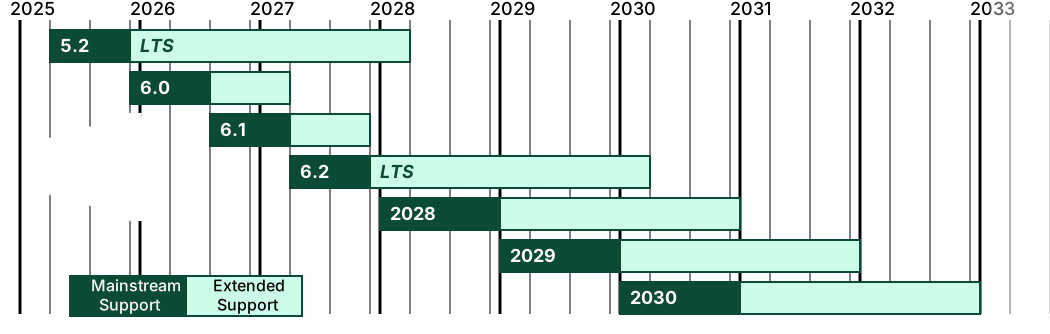
| Release Series | Latest Release | End of mainstream support1 | End of extended support2 |
|---|---|---|---|
| 5.2 LTS | 5.2.17 | December 3, 2025 | April 2028 |
| 6.0 | 6.0.8 | August 4, 2026 | April 2027 |
| 6.1 | 6.1 | April 2027 | December 2027 |
Future Roadmap
| Release Series | Release Date | End of mainstream support1 | End of extended support2 |
|---|---|---|---|
| 6.2 LTS | April 2027 | December 2027 | April 2030 |
| 2028 | January 2028 | January 2029 | January 2031 |
| 2029 | January 2029 | January 2030 | January 2032 |
Unsupported previous releases
These release series no longer receive security updates or bug fixes.
| Release Series | Latest Release | End of mainstream support1 | End of extended support2 |
|---|---|---|---|
| 5.1 | 5.1.15 | April 2, 2025 | December 3, 2025 |
| 5.0 | 5.0.14 | August 7, 2024 | April 2, 2025 |
| 4.2 LTS | 4.2.30 | December 4, 2023 | April 7, 2026 |
| 4.1 | 4.1.13 | April 5, 2023 | December 1, 2023 |
| 4.0 | 4.0.10 | August 3, 2022 | April 1, 2023 |
| 3.2 LTS | 3.2.25 | December 7, 2021 | April 1, 2024 |
| 3.1 | 3.1.14 | April 6, 2021 | December 7, 2021 |
| 3.0 | 3.0.14 | August 3, 2020 | April 6, 2021 |
| 2.2 LTS | 2.2.28 | December 2, 2019 | April 11, 2022 |
| 2.1 | 2.1.15 | April 1, 2019 | December 2, 2019 |
| 2.0 | 2.0.13 | August 1, 2018 | April 1, 2019 |
| 1.11 LTS 3 | 1.11.29 | December 2, 2017 | April 1, 2020 |
| 1.10 | 1.10.8 | April 4, 2017 | December 2, 2017 |
| 1.9 | 1.9.13 | August 1, 2016 | April 4, 2017 |
| 1.8 LTS | 1.8.19 | December 1, 2015 | April 1, 2018 |
| 1.7 | 1.7.11 | April 1, 2015 | December 1, 2015 |
| 1.6 | 1.6.11 | September 2, 2014 | April 1, 2015 |
| 1.5 | 1.5.12 | November 6, 2013 | September 2, 2014 |
| 1.4 LTS | 1.4.22 | February 26, 2013 | October 1, 2015 |
| 1.3 | 1.3.7 | March 23, 2012 | February 26, 2013 |
[1] Security fixes, data loss bugs, crashing bugs, major functionality
bugs in newly-introduced features, and regressions from older versions of Django.
[2] Security fixes and data loss bugs.
[3] Last version to support Python 2.7.