On this page:
About the DHC
The 2020 Census Demographic and Housing Characteristics File (DHC) includes detailed data tables on the following:
- Subjects: Age, sex, race, Hispanic or Latino origin, household type, family type, relationship to householder, group quarters population, housing occupancy, and housing tenure
- Lowest level of geography: Varies, with many tables at the census block level
- Many of the DHC tables are also available for ZIP Code Tabulation Areas (ZCTA) generalized representations of U.S. Postal Service ZIP Code service routes.
Which 2020 Census Data Product Should I Use?
Access DHC Data
User note: When using DHC data, we encourage data users to aggregate small populations and geographies to improve accuracy and diminish implausible results. For more information, visit our Technical Documentation webpage.
Interested in data tables on a specific topic? Access popular tables directly from the Explore Data By Topic section below.
Explore Data by Topic
Access data tables on specific topics and find related data visualizations, maps, America Counts stories, and other resources below.
Other Ways to Explore the Data
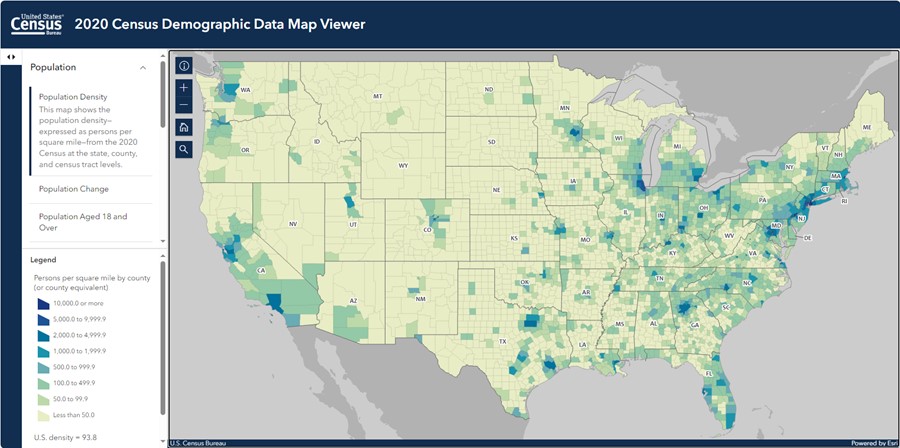
Click the map below to view state, county, and census tract-level data on: population, race, Hispanic origin, families and households, housing, and group quarters.
Technical Documentation and Other Guidance
-

Information on data collection, confidentiality protection, nonsampling error, subject definitions, and guidance on using the data.
-
Information about how disclosure avoidance is applied to 2020 Census data products.
-

List of data tables, lowest level of geography by table, and table shells for the DHC.
Data Confidentiality
As with all Census Bureau data products, DHC data use disclosure avoidance methods to protect respondent confidentiality. To ensure that no one can link the published data to a specific person or household with any certainty, “statistical noise” — small, random additions or subtractions — was added to the data. The Census Bureau worked closely with the data user community to implement these protections.
The Census Bureau also released metrics to help data users understand the disclosure avoidance-related variability in the DHC. The 2020 Census is the first to be able to quantify this variability because it uses a more sophisticated approach for disclosure avoidance.
How new disclosure avoidance protections work
Disclosure Avoidance and the 2020 Census: The TopDown Algorithm
Why the Census Bureau Chose Differential Privacy
How the statistical noise affects the data
What to Expect: Disclosure Avoidance and the 2020 Census Demographic and Housing Characteristics File
2020 Census Production Disclosure Avoidance System Detailed Summary Metrics
Press Kit