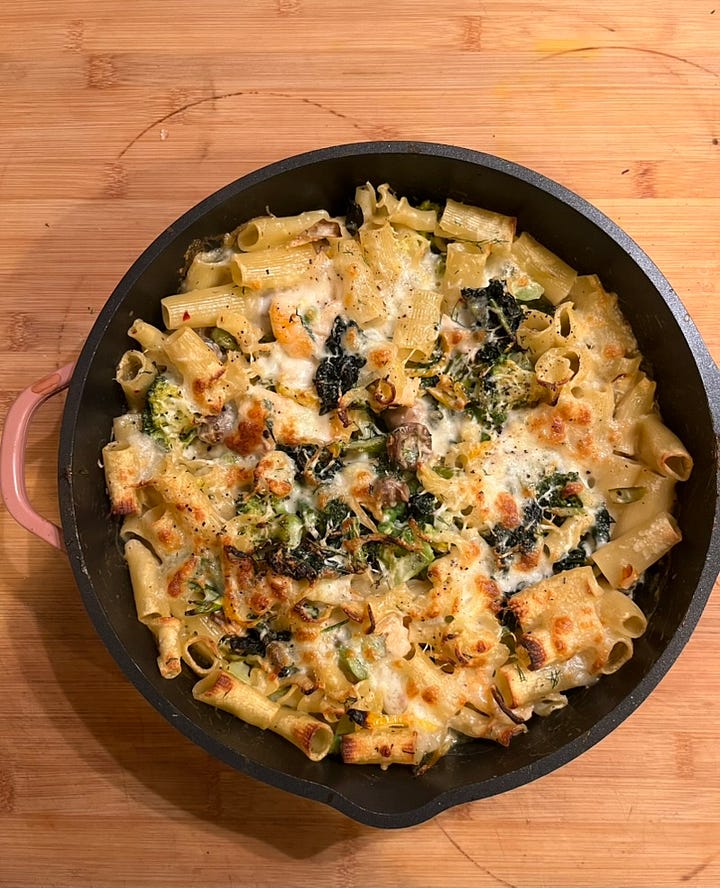
Crushed the garlic clove, chopped one peperoncino; drizzled some olive oil in a pan, sizzled. Sliced chestnut mushrooms, roughly chopped broccoli florets and stem, stirred. Boiled some salted water and cooked the pasta. Fetched a handful of garden peas from the freezer, pushed the door to a close with the back of my foot, drained the pasta. Combined with the vegetables. Stirred some oat cream and the peas; reduced the heat, simmered. Pre-heated the oven. Crumbled mozzarella cheese on top.
‘Take a photo,’ I said to L., nodding at the dish as I slid my hand in an oven glove. ‘I’m afraid I’m going to write a newsletter about this pasta bake.’
It was the last supper of 2025. The boiler was broken and leftovers unionised to save the day. I wasn’t afraid of writing to you per se – you wish! – but I was concerned about the licence I give to my superstitions. I was standing before the kitchen counter with a woolly hat and two pairs of socks on, bloodless but not careless; although I wasn’t cooking good fortune lentils, I was still wearing red underwear for a change of good luck and passion. I was effortfully holding on to a centre that wouldn’t hold, so the world as I knew it would keep on spinning as it needed for me to keep twirling along with it. I was jotting down some notes about the leftover (paccheri) pasta bake as well when I realised that I had reached the last page of my recipe notebook. And not one occurrence in the world is ever truly random, to echo Leonora Carrington, the surrealist mastermind of all fever dreams.
The first date recorded in the recipe notebook isn’t 1 January 2025 but 13 November 2024. I started keeping a recipe notebook on a kitchen shelf since I began cooking with added interests than to feed myself, using it to record the obvious, daily stuff. Which pan for which dish, a glorious bean for a particular soup; rhetorical questions and kneading schedules; spice combinations, sketches for new pasta shapes to fold, the teaspoons that make all the difference; little hearts here and there, strikethrough ingredients and list of alternatives to allergens, notes to self and no menus but plenty of dishes named after loved ones. The tone is candid and all entries are dated. This is the fourth volume in my personal collection.
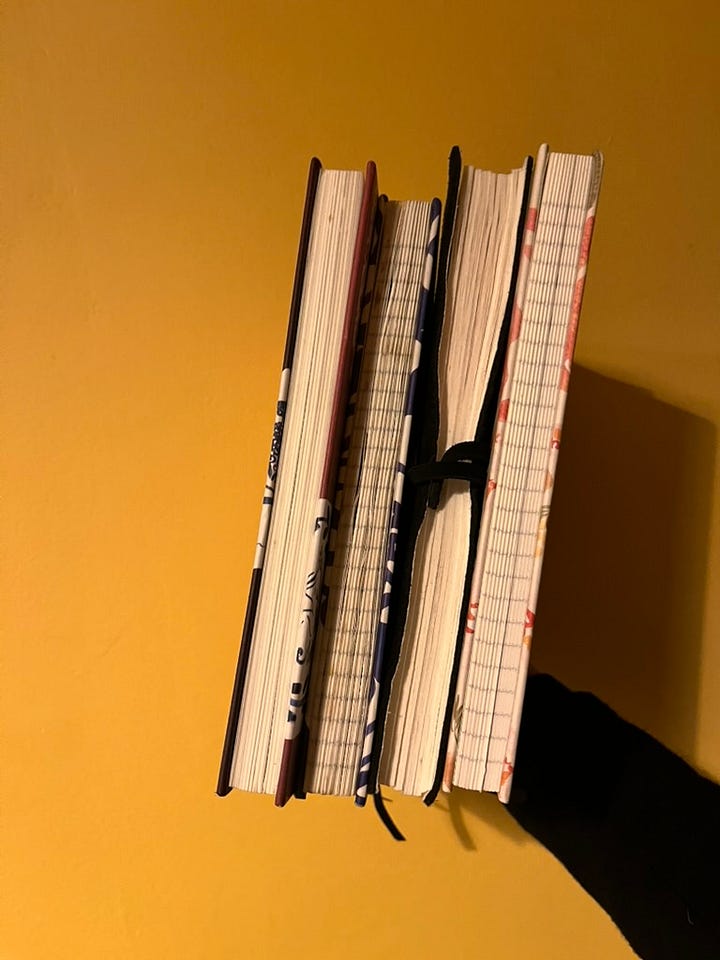
The recipe notebook isn’t a cookbook in drafting, but it is a loose sheet I keep next to me when I draft, always – a grubby, coffee-drenched companion that shoulders me in sticky time. Banging lasagna, hangover soup, hospital schiacciata; ‘cut in two, or less hydration?’; ‘gluey dough for friendly farfalle’; ‘the courgettes must have a crunch’. It is about the small things that are easy to forget as seconds, minutes, days pass by, year after year, and it is a personal enterprise, clumsy and detail-oriented.
And I have kneaded enough dough in plenty of cold kitchens to say it: screw the bread routine.
Since the day flour and water met, there have been countless theories about how to make the most of their pairing. Mix the two with bare hands, form a ball. Punch the dough and push and roll it, and punch it again. More flour, less hydration; less flour, more hydration. Knead and knead, working clockwise and rotating the dough by each quarter. Push and push and roll and turn and push. Exercise caution, too. This isn’t a fists fight: the strongest doesn’t necessarily win. Overworking is a bad omen for a loaf. Let it curl and rise again. Tune in. Work together. Punch it down; let it rest; see it rise. And rise the next day to bake until golden. Crunchy, malty, honey loaf – bread to be broken.
Words need saying before they can be rewritten with a new perspective so, at the risk of boring you, allow me to consult a dictionary. To theorise is to develop a set of ideas about something. The online Cambridge dictionary goes on to illustrate the concept as follows: ‘It’s easy to theorise about what might have happened.’
Might have indeed. Last year, be it a consequence of my age or the era in which we live, I have had countless conversations with friends about whether Now is the “good” time to take certain decisions and make changes, move on with projects and leave others behind. Walking away from those exchanges, I often find myself thinking of all the encouraging words I wish I had said to that friend but didn’t think of in the moment, occasionally days later, struck by a ring in my ear while paying for the grocery or stirring the soup, (mis)remembering them through the gaze of my personal concerns and joys. Often, I jot the thought down in the recipe book randomly, midway through recording yet another trustworthy, one-pot meal.
‘The rest is silence,’ as William Shakespeare ends Hamlet (1623).
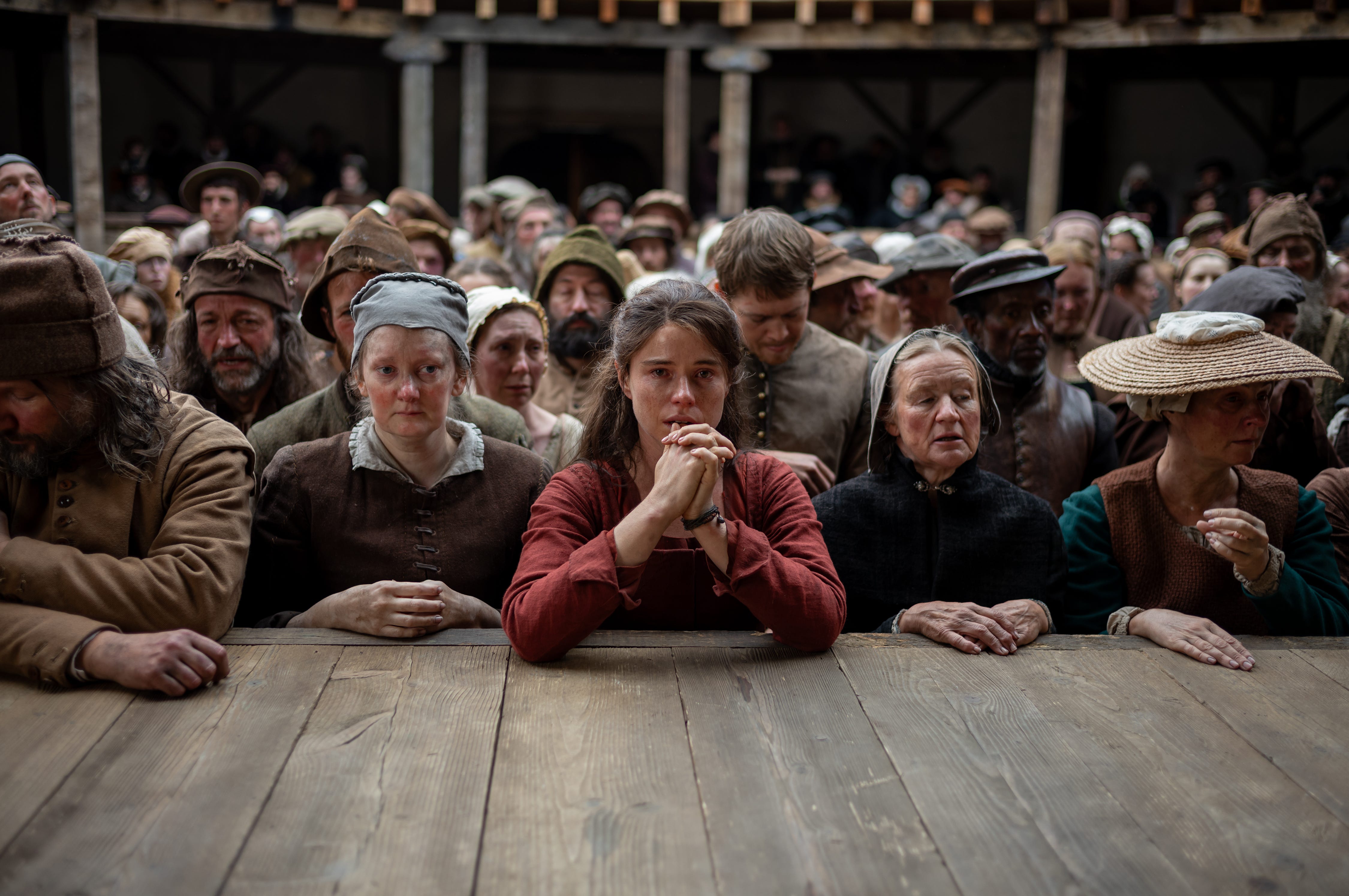
Last week, I found myself sobbing through credits at the cinema, stranded in my chair and shocked by the strength of my emotions. I had left my house in mourning to watch ‘Hamnet’, a movie directed by Chloë Zhao and based on Maggie O’Farrell’s 2020 novel, which I highly recommend and gives a portrait of Agnes Hathaway, who was a skilled herbalist and Shakespeare’s wife. This is the reimagined story of William and Agnes’ marriage and their family life, as well as the loss of their eleven-year-old son, Hamnet, to the plague. The historical angle and storytelling leave a trail of breadcrumbs for the audience to follow and be reminded about plenty of human-centred topics – the cost of loving; safety as a vanishing force, a ghost; the main character never is who you think they might be and often a main character is multifaceted, plural, a community in disguise – but, in the end, ‘What shall I do?’ Agnes asks.
‘Keep your heart open,’ responds her brother, Bartholomew, quoting their late mother. The sentence becomes a leitmotif for the narration to bow its arc.
Agnes, who is magnificently played by Jessie Buckley, embodies the metaphorical force of the womb. Agnes is visceral and connected to nature, to herself, to life and, correlatively, she is deeply unprepared to face death. Agnes defies death. She grows a garden and her aura is magnetic, filled with wit, she treats ills with remedies and is raising three lively children. And, tragically, as Hamnet is faced with his own death, his neck covered in buboes and his fingers as black as the night, she refuses to let him pass away. ‘Let him go!’ Susanna, her eldest daughter, must shout in tears for Agnes to let Hamnet draw his final breath and reclaim his own terrors.
‘To be, or not to be: that is the question:
Whether ‘tis nobler in the mind to suffer
The slings and arrows of outrageous fortune,
Or to take arms against a sea of troubles,
And by opposing end them? To die: to sleep;
No more; and by a sleep to say we end
The heart-ache and the thousand natural shocks
That flesh is heir to, ‘tis a consummation
Devoutly to be wish’d.’
– Hamlet by William Shakespeare
Keep your heart open as, in the end, not one theory will defeat the ending. Don’t limit yourself to theories and what may happen, as I choose to hear it.
Basic recipe notebook practice implies sincerity. People do beautiful things, people are odious; some of us fall ill, some recover, some thrive, and it is possible to be ill and happy at the same time; people we love will die before us; humans are compassionate; human consumption and greed are draining the planet; science can do great things and be used for horrific ends; nature heals and must heal; some species go extinct, others adapt. To be, or not to be is always going to be an unsolvable equation for the simple reason that the question presents a reasonable mind without a problem to solve. Life unravels, and there isn’t a pause button to press.
To quote Simone de Beauvoir in basic, French-kiss and existentialist practice: ‘We are having a hard time living because we are so bent on outwitting death.’
(from The Ethics of Ambiguity, 1947)
So: with my fingers deep in a sticky dough, as I figure a way out of this mess I created with my own hands, let me answer Agnes by asking another question. How do you want to live?
Capitalist and ableist societies have worked extra hours to make civilians believe that life must be conducted a certain way, that love is a two-way transaction, that bodies must be efficient and that money earns respect. Set an alarm for tomorrow; ate my proteins; socialised with like-minded friends; cleaned the house. I did, because in a society that often categorises interdisciplinarity (and intersectionality) as untrustworthy – acts of distraction – we are told to find our path and stick to it with noise-cancelling headphones fitted over our ears, climb the propriety and career ladders and find a suited partner and pour everything into flourishing that heteronormative relationship. And check on your biological clock as the production chain must go on. We are taught that there is one way to feel fulfilled; no point in asking for much else than what we were born into. But keep your heart open and, as I choose to hear it, intersectionality (and interdisciplinarity) would see us thrive as curious beings about diverse ways of being humans.
Being an amateur cook makes me both ambitious and humble enough to ask for advice.
Simone de Beauvoir was an author and intellectual figure of existentialism in post-war France and is arguably most famous for publishing The Second Sex (1946-9), in which she wrote that ‘one is not born, but rather becomes, a woman.’, and for her feminism. De Beauvoir wrote plenty of other books, from open letters to philosophical treaties, memoirs and novels. What interests me the most with Simone de Beauvoir’s work is how she reframed philosophical discourses and subsequent hypotheses about freedom by putting an emphasis on personal responsibility.
Responsibility n, state of being responsible. Responsible adj 1 having control and authority. 2 being the cause (of some action). 3 reporting accountable (to). 4 sensible and dependable.
De Beauvoir’s philosophy was influenced by living in Nazi-occupied Paris during World War II. About the experience, she spoke of undergoing a transition as, in the wake of such horrors, she couldn’t focus on her freedom and pleasure solely but evil had to be the priority. If, broadly, existentialism is a philosophy that gravitates around individual freedom, responsibility and subjectivity, it isn’t a utopia either. According to Simon de Beauvoir, we can be alienated by our own freedom as, to exist and to be sustainable, freedom must involve reciprocity. Simone de Beauvoir was an activist and stood against despotism. She affirmed that any system or any theory, however ethical they may claim to be, cannot be absolute; otherwise, they would write the ending before unheard voices may raise to signpost alternative roads. They would become tyrannical, even if they were implemented with the best of intentions.
My issue with theorisation isn’t about seeking perfectionism as I think the two topics are separate, though not unrelated, but the apprehension of anything that may be or happen in theory. Conditional conjugation locks with unspeakable possibilities. On the other hand, existentialists tell us that existence precedes essence, meaning that one is born without an inherent purpose but must find and create one’s own meaning through choices and actions. We hold the key to unlock ourselves, but not without the risk of being met with disapproval, failing or being challenged.
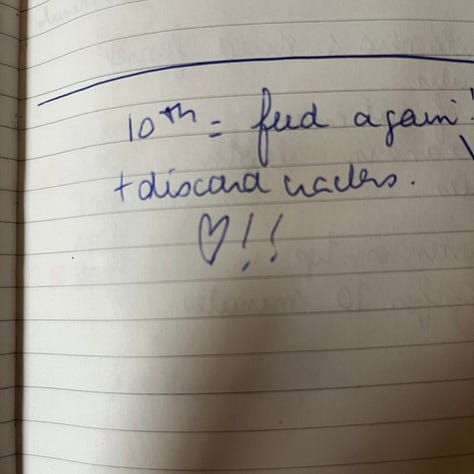
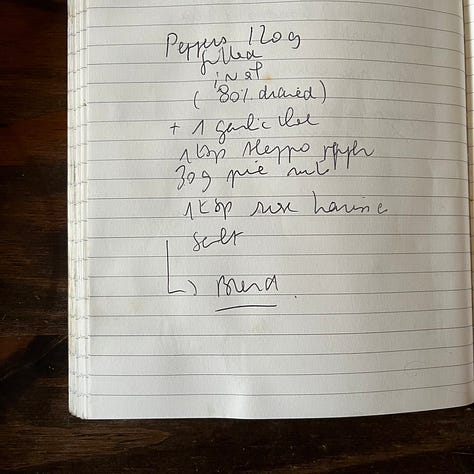

Stepping aside from the yellowing pages of my philosophy books, I gather in the kitchen to be met by a compassionate teacher. Skimming through the old recipe notebooks, I find recipes in writing. Some components return – I host a tomatoey and beany kitchen, corn-based meals, though I am most akin to wheat for baking; I favour spoonable dishes, herby and bitter flavours, sour deserts – but, ultimately, if I consider each entry individually and without context, I am presented with flawed dishes. I am always missing an ingredient, measurements don’t add up and some steps are left unfinished. This isn’t about transmission. I don’t keep up with the recipe notebooks to pass on recipes but to celebrate untested systems, imperfect amalgams that entertain open futures.
Keep your heart open doesn’t encourage us to be self-centred and biased by your own desires, but it asks us to hold up to our intuitions and empathy, reframing the two qualities as reasonable considerations when making a decision or taking an action. Whether history is fiction or not is another topic, which we shall reserve for a subsequent newsletter, but thus far good historical fiction has shown that most upheavals do have emotional roots. It is when one is feeling discontent and disconnected with the real world, that one rises most determined to build an alternative world. Think of a tasteless dish that took you hours to cook – disappointing and nonsensical, right? Emotional intelligence accounts for our respective subjectivities as we experience the world, and to such freedom our personal responsibility is enclosed. If today’s world isn’t perfect, tomorrow’s world doesn’t have to be human, and it is up to humans to heal it.
We ate the pasta bake with our legs crossed on the sofa with L. Then, on the first day of the year, I walked into the kitchen to find L. reheating leftovers for his breakfast.
Beamed, stuffed a portion of pasta bake in his mouth but looked me in the eyes; said Happy New Year, kissed good morning.
Then, everything felt possible. A persistent pleasure had outcast any theories about pasta bake and working boilers and New Year Eve’s celebrations and New Year’s expectations. Such beloved consistency is a privilege too, since, if you were here last year already, you will know that finding L. eating leftover pasta on the first day of the year isn’t a coincidence in our family. But, then, the other L. had said it long ago: nothing ever occurs randomly. And, be it a (historical) fiction of my own doing, Simone would cheer for that new year too, foreseeing us making it all happen for ourselves with our responsible hands and/or hearts and/or heads and/or heat, with and for ourselves. So, without breaking any grand theory, I kissed my L. back.
Keep on reframing, you personable and open-hearted cooks.
margaux

thank you for reading The Onion Papers. i’m margaux, a writer adrift, and this is my hybrid newsletter. if you enjoy my work, remember to subscribe and/or invite friends to the party as you keep me going. read more about TOP here.
PS. I write novels too.
No posts