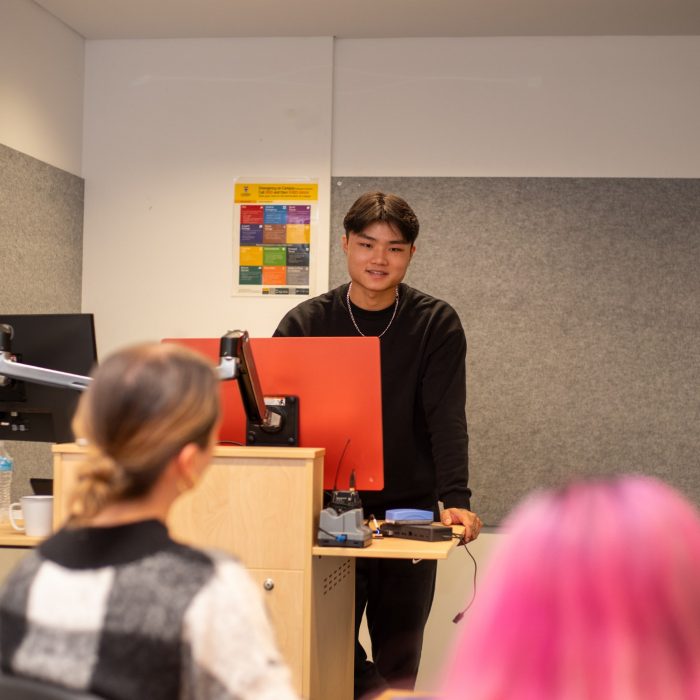
Learn how to make the most of tutorials and reap the rewards of class discussions
-
1. Observe
-
-
2. Listen
-
-
3. Prepare
-
-
4. Practise
-
-
5. Participate
-
Voice your opinion effectively in three steps
Expressing your opinion and using effective arguing techniques are valuable skills. Participating in a tutorial discussion can be a bit intimidating, especially when you want to disagree with a point of view and are not sure how to, or don’t know what language to use.
You may have a great idea, but you need to communicate it effectively and support it. The three essential parts to a point of view are:
- A valid opinion (a believable point of view)
- I believe that ...
- I think that ...
- From what I understand ...
- As I understand it ...
- A reason why
- This is due to ...
- Because ...
- What I mean by this is ...
- Evidence (relevant and up-to-date examples, statistics, explanations and/or expert opinions, with the source)
- This can be seen by ...
- For instance ...
- For example ...
- An example can be seen ...
- (Author's name) states that ...
- (Author's name) suggests...
- Statistics from (a relevant source) indicate ...
Remember, confidence is the key. If you do your tutorial preparation and think things through, you can speak with confidence and believe that your contribution will be valid.
Disagree respectfully in three steps
When you disprove another speaker's point, it's important to disagree politely, and to keep the discussion moving in a constructive direction. Following the three steps below to use when disagreeing with another speaker:
- Acknowledge their thoughts/ideas
- I can see your point - however ...
- That's a good point, but ...
- I see where you're coming from, but ...
- I see what you mean - however...
- Explain why you disagree
- That's not always the case because ...
- That's not necessarily true because ...
- This idea isn't supported by statistics/ evidence ...
- I thought the author meant that ...
- Offer your opinion complete with reason and support
- From what I've read ...
- The statistics seem to indicate that ...
- I think what (author's name) may actually be suggesting is ...
- Other studies by (author's name) show that ...
Be prepared for counter-argument and further discussion, continuing to use the three steps above to keep the discussion respectful.
Ask and answer questions with confidence following oral presentations
Depending on your course, your oral presentations may conclude with a group discussion. If this is the case, prepare a couple of questions that are relevant to your topic. When you start speaking, tell your audience that you'll be asking some questions at the end of your presentation. This can help keep your listeners engaged during your presentation.
Asking questions
- Speak slowly and clearly. Your group needs to comprehend a question before they can answer it, so it's important to fully articulate your questions. Repeat the question if necessary.
- Give your audience the option to read your questions. This will support their comprehension. You can put your questions on a PowerPoint slide, write them on a whiteboard or include them on any handouts you give the group.
- Provide the audience with handouts. Having a summary of your talk or a list of the main points in front of them will help stimulate discussion.
Answering questions
After your presentation, members of your tutorial group may ask you questions. Don’t be afraid of questions; they are a positive sign. Questions show that the audience is listening and interested.
- Listen carefully to the question. Repeat or paraphrase the question so you are sure you understand it and so everyone in the audience hears it.
- Break the question up into sections if it's long and answer each section one by one.
- Be brief when answering questions. Avoid introducing new information.
- Try to get the group involved by opening responses up to the audience and letting someone else answer.
- Don't worry if you don’t know the answer to the question. You can’t be expected to know absolutely everything about your topic. You can always offer to find out the answer for them later.
Follow proper etiquette for discussions and academic ‘arguments’
In order to successfully negotiate discussion, courtesy is important. The following are a few ground rules for good conduct.
What to remember
- Respect the contribution of other speakers. Speak pleasantly and with courtesy to all members of the group.
- Listen well to the ideas of other speakers; you will learn something.
- Acknowledge what you find interesting.
- Respect differing views. Those who hold them are not necessarily wrong.
- Remember that a discussion is not a fight. Learn to disagree politely.
- Think about your contribution before you speak. How best can you answer the question/contribute to the topic?
- Try to stick to the discussion topic. Don't introduce irrelevant information. If the discussion does digress, bring it back on topic by saying something like 'Just a final point about the last topic before we move on' or 'that's an interesting point, can we come back to that later?
- Speak clearly. Don't whisper; even if you're feeling uncertain about your ideas or language.
- Be aware of your body language. Keep it open and friendly. Avoid gestures that appear aggressive.
What to be careful of
- Don't take offence if another speaker disagrees with you. Putting forward different points of view is an important part of any discussion. Others may disagree with your ideas, and they are entitled to do so.
- Never try to intimidate or insult another speaker or ridicule the contribution of others. Don't use negative comments like "that’s stupid" or 'you're wrong'. Learn to disagree and argue appropriately.
- Take care to use a moderate tone of voice. If you sound angry or aggressive others will not want to listen to you.
- Try not to dominate the discussion, especially if you are a confident speaker. Pause to allow quieter students a chance to contribute.
- Don't interrupt or talk over another speaker. Let them finish their point before you start. Listening to others earns you the right to be heard.
- Avoid drawing too much on personal experience or anecdote. Although some tutors encourage students to reflect on their own experience, remember not to generalise too much.
Follow these tips to lead group discussions confidently
You may need to lead a group discussion or lead a discussion after an oral presentation in a tutorial or seminar. To successfully lead a discussion:
- Introduce yourself and state the purpose of the discussion
- Ask questions to stimulate the discussion
- Make sure no one dominates the discussion by inviting contributions from everyone
- Ensure only one member of the group speaks at a time
- Ensure the discussion remains relevant and doesn't drift off topic
- Summarise or rephrase speaker's point where needed for the group
- Summarise the entire discussion at the very end.
Follow these tips to chair a group discussion fairly
When chairing a group discussion, you must communicate in a positive way to assist the speakers in accomplishing their objective. Make sure to:
- Introduce the topic and purpose of the discussion
- Introduce yourself and the other speakers
- Distribute approximately the same amount of speaking time to each member
- Thank group members for their contribution
- Be objective in summarising the group’s discussion and achievements.