Businesses everywhere are looking to transform their applications by adding Gen AI capabilities to them. Conversational chatbots, code assistance, healthcare diagnostics are some of the use cases for Gen AI.
What is Generative AI?
Generative AI is a type of Artificial Intelligence that can create new content such as text, images, videos and more. Things that make Gen AI unique are human language as the interface, contextually relevant output, pre-trained models, and accessibility via Web APIs.
Why Java developers should care?
Java remains one of the most popular programming languages in the enterprise. Its stability, security, and scalability are unmatched. However, integrating AI capabilities such as retrieval-augmented generation (RAG), multimodal use cases like image recognition, as well as predictive analytics, has often required that teams learn new skills or switch to different platforms.
Generative AI with Spring
Spring AI is a robust extension of the Spring Framework. It’s designed to empower Java developers to create AI-capable applications without the need for extensive reskilling. By leveraging the familiarity and strengths of the Spring Framework, Spring AI democratizes access to sophisticated AI features, making it easier for developers to build intelligent apps.
@Service
public class SpringAI {private final ChatClient chatClient;
public
SpringAI(ChatClient.Builder builder)
{
this.chatClient = builder.build();
}
public
String tellMeAJoke()
return
chatClient.prompt().user("Tell me a joke").call().content());
}
}Tool Calling
Tool calling allows you to register your own functions to connect the LLMs to the APIs of external systems. These systems can provide LLMs with real-time data and perform data processing actions on their behalf. Spring AI greatly simplifies code you need to write to support function invocation. It handles the function invocation conversation for you. You can provide your function as a @Bean and then provide the bean name of the function in your prompt options to activate that function. Additionally, you can define and reference multiple functions in a single prompt.
Model Context Protocol (MCP)
Standardized protocol that enables AI models and Agents to interact with external tools and resources in a structured way. It supports multiple transport mechanisms to provide flexibility across different environments.
Retrieval Augmented Generation
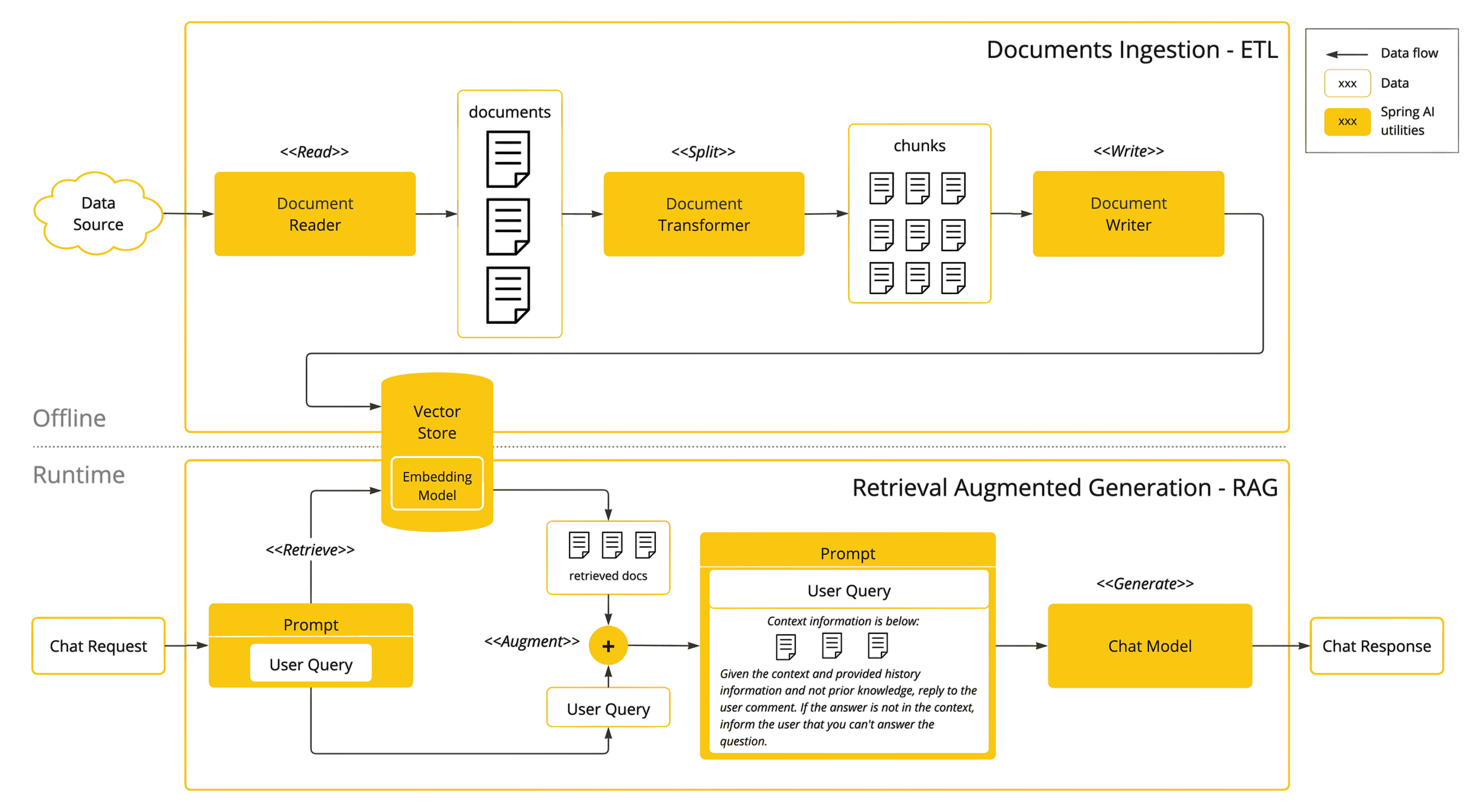
At its core, Spring AI addresses the fundamental challenge of AI integration - Connecting your enterprise Data and APIs with the AI Models. A technique termed Retrieval Augmented Generation (RAG) has emerged to address the challenge of incorporating relevant data into prompts for accurate AI model responses.Spring AI greatly simplifies code you need to write to support RAG pipelines.
Spring AI supported patterns
Generative AI brings with it it's own set of challenges. Spring AI supports the following patterns to address these challenges.
| Challenges | Patterns |
|---|---|
| Align responses to goals | System prompt |
| No structured output | Output converters |
| Not trained on your data | Prompt Stuffing |
| Limited Context Size | RAG |
| Stateless APIs | Chat memory |
| Not aware of your APIs | Function calling |
| Hallucinations | Evaluators |
Integration with common technologies
Spring AI provides abstractions that serve as the foundation for developing AI applications. These abstractions have multiple implementations, enabling easy component swapping with minimal code changes. Spring AI has support for all major Model providers such as OpenAI, Microsoft, Amazon, Google, and Hugging Face. It also supports all major Vector Database providers such as Apache Cassandra, Azure Vector Search, Chroma, Milvus, MongoDB Atlas, Neo4j, Oracle, PostgreSQL/PGVector, PineCone, Qdrant, Redis, and Weaviate.