Shared Content Block:
Styles -- modify testimonial colors
The mission of the RNA Bioscience Initiative (RBI) is to cultivate a vibrant center of discovery and innovation in RNA biology, informatics, diagnostics, and therapy. Our goal is to provide a fluid pipeline from basic to clinical RNA research at CU Anschutz.
RNA in the News

Targeting of Unique RNA Structures for Degradation Shows Therapeutic Promise
Summer 2023
Therapeutic compounds that contain RNA-binding small molecules linked to molecules targeting bound RNA for degradation may one day be used to fight cancer. Scientists at the Scripps Research Institute in Jupiter, FL recently "created an encyclopedia of druggable RNA folds". Using this information, they were able to selectively destroy mRNAs encoding the cancer promoting MYC protein.
Personalized mRNA Vaccines Target Pancreatic Cancer
Summer 2023
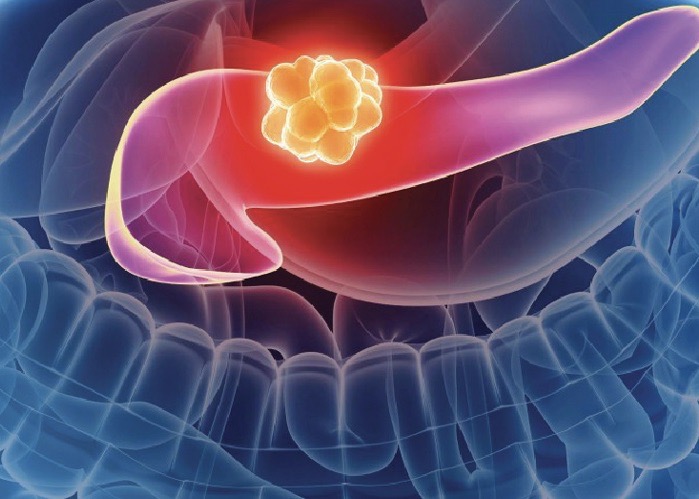
Researchers at Memorial Sloan Kettering in New York have partnered with BioNTech in Germany to produce and administer personalized mRNA vaccines designed to train the immune systems of individual patients to attack their own pancreatic tumor cells. The strategy showed great promise when used in combination with more standard treatments. A larger trial is planned in the near future.
RBI Faculty Train Underrepresented Undergraduate Students from Denver's Metro State
June 12, 2023
The MAP Scholars program, developed by RBI's Olivia Rissland, PhD and Srinivas Ramachandran, PhD, is highlighted in the most recent newsletter from the School of Medicine Dean, John J Reilly, Jr, MD.
Ramachandran Wins 2023 AB Nexus Award
June 6, 2023
Congratulations to RBI's Dr. Srinivas Ramachandran and his and his CU – Boulder collaborator Dr. Amy Palmer for their selection as a 2023 AB Nexus Awardees! The AB Nexus program was launched in 2020 to promote cross-campus research partnerships to advance medical discovery. Ramachandran is RBI's second winner, following in the footsteps of Jay Hesselberth, a 2022 awardee.
Johnson Awarded the Dean's Doctoral Mentoring Award
May 22, 2023
Dr. Aaron Johnson, Associate Professor of Biochemistry and Molecular Genetics, RBI director of education, and Biomedical Sciences Program director was recently awarded a Doctoral Mentoring Award from the Dean of the Graduate School. A much deserved recognition for a passionate educator... CONGRATULATIONS Aaron!
Read More
Zhongyou Li Awarded a Cystic Fibrosis Foundation Fellowship
April 25, 2023
Dr. Li, a postdoctoral fellow in RBI's Jagannathan Lab, was recently awarded a Path to a Cure fellowship to fund his work examining the role of NMD in cystic fibrosis (CF) and determining method of modulating NMD efficiency. Congratulations Zhongyou!
Compromised nonsense-mediated RNA decay results in truncated RNA-binding protein production upon DUX4 expression
June 13, 2023
Amy E Campbell, Michael C Dyle, Roberto Albanese, Tyler Matheny, Kavitha Sudheendran, Michael A Cortázar, Thomas Forman, Rui Fu, Austin E Gillen, Marvin H Caruthers, Stephen N Floor, Lorenzo Calviello, Sujatha Jagannathan
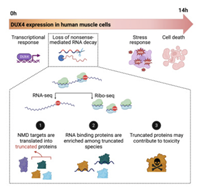
Nonsense-mediated RNA decay (NMD) degrades transcripts carrying premature termination codons. NMD is thought to prevent the synthesis of toxic truncated proteins. However, whether loss of NMD results in widespread production of truncated proteins is unclear. A human genetic disease, facioscapulohumeral muscular dystrophy (FSHD), features acute inhibition of NMD upon expression of the disease-causing transcription factor, DUX4. Complete Abstract
 Pre-mRNA splicing and its cotranscriptional connections
May 25, 2023
Hossein Shenasa and David L. Bentley
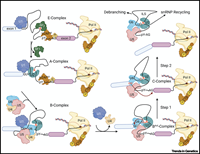
Transcription of eukaryotic genes by RNA polymerase II (Pol II) yields RNA pre- cursors containing introns that must be spliced out and the flanking exons ligated together. Splicing is catalyzed by a dynamic ribonucleoprotein complex called the spliceosome. Recent evidence has shown that a large fraction of splicing occurs cotranscriptionally as the RNA chain is extruded from Pol II at speeds of up to 5 kb/minute. Splicing is more efficient when it is tethered to the transcription elongation complex, and this linkage permits functional coupling of splicing with transcription. We discuss recent progress... Complete Article
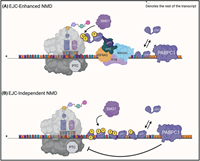
The long and short of EJC-independent nonsense-
mediated RNA decay
May 5, 2023
Oscar Muñoz, Mlana Lore, and Sujatha Jagannathan
Nonsense-mediated RNA decay (NMD) plays a dual role as an RNA surveillance mechanism against aberrant transcripts containing premature termination codons and as a gene regulatory mechanism for normal physiological transcripts. This dual function is possible because NMD recognizes its substrates based on the functional definition of a premature translation termination event. An efficient mode of NMD target recognition involves the presence of exon-junction complexes (EJCs) downstream of the terminating ribosome. A less efficient, but highly conserved, mode of NMD is triggered by long 30 untranslated regions (UTRs) that lack EJCs (termed EJC-independent NMD). Complete Article
On Tap
No events currently scheduled.
The RBI has made CU Anschutz a clear hub of RNA biology expertise, raising the status of the university and its researchers in the eyes of scientists at institutions around the country and the world. The RBI sets CU Anschutz up as a leader in the exciting and groundbreaking field of RNA biology.
.jpg?sfvrsn=60498fb9_4 "Amy Campbell, PhD")
Amy Campbell, PhD
RBI Co-Director Discusses the Future of mRNA Technology on 9News
RBI Co-Director, David Bentley, PhD, was interviewed by 9News reporter Anusha Roy and featured on Next with Kyle Clark. In this piece Dr. Bentley expertly describes the future of mRNA technology and its possible therapeutic uses beyond the COVID vaccine.
RBI Researcher Engages Public in Scientific Outreach
RBI's Dr. Matt Taliaferro writes about his latest research for The Conversation, an online news organization "dedicated to unlocking the knowledge of experts for the public good". In this case, to make complex scientific ideas understandable for non-scientists. Here, Taliaferro describes cells as cities organized in districts that can be distinguished from one another by unique mRNA sequences. These RNA "Zip Codes" are recognized by proteins that deliver them to particular cellular addresses.