Ground Truth is a monthly series following the research coming out of Vineland’s Greening the Landscape Research Consortium — brought to a wider audience for anyone curious about how cities grow and keep their trees. New issues every month.
If you work in urban forestry, you’ve probably spent time making the case for trees to people who see them as a nice-to-have.
You talk about shade. Cooling. Stormwater. Energy savings. Maybe carbon, if you’re feeling ambitious.
And yet the budget still gets cut.
Here’s what might change that conversation: the public health research.
Over the past two decades, a growing body of peer-reviewed evidence has linked urban tree canopy to measurable improvements in human health outcomes — not soft quality-of-life metrics, but hard clinical ones. Lower rates of cardiovascular mortality. Better birth outcomes. Reduced rates of hypertension during pregnancy. Improved mental health, particularly in children and youth.
And the effect sizes are not small.
I want to be clear about something upfront, because this research is sometimes reduced to a handful of famous studies.
The evidence base for trees as public health infrastructure spans more than two decades and multiple independent research groups working across different countries. No single study. No single researcher. A consistent signal from many directions….which is exactly what gives it credibility.
Dr. Matilda van den Bosch and colleagues published a landmark systematic review of reviews in 2017, synthesizing findings across dozens of studies and establishing robust associations between urban natural environments and lower rates of cardiac disease, asthma, and mental health disorders. That was a review of reviews — meaning that by 2017, there was already enough literature to warrant that kind of synthesis.
Dr. Ming Kuo at the University of Illinois has spent her career documenting the psychological, social, and physical benefits of green spaces across vulnerable populations. Her research showed that time in nature reduces ADHD symptoms in children — and that kids without ADHD show measurably higher concentration and classroom engagement after spending time outdoors.
On birth outcomes, Dr. Geoffrey Donovan’s 2011 study was the first ever to examine the relationship between the natural environment and birth outcomes. He found that women with more tree canopy near their homes were less likely to have an underweight baby — a result that held even after controlling for maternal characteristics from birth certificates and neighborhood variables from tax records, so the effect wasn’t simply a matter of wealthier mothers living in leafier places.
Since then, at least three dozen studies have confirmed that very relationship. Tiako and colleagues (2023) documented the specific link between low urban greenness and hypertensive disorders of pregnancy, adjusting for individual sociodemographic factors (race/ethnicity, age, insurance status) and a census-tract neighborhood deprivation index — a holistic measure of socioeconomic status. Again, these aren’t isolated findings. They keep appearing, in different places, from different teams — and the canopy effect persists once the usual socioeconomic “suspects” are accounted for.
The downstream consequences compound across a lifetime. Being born underweight elevates a child’s risk of diabetes, cardiovascular disease, and even lower educational outcomes. Before they’re even born, through no fault of their own, a child can be put on a different path. And we could change it for the price of some trees.
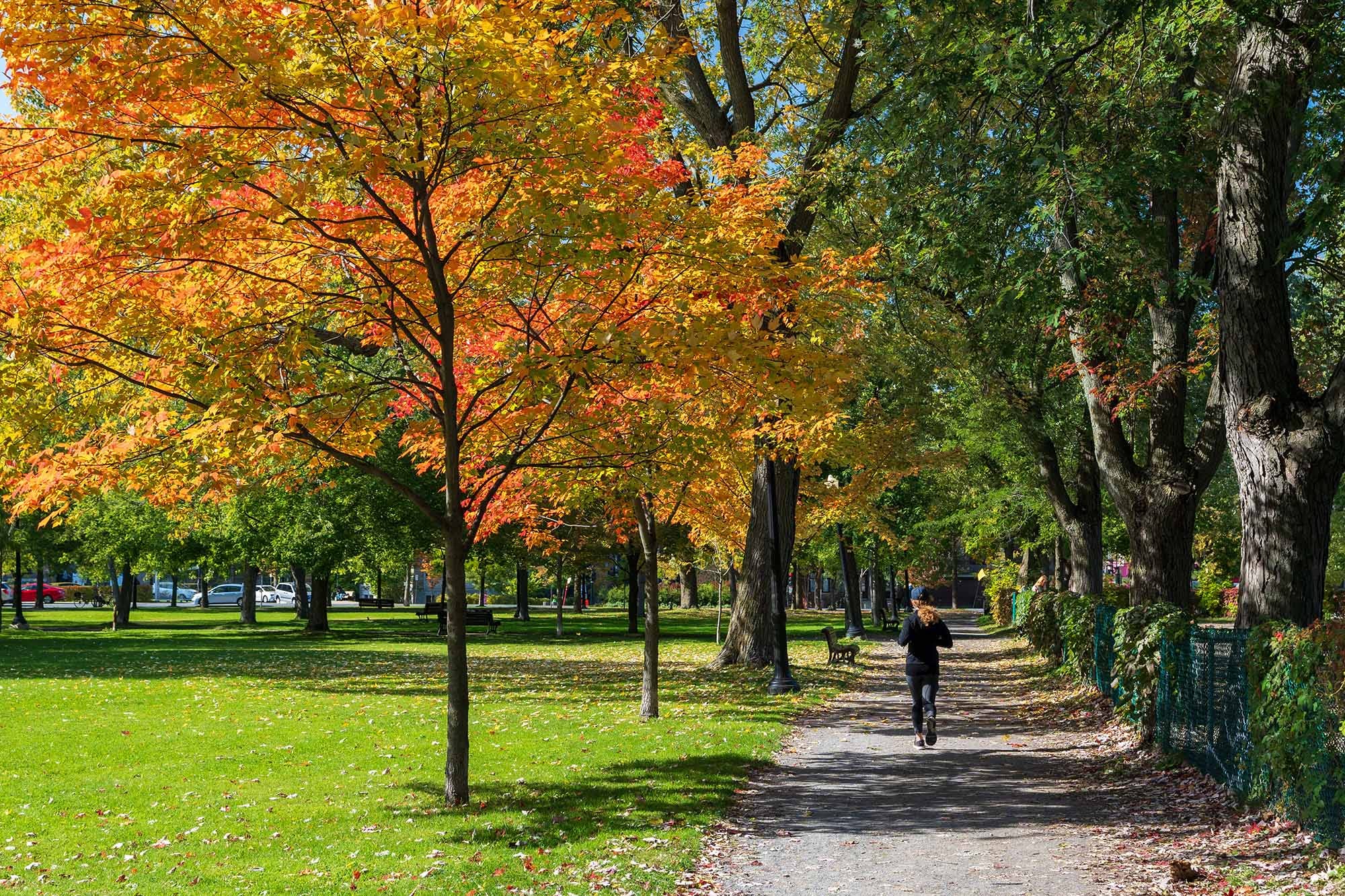
The research also tells us, with uncomfortable consistency, that the communities with the least canopy are the same communities already carrying the heaviest health burdens.
This isn’t just a problem in American cities. Martin and colleagues (2025) analyzed street tree density and size across 32 Canadian cities and found systematic distributional inequities — fewer and smaller trees were in more vulnerable neighbourhoods.
Jia and Duan (2023) found the same pattern in New York City, where canopy gaps tracked closely with income, disability, and built environment density. The Green Municipal Fund’s own 2024 research confirmed that across Canada, neighbourhoods with higher levels of social and environmental vulnerability consistently have lower canopy cover.
This is not a coincidence. It is a compounding injustice. And it means that canopy equity is not an aesthetic concern or a secondary priority. It is a health equity issue, full stop.
Perhaps the most powerful piece of evidence in this field came from a natural experiment nobody would have designed by choice.
When the emerald ash borer swept through the Upper Midwest of the United States — and Canada — it killed hundreds of millions of ash trees in a short period of time. Donovan recognized it as a rare opportunity to test the tree-health relationship at scale: if trees are good for health, killing them rapidly should be bad for health.
He was right. The die-off was associated with approximately 15,000 additional cardiovascular deaths and 6,000 additional lower respiratory deaths in affected counties. Around 21,000 excess deaths in total.
Now, a reasonable person might ask: how do we know trees caused that, rather than some other factor that happened to change at the same time?
Donovan anticipated that objection. He added every confounder he could think of. And then he ran a negative control — accidental deaths, which trees couldn’t plausibly affect — and found nothing there. The results held. Then he ran the inverse study in Portland, where a nonprofit had spent three decades planting street trees and keeping meticulous records of every tree, every date, every location. He found the mirror image: tree planting was associated with decreased cardiovascular mortality.
Two different study designs. Different locations. Different time periods. Both are pointing in the same direction.
The most striking distillation of the Portland findings: roughly one hundred trees in the ground equals one death averted. One hundred trees is not an ambitious number. Most cities could plant hundreds of thousands more trees if given the right-sized budgets and supports. And the outcome we’re talking about isn’t reduced anxiety or improved mood. It is the most fundamental health outcome there is: not being dead.
Read and/or listen more about Dr. Geoffrey Donovan’s in the Internet of Nature Podcast, Season 7, Episode 2 👇
More recent work has pushed the research in a direction that should matter to everyone making planting decisions.
In studies conducted in New Zealand, Donovan found that children living in greener neighbourhoods were less likely to develop asthma. But here’s the twist: when that greenness was more biodiverse — more species, more structural variety — the protective effect was even stronger. A follow-up study found the same biodiversity signal in childhood leukemia rates, the most common pediatric cancer in the world. Kids in more biodiverse neighbourhoods were significantly less likely to develop it.
The leading hypothesis involves microbes. Genus-level diversity means differnent plant leaf types, which each host vast and varied microbial communities, and exposure to that diversity appears to be important for immune system development in early childhood. More diverse plantings support more diverse microbial ecosystems — which may be part of why species diversity isn’t just about pest resilience. It may be about health outcomes, too.
For urban foresters already making the case for diverse species palettes, this is additional ammunition. The argument for moving beyond the default thirty species isn’t just ecological. It may be medical.
One of the most striking recent studies in this field didn’t come from urban forestry at all. It came from a health insurer.
Researchers linked satellite imagery data — measuring the greenness of neighbourhoods — to the actual healthcare records of over five million Kaiser Permanente members in Northern California, tracked across more than a decade. After accounting for age, sex, race, income, education, and housing density, they found one consistent pattern: people living in the greenest neighbourhoods spent $374 less per person per year on direct healthcare costs than those living in the least green neighbourhoods.
The savings weren’t driven by people feeling generally better. They were driven specifically by fewer emergency room visits and fewer hospitalizations — the most expensive, acute interactions with the health system.
Now apply that to a mid-sized Ontario city of 150,000 people. The healthcare cost implications of low canopy are not rounding error. They are a budget argument — and one that belongs in front of city finance committees, not just parks departments.
Donovan’s own return on investment calculation for tree planting in Portland came out at roughly 1,700 to one, expressed in health outcomes. His message to municipal decision-makers is direct: skim a tenth of one percent off your health spending. Put it into trees. No other public health care investment will come close in terms of return for investment.
Here’s a question worth sitting with before we move to implications.
The research keeps showing that trees reduce cardiovascular mortality, improve birth outcomes, lower healthcare costs, and reduce ADHD symptoms. The effect sizes are large. The replication is strong. But maybe the more unsettling question isn’t why trees are so good for us — it’s why we need them so badly.
We didn’t evolve to live in cities. We evolved over hundreds of thousands of years in landscapes full of vegetation, soil, birdsong, and biological diversity. The modern built environment — concrete, noise, air pollution, sensory overload — is, in an evolutionary sense, deeply foreign to us.
Perhaps what the research is really showing isn’t that trees are miraculous. It’s that the environments we’ve built for ourselves are toxic, and trees take the edge off that poison.
Donovan has a phrase for this that cuts through all the policy language. Trees aren’t livable infrastructure. They’re survivable infrastructure. The distinction matters. Livable implies comfort, amenity, quality of life — the kind of thing that gets cut when budgets are tight because it sounds optional. Survivable implies something else entirely.
And yet we keep calling tree canopy a benefit. The word itself is the problem. Benefits are extras. Benefits are the frilly bits on the edges.
But a person not dying of cardiovascular disease is not a frilly bit. A baby born at a healthy weight is not a frilly bit. These are the most fundamental health outcomes we have — and we’re treating the infrastructure that protects them as a discretionary line item.
The ecosystem services framing is well established in urban forestry circles. But it tends to resonate with people who are already convinced.
The public health framing opens a different door…and hopefully may even lead to different rooms.
When trees are positioned as health infrastructure, they belong in a different budget conversation. Not parks. Not beautification. The same conversation as hospitals, transit, and community health centres. Public health officers, hospital networks, and community health organizations are increasingly interested in upstream (social) determinants of health. Urban foresters who speak this language will find allies in places they haven’t before.
Maybe the question to put to decision-makers isn’t can we afford to plant more trees? It’s can we afford to keep pretending we’ve built environments that humans can thrive in without them?
Share it across your organization — but share it strategically. The cardiovascular mortality findings and the $374-per-person healthcare cost figure belong in front of finance and public health staff, not just your forestry team. Frame it as a healthcare cost conversation, not a parks conversation.
Look at where your canopy gaps are. If you’re in Ontario, the Greening the Landscape Research Consortium’s (GLRC) Canopy Mapping and Tree Equity Case Study is actively working with Living Lab member municipalities to build exactly this kind of picture. Understanding where your canopy is missing is the first step to understanding where your health equity gaps are.
When you’re making species selection decisions, let diversity be a health argument, not just an ecological one. The biodiversity-health research gives you new ground to stand on when pushing back against default species lists. Consider using Vineland’s free Tree Selector Tool, which includes more than 200 species filterable by climate zone, native status in Ontario, drought and salt tolerance, soil conditions, and more.
Last fall, the GLRC brought together Dr. Matilda van den Bosch and Dr. Geoffrey Donovan for a public Conversation Series webinar on exactly this topic — hosted by yours truly. If you haven’t watched it, it’s available on YouTube (below) and worth your time.
The science is there. It has been replicated. It is ready to be used.
Happy trails,
Nadina
Disclosure: The Ground Truth series is produced in collaboration with the Vineland Research and Innovation Centre in Lincoln, Ontario, Canada. As always, the words and opinions are my own.
Vineland Research and Innovation Centre (Vineland) is an independent, not-for-profit corporation. created in 2007 to drive growth and impact in the horticulture sector. Funded in part by the Sustainable Canadian Agricultural Partnership (Sustainable CAP), a five-year, federal-provincial-territorial initiative, the property and buildings at Vineland are owned by Agricultural Research and Innovation Ontario (ARIO), an agency of the Government of Ontario. Vineland coordinates applied research, innovation, and commercialization activities across Ontario’s horticulture value chain, aligning government, private‑sector, and research partners to deliver measurable outcomes to the sector.
