Abstract
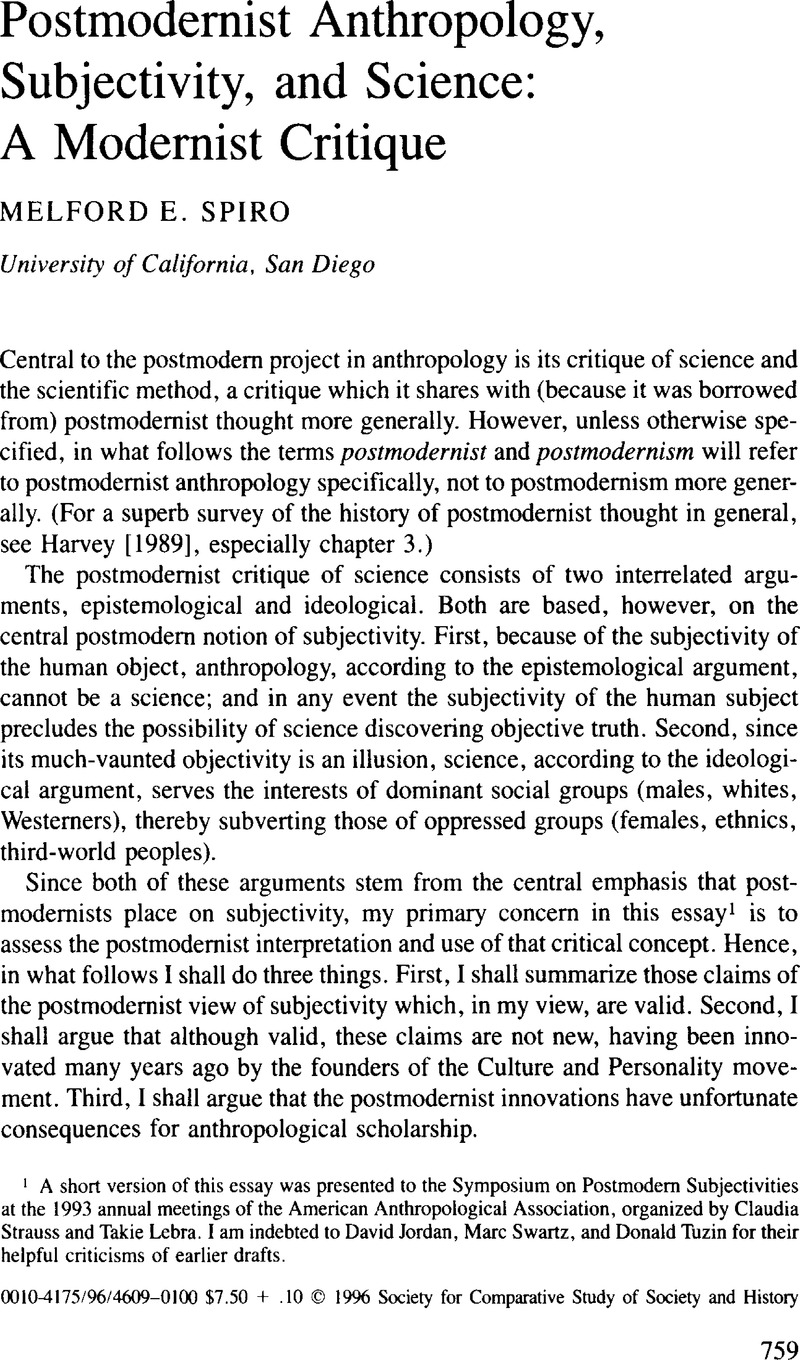
An abstract is not available for this content so a preview has been provided. Please use the Get access link above for information on how to access this content.
References
Abu-Lughod, Lila; and Lutz, Catherine. “Introduction,” in Lutz, Catherine and Abu-Lughod, Lila, eds., Language and the Politics of Emotion. Cambridge: Cambridge University Press.Google Scholar
Appell, George N. 1992. “Scholars, True Believers, and the Identity Crisis in American Anthropology.” Reviews in Anthropology, 21:193–202.CrossRefGoogle Scholar
Appleby, Joyce; Hunt, Lynn; and Jacobs, Margaret. 1994. Telling the Truth about History. New York: W. W. NortonGoogle Scholar
Arendt, Hannah. 1968. Between Past and Future: Eight Exercises in Political Thought. New York: Viking.Google Scholar
Bourguignon, Erika. 1979. Psychological Anthropology: An Introduction to Human Nature and Cultural Differences. New York: Holt, Rinehart and Winston.Google Scholar
Bowen, Elenore Smith (Laura Bohannan). 1964. Return to Laughter. New York: Doubleday.Google Scholar
Breuer, Josef; and Freud, Sigmund. 1893–1895 [1955]. Studies on Hysteria, vol. 2 of The Standard Edition of the Complete Psychological Works of Sigmund Freud. London: Hogarth Press.Google Scholar
Briggs, Jean L. 1970. Never in Anger: Portrait of an Eskimo Family. Cambridge: Harvard University Press.Google Scholar
Bruner, Edward M. 1986. “Experience and Its Expression,” in Turner, Victor W. and Bruner, Edward M., eds., The Anthropology of Experience. Urbana: University of Illinois Press.Google Scholar
Clifford, James; and Marcus, George E., eds. 1986. Writing Culture: The Poetics and the Politics of Ethnography. Berkeley: University of California Press.CrossRefGoogle Scholar
Cope-Casten, Vance. 1989. “A Portrait of Dominant Rationality.” American Philosophical Association Newsletter on Feminism and Philosophy, 88:29–34.Google Scholar
Crapanzano, Vincent. 1980. Tuhami: Portrait of a Moroccan. Chicago: University of Chicago Press.CrossRefGoogle Scholar
Devereux, George. 1951. Reality and Dream: The Psychotherapy of a Plains Indian. New York: New York University Press.Google Scholar
Devereux, George 1967. From Anxiety to Method in the Behavioral Sciences. The Hague: Mouton.CrossRefGoogle Scholar
DeVos, George. 1954. “A Comparison of Personality Differences in Two Generations of Japanese Americans by Means of the Rorschach Test.” Ngoya Journal of Medical Science, 17:153–65.Google Scholar
DeVos, George; and Boyer, L. Bryce. 1989. Symbolic Analysis Cross-Culturally: The Rorschach Test. Berkeley and Los Angeles: University of California Press.CrossRefGoogle Scholar
Dewey, John. 1938. Logic: The Theory of Inquiry. New York: Henry Holt.Google Scholar
DuBois, Cora. 1944. The People ofAlor. Minneapolis: University of Minnesota Press.Google Scholar
Eagle, Morris N. 1984. Recent Developments in Psychoanalysis. New York: McGraw-Hill.Google Scholar
Erikson, Erik H. 1964. Insight and Responsibility. New York: Norton.Google Scholar
Ewing, Katherine. 1987. “Clinical Psychoanalysis as an Ethnographic Tool.” Ethos, 15:16–39.CrossRefGoogle Scholar
Eysteinsson, Astradur. 1990. The Concept of Modernism. Ithaca: Cornell University Press.Google Scholar
Fabian, Johannes. 1983. Time and the Other: How Anthropology Makes its Object. New York: Columbia University Press.Google Scholar
Fabian, Johannes 1991. “Dilemmas of Critical Anthropology,” in Nencel, Lorraine and Pels, Peter, eds., Constructing Knowledge: Authority and Critique in Social Science. London: Sage Publications.Google Scholar
Fredrickson, George M. 1993. “Pioneer.” The New York Review, September 23:30–34.Google Scholar
Freud, Sigmund. 1910. [1958]. The Future Prospects of Psychoanalytic Therapy, vol. 11 of The Standard Edition of the Complete Psychological Works of Sigmund Freud. London: Hogarth Press.Google Scholar
Freud, Sigmund 1912. [1958]. The Dynamics of the Transference, vol. 12 of The Standard Edition of the Complete Psychological Works of Sigmund Freud. London: Hogarth Press.Google Scholar
Freud, Sigmund 1937. [1964]. Analysis Terminable and Interminable, vol. 23 of The Standard Edition of the Complete Psychological Works of Sigmund Freud. London: Hogarth Press.Google Scholar
Gellner, Ernest. 1992. Postmodernism, Reason and Religion. London: Routledge.Google Scholar
Gillispie, Charles Coulston. 1960. The Edge of Objectivity: An Essay in the History of Scientific Ideas. Princeton, NJ: Princeton University Press.Google Scholar
Ginzberg, Ruth. 1989. “Feminism, Rationality, and Logic.” American Philosophical Association Newsletter on Feminism and Philosophy, 88: 34–39.Google Scholar
Gladwin, Thomas; and Sarason, Seymour B.. 1953. Truk: Man in Paradise. New York: Wenner-Gren Foundation for Anthropological Research.Google Scholar
Gleick, James. 1992. Genius: The Life and Science of Richard Feynman. New York: Pantheon.Google Scholar
Griinbaum, Adolf. 1984. The Foundations of Psychoanalysis: A Philosophical Critique. Berkeley: University of California Press.Google Scholar
Habermas, Jurgen. 1971. Knowledge and Human Nature. Boston: Beacon Press.Google Scholar
Hallowell, A. Irving. 1938. [1955]. “Fear and Anxiety as Cultural and Individual Variables in a Primitive Society.” Journal of Social Psychology, 9:25–47. Reprinted in Culture and Experience. Philadelphia: University of Pennsylvania Press.CrossRefGoogle Scholar
Hallowell, A. Irving. 1954. [1955]. The Self and its Behavioral Environment Explorations, II (April). Reprinted in Culture and Experience. Philadelphia, PA: University of Pennsylvania Press.Google Scholar
Hallowell, A. Irving. 1955b. Culture and Experience. Philadelphia: University of Pennsylvania Press.CrossRefGoogle Scholar
Haraway, Donna Jean. 1986. “Primatology is Politics by Other Means,” in Bleier, Ruth, ed., Feminist Approaches to Science. New York: Permagon Press.Google Scholar
Haraway, Donna Jean. 1989. Primate Visions. New York: Routledge.Google Scholar
Harvey, David. 1989. The Condition of Postmodernity: An Enquiry into the Origins of Cultural Change. Oxford: Basil Blackwell.Google Scholar
Hempel, Carl. 1965. Aspects of Scientific Explanation. New York: The Free Press.Google Scholar
Henry, William. 1947. “The Thematic Apperception Technique in the Study of Culture-Personality Relations.” Genetic Psychology Monographs, 35:3–135.Google Scholar
Hobsbawm, Eric. 1993. “The New Threat to History.” The New York Review, December 16, 62–64.Google Scholar
Kelley, Michael. 1993. “David Gergen, Master of the Game.” New York Times Magazine. October 31, 1964.Google Scholar
Kitcher, Philip. 1994. The Advancement of Science: Science without Legend, Objectivity without Illusions. New York: Oxford University Press.Google Scholar
Kracke, Waud. 1978. Force and Persuasion: Leadership in an Amazonian Society. Chicago: University of Chicago Press.Google Scholar
Kracke, Waud. 1987. “Encounter with Other Cultures: Psychological and Epistemological Aspects.” Ethos, 15:58–81.CrossRefGoogle Scholar
La Barre, Weston. 1967. “Preface,” in Devereux, George, From Anxiety to Method in the Behavioral Sciences. The Hague: Mouton.Google Scholar
Latour, Bruno. 1983. “Give Me a Laboratory and I Will Raise the World,” in Knorr-Cetina, Karin D. and Mulkay, Michael, eds., Science Observed: Perspectives on the Social Study of Science. London; Beverly Hills: Sage Publications.Google Scholar
Lévi-Strauss, Claude. 1955 [1964]. Tristes Tropiques. New York: Atheneum.Google Scholar
LeVine, Sarah. 1981. “Dreams of the Informant About the Researcher: Some Difficulties Inherent in the Research Relationships.” Ethos, 9:276–293.CrossRefGoogle Scholar
Lewis, Herbert S. 1994. “On the Parlous State of Anthropology Today.” Manuscript.Google Scholar
Lindzey, Gardner. 1961. Projective Techniques and Cross-Cultural Research. New York: Appleton-Century-Crofts.Google Scholar
Lutz, Catherine. 1990. “Engendered Emotion: Gender, Power, and the Rhetoric of Emotional Control in American Discourse,” in Lutz, Catherine and Abu-Lughod, Lila, eds., Language and the Politics of Emotion. Cambridge: Cambridge University Press.Google Scholar
Mandelbaum, David G., ed. 1957. Edward Sapir: Culture, Language and Personality. Berkeley: University of California Press.Google Scholar
Marcus, George E.; and Fischer, Michael M.. 1986. Anthropology as Cultural Critique: An Experimental Moment in the Human Sciences. Chicago: University of Chicago Press.Google Scholar
Megill, Allan, ed. 1994. Rethinking Objectivity. London: Duke University Press.Google Scholar
Nencel, Lorraine; and Pels, Peter, eds. 1991. Constructing Knowledge: Authority and Critique in Social Science. London: Sage Publications.Google Scholar
Paul, Robert A. 1990. “What Does Anybody Want? Desire, Purpose, and the Acting Subject in the Study of Culture.” Cultural Anthropology, 5:431–51.CrossRefGoogle Scholar
Popper, Karl. 1963. Conjectures and Refutations. New York: Basic Books.Google Scholar
Rabinow, Paul. 1977. Reflections on Fieldwork in Morocco. Berkeley: University of California Press.Google Scholar
Rabinow, Paul. 1986. “Representations are Social Facts: Modernity and Postmodemity in Anthropology,” in Clifford, James and Marcus, George E., eds., Writing Culture: The Poetics and Politics of Ethnography. Berkeley: University of California Press.Google Scholar
Rabinow, Paul; and Sullivan, William. 1987. Interpretive Social Science: A Second Look. Los Angeles: University of California Press.Google Scholar
Read, Kenneth E. 1967. The High Valley. London: George Allen and Unwin.Google Scholar
Ricoeur, Paul. 1981. Hermeneutics and the Human Sciences. New York: Cambridge University Press.Google Scholar
Rorty, Richard. 1995. “Untruth and Consequences.” New Republic, July 31, 32–36.Google Scholar
Rosaldo, Renato. 1984. “Grief and a Headhunter's Rage: On the Cultural Force of Emotions,” in Brunner, Edward, ed., Text, Play and Story. Washington, D.C.: Proceedings of the American Ethnological Society.Google Scholar
Rosaldo, Renato. 1986. “From the Door of His Tent: The Fieldworker and the Inquisitor,” in Clifford, James and Marcus, George, eds., Writing Culture. Berkeley: University of California Press.Google Scholar
Rosaldo, Renato. 1989. Culture and Truth: The Remaking of Social Analysis. Boston: Beacon.Google Scholar
Ruby, Jay, ed. 1982. A Crack in the Mirror: Reflexive Perspectives in Anthropology. Philadelphia: University of Pennsylvania Press.CrossRefGoogle Scholar
Rudner, Richard. 1966. Philosophy of Social Science. Englewood Cliffs, NJ: Prentice Hall.Google Scholar
Said, Edward W. 1989. “Representing the Colonized: Anthropology's Interlocutors.” Critical Inquiry, 15:205–25.Google Scholar
Scheper-Hughes, Nancy. 1992. “Hungry Bodies, Medicine, and the State: Toward a Critical Psychological Anthropology,” in Schwartz, Theodore, White, Geoffrey M., and Lutz, Catherine A., eds., New Directions in Psychological Anthropology. Cambridge: Cambridge University Press.Google Scholar
Scheper-Hughes, Nancy. 1994. “The Violence of Everyday Life: In Search of a Critical and Politically Engaged Psychological Anthropology,” in Suarez-Orozco, Marcelo M. and George, and Spindler, Louise, eds., The Making of Psychological Anthropology, II. Fort Worth: Harcourt Brace College Publishers.Google Scholar
Scholte, Bob. 1984. “Reason and Culture: The Universal and the Particular Revisited.” American Anthropologist, 86:960–65.CrossRefGoogle Scholar
Schwartz, Theodore. 1992. “Anthropology and Psychology: An Unrequited Relationship,” in Schwartz, Theodore, White, Geoffrey M., and Lutz, Catherine A., eds., New Directions in Psychological Anthropology. Cambridge: Cambridge University Press.Google Scholar
Searle, John R. 1993a. “Is There a Crisis in American Higher Education?” Bulletin of the American Academy of Arts and Sciences, 56: 24–47.CrossRefGoogle Scholar
Searle, John R. 1993b. “Rationality and Realism, What is at Stake?” Daedalus, 122:55–84.Google Scholar
Spindler, George D. 1955. Sociocultural and Psychological Processes in Menomini Acculturation, vol. 5. Berkeley: University of California Press.Google Scholar
Spiro, Melford E. 1984 [1994]. “Some Reflections on Cultural Determinism and Relativism with Special Reference to Emotion and Reason,” in Shweder, Richard A. and LeVine, Robert A., eds., Essays on Mind, Self, and Emotion. Cambridge: Cambridge University Press. Reprinted in Culture and Human Nature. New Brunswick: Transaction Publishers.Google Scholar
Spiro, Melford E. 1986 [1992]. “Cultural Relativism and the Future of Anthropology.” Cultural Anthropology, 1:259–86. Reprinted and expanded in Anthropological Other or Burmese Brother?: Studies in Cultural Analysis. New Brunswick: Transaction Publishers.CrossRefGoogle Scholar
Spiro, Melford E. 1990 [1992]. “On the Strange and the Familiar in Recent Anthropological Thought,” in Stigler, James E., Shweder, Richard A., and Herdt, Gilbert, eds., Cultural Psychology: Essays on Comparative Human Development. Cambridge: Cambridge University Press. Reprinted in Anthropological Other or Burmese Brother? Studies in Cultural Analysis. New Brunswick: Transaction Publishers.Google Scholar
Spiro, Melford E. 1993. “On a Feminist/Constructionist View of Emotions.” Manuscript.Google Scholar
Spiro, Melford E. 1994. Culture and Human Nature, 2nd ed., Kilbome, Benjamin and Langness, L. L., eds. New Brunswick: Transaction Publishers.Google Scholar
States, Bert O. 1994. “Notes on the Poststructural Code.” The American Scholar (Winter), 111–16.Google Scholar
Suarez-Orozco, Marcelo M. 1989. Central American Refugees and U.S. High Schools: A Psychosocial Study of Motivation and Achievement. Stanford: Stanford University Press.Google Scholar
Suarez-Orozco, Marcelo M. 1994. “Terror at the Fin de Siècle: The Systematization of Hatred in a Paranoid Era.” Manuscript.Google Scholar
Tyler, Steven. 1987. The Unspeakable: Discourse, Dialogue, and Rhetoric in the Postmodern World. Madison: University of Wisconsin Press.Google Scholar
Tyson, Robert L. 1984. “Countertransference: Evolution in Theory and Practice.” Journal of the American Psychoanalytic Association, 34: 251–74.CrossRefGoogle Scholar
Vendler, Zeno. 1984. “Understanding People,” in Shweder, Richard and Levine, Robert, eds., Culture Theory. Cambridge: Cambridge University Press.Google Scholar
Wallace, Anthony F. C. 1952. The Modal Personality Structure of the Tuscarora Indians as Revealed by the Rorschach Test. Washington: Bureau of American Ethnology (Bulletin 150).Google Scholar
Wikan, Unni. 1993. “Beyond the Words: The Power of Resonance,” in Palsson, Gisli, ed., Beyond Boundaries: Understanding Translation and Anthropological Discourse. Berg: Oxford/Providence.Google Scholar
Wolf, Eric R. 1980. “The United States. The Cultural Predicament of the Anthropologist,” in Diamond, Stanley, ed., Anthropology: Ancestors and Heirs. The Hague: Mouton.Google Scholar