Weakness ID: 918
Vulnerability Mapping: ALLOWED This CWE ID may be used to map to real-world vulnerabilitiesAbstraction: Base Base - a weakness that is still mostly independent of a resource or technology, but with sufficient details to provide specific methods for detection and prevention. Base level weaknesses typically describe issues in terms of 2 or 3 of the following dimensions: behavior, property, technology, language, and resource.
 Description
| The web server receives a URL or similar request from an upstream component and retrieves the contents of this URL, but it does not sufficiently ensure that the request is being sent to the expected destination. |
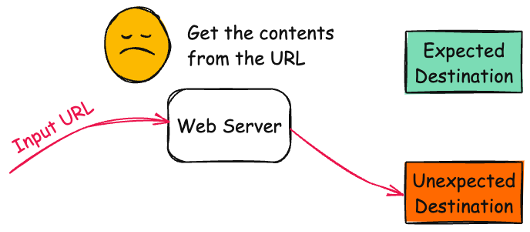
|
Alternate Terms
| XSPA |
Cross Site Port Attack |
| SSRF |
Server-Side Request Forgery |
Common Consequences
 This table specifies different individual consequences
associated with the weakness. The Scope identifies the application security area that is
violated, while the Impact describes the negative technical impact that arises if an
adversary succeeds in exploiting this weakness. The Likelihood provides information about
how likely the specific consequence is expected to be seen relative to the other
consequences in the list. For example, there may be high likelihood that a weakness will be
exploited to achieve a certain impact, but a low likelihood that it will be exploited to
achieve a different impact.
This table specifies different individual consequences
associated with the weakness. The Scope identifies the application security area that is
violated, while the Impact describes the negative technical impact that arises if an
adversary succeeds in exploiting this weakness. The Likelihood provides information about
how likely the specific consequence is expected to be seen relative to the other
consequences in the list. For example, there may be high likelihood that a weakness will be
exploited to achieve a certain impact, but a low likelihood that it will be exploited to
achieve a different impact.
| Impact | Details |
|---|---|
|
Read Application Data |
Scope: Confidentiality |
|
Execute Unauthorized Code or Commands |
Scope: Integrity |
|
Bypass Protection Mechanism |
Scope: Access Control
By providing URLs to unexpected hosts or ports, attackers can make it appear that the server is sending the request, possibly bypassing access controls such as firewalls that prevent the attackers from accessing the URLs directly. The server can be used as a proxy to conduct port scanning of hosts in internal networks, use other URLs such as that can access documents on the system (using file://), or use other protocols such as gopher:// or tftp://, which may provide greater control over the contents of requests. |
Relationships
This table shows the weaknesses and high level categories that are related to this
weakness. These relationships are defined as ChildOf, ParentOf, MemberOf and give insight to
similar items that may exist at higher and lower levels of abstraction. In addition,
relationships such as PeerOf and CanAlsoBe are defined to show similar weaknesses that the user
may want to explore.
Relevant to the view "Research Concepts" (View-1000)
| Nature | Type | ID | Name |
|---|---|---|---|
| ChildOf |
 Class - a weakness that is described in a very abstract fashion, typically independent of any specific language or technology. More specific than a Pillar Weakness, but more general than a Base Weakness. Class level weaknesses typically describe issues in terms of 1 or 2 of the following dimensions: behavior, property, and resource.
|
441 | Unintended Proxy or Intermediary ('Confused Deputy') |
Relevant to the view "Software Development" (View-699)
| Nature | Type | ID | Name |
|---|---|---|---|
| MemberOf |
 Category - a CWE entry that contains a set of other entries that share a common characteristic.
|
417 | Communication Channel Errors |
Relevant to the view "Weaknesses for Simplified Mapping of Published Vulnerabilities" (View-1003)
| Nature | Type | ID | Name |
|---|---|---|---|
| ChildOf |
Class - a weakness that is described in a very abstract fashion, typically independent of any specific language or technology. More specific than a Pillar Weakness, but more general than a Base Weakness. Class level weaknesses typically describe issues in terms of 1 or 2 of the following dimensions: behavior, property, and resource.
|
610 | Externally Controlled Reference to a Resource in Another Sphere |
Modes
Of Introduction
The different Modes of Introduction provide information
about how and when this
weakness may be introduced. The Phase identifies a point in the life cycle at which
introduction
may occur, while the Note provides a typical scenario related to introduction during the
given
phase.
| Phase | Note |
|---|---|
| Architecture and Design | |
| Implementation |
Applicable Platforms
This listing shows possible areas for which the given
weakness could appear. These
may be for specific named Languages, Operating Systems, Architectures, Paradigms,
Technologies,
or a class of such platforms. The platform is listed along with how frequently the given
weakness appears for that instance.
| Languages |
Class: Not Language-Specific (Undetermined Prevalence) |
| Technologies |
Class: Web Based (Undetermined Prevalence) AI/ML (Often Prevalent) Web Server (Undetermined Prevalence) |
Demonstrative Examples
Example 1
This code intends to receive a URL from a user, access the URL, and return the results to the user.
(bad code)
Example Language: PHP
$url = $_GET['url'];# User-controlled input
# Fetch the content of the provided URL
$response = file_get_contents($url);
echo $response;
The given PHP code is vulnerable to Server-Side Request Forgery (SSRF) because it directly accepts a user-supplied URL from the $_GET['url'] parameter and fetches its content using file_get_contents(), without any validation or restrictions. This allows an attacker to request internal or restricted resources within the server's network, such as internal admin panels, cloud metadata endpoints, or local services running on localhost.
(good code)
Example Language: PHP
# Define allowed URLs (or domains)
$allowed_urls = [
'https://example.com/data.json',
'https://api.example.com/info',
];
# Get the user-provided URL
$url = $_GET['url'] ?? '';
# Validate against allowed URLs
if (!in_array($url, $allowed_urls)) {
http_response_code(400);
echo "Invalid or unauthorized URL.";
exit;
}
# Fetch content safely
$response = @file_get_contents($url);
if ($response === false) {
http_response_code(500);
echo "Failed to fetch content.";
exit;
}
echo htmlspecialchars($response);# Escape output for safety
Selected Observed
Examples
Note: this is a curated list of examples for users to understand the variety of ways in which this weakness can be introduced. It is not a complete list of all CVEs that are related to this CWE entry.
| Reference | Description |
|---|---|
|
SSRF in LLM toolkit accesses arbitrary URLs for images, as exploited in the wild in April 2026 to conduct port scanning [REF-1519] |
|
|
SSRF in LLM application development framework because the URL retriever allows connections to local addresses using a crafted Location header |
|
|
Chain: LLM integration framework has prompt injection (CWE-1427) that allows an attacker to force the service to retrieve data from an arbitrary URL, essentially providing SSRF (CWE-918) and potentially injecting content into downstream tasks. |
|
|
Server Side Request Forgery (SSRF) in mail server, as exploited in the wild per CISA KEV. |
|
|
Server Side Request Forgery in cloud platform, as exploited in the wild per CISA KEV. |
|
|
Chain: incorrect validation of intended decimal-based IP address format (CWE-1286) enables parsing of octal or hexadecimal formats (CWE-1389), allowing bypass of an SSRF protection mechanism (CWE-918). |
|
|
Web server allows attackers to request a URL from another server, including other ports, which allows proxied scanning. |
|
|
CGI script accepts and retrieves incoming URLs. |
|
|
Web-based mail program allows internal network scanning using a modified POP3 port number. |
|
|
URL-downloading library automatically follows redirects to file:// and scp:// URLs |
Weakness Ordinalities
| Ordinality | Description |
|---|---|
|
Resultant |
(where the weakness is typically related to the presence of some other weaknesses) |
Detection
Methods
| Method | Details |
|---|---|
|
Automated Static Analysis |
Automated static analysis, commonly referred to as Static Application Security Testing (SAST), can find some instances of this weakness by analyzing source code (or binary/compiled code) without having to execute it. Typically, this is done by building a model of data flow and control flow, then searching for potentially-vulnerable patterns that connect "sources" (origins of input) with "sinks" (destinations where the data interacts with external components, a lower layer such as the OS, etc.) Effectiveness: High |
Memberships
This MemberOf Relationships table shows additional CWE Categories and Views that
reference this weakness as a member. This information is often useful in understanding where a
weakness fits within the context of external information sources.
| Nature | Type | ID | Name |
|---|---|---|---|
| MemberOf |  View - a subset of CWE entries that provides a way of examining CWE content. The two main view structures are Slices (flat lists) and Graphs (containing relationships between entries). View - a subset of CWE entries that provides a way of examining CWE content. The two main view structures are Slices (flat lists) and Graphs (containing relationships between entries). |
1337 | Weaknesses in the 2021 CWE Top 25 Most Dangerous Software Weaknesses |
| MemberOf | Category - a CWE entry that contains a set of other entries that share a common characteristic. |
1356 | OWASP Top Ten 2021 Category A10:2021 - Server-Side Request Forgery (SSRF) |
| MemberOf | View - a subset of CWE entries that provides a way of examining CWE content. The two main view structures are Slices (flat lists) and Graphs (containing relationships between entries). |
1387 | Weaknesses in the 2022 CWE Top 25 Most Dangerous Software Weaknesses |
| MemberOf | Category - a CWE entry that contains a set of other entries that share a common characteristic. |
1396 | Comprehensive Categorization: Access Control |
| MemberOf | View - a subset of CWE entries that provides a way of examining CWE content. The two main view structures are Slices (flat lists) and Graphs (containing relationships between entries). |
1425 | Weaknesses in the 2023 CWE Top 25 Most Dangerous Software Weaknesses |
| MemberOf | View - a subset of CWE entries that provides a way of examining CWE content. The two main view structures are Slices (flat lists) and Graphs (containing relationships between entries). |
1430 | Weaknesses in the 2024 CWE Top 25 Most Dangerous Software Weaknesses |
| MemberOf | View - a subset of CWE entries that provides a way of examining CWE content. The two main view structures are Slices (flat lists) and Graphs (containing relationships between entries). |
1435 | Weaknesses in the 2025 CWE Top 25 Most Dangerous Software Weaknesses |
| MemberOf | Category - a CWE entry that contains a set of other entries that share a common characteristic. |
1436 | OWASP Top Ten 2025 Category A01:2025 - Broken Access Control |
| MemberOf | Category - a CWE entry that contains a set of other entries that share a common characteristic. |
1447 | General Software Weaknesses that Appear in Products that Use or Support AI/ML Technology |
Vulnerability Mapping Notes
| Usage |
ALLOWED
(this CWE ID may be used to map to real-world vulnerabilities) |
| Reason | Acceptable-Use |
|
Rationale |
This CWE entry is at the Base level of abstraction, which is a preferred level of abstraction for mapping to the root causes of vulnerabilities. |
|
Comments |
Carefully read both the name and description to ensure that this mapping is an appropriate fit. Do not try to 'force' a mapping to a lower-level Base/Variant simply to comply with this preferred level of abstraction. |
Notes
Relationship
CWE-918 (SSRF) and CWE-611 (XXE) are closely related, because they both involve web-related technologies and can launch outbound requests to unexpected destinations. However, XXE can be performed client-side, or in other contexts in which the software is not acting directly as a server, so the "Server" portion of the SSRF acronym does not necessarily apply.
References
| [REF-913] |
Alexander Polyakov and Dmitry Chastukhin. "SSRF vs. Business-critical applications: XXE tunneling in SAP". 2012-07-26.
<https://media.blackhat.com/bh-us-12/Briefings/Polyakov/BH_US_12_Polyakov_SSRF_Business_Slides.pdf>. |
| [REF-914] |
Alexander Polyakov, Dmitry Chastukhin and Alexey Tyurin. "SSRF vs. Business-critical Applications. Part 1: XXE Tunnelling in SAP NetWeaver".
<http://erpscan.com/wp-content/uploads/2012/08/SSRF-vs-Businness-critical-applications-whitepaper.pdf>. |
| [REF-915] |
Riyaz Ahemed Walikar. "Cross Site Port Attacks - XSPA - Part 1". 2012-11-07.
<https://ibreak.software/2012/11/cross-site-port-attacks-xspa-part-1/>. |
| [REF-916] |
Riyaz Ahemed Walikar. "Cross Site Port Attacks - XSPA - Part 2". 2012-11-13.
<https://ibreak.software/2012/11/cross-site-port-attacks-xspa-part-2/>. |
| [REF-917] |
Riyaz Ahemed Walikar. "Cross Site Port Attacks - XSPA - Part 3". 2012-11-14.
<https://ibreak.software/2012/11/cross-site-port-attacks-xspa-part-3/>. |
| [REF-918] |
Vladimir Vorontsov and Alexander Golovko. "SSRF attacks and sockets: smorgasbord of vulnerabilities".
<https://www.slideshare.net/DefconRussia/vorontsov-golovko-ssrf-attacks-and-sockets-smorgasbord-of-vulnerabilities>. (URL validated: 2023-04-07) |
| [REF-919] |
ONsec Lab. "SSRF bible. Cheatsheet". 2013-01-26.
<https://docs.google.com/document/d/1v1TkWZtrhzRLy0bYXBcdLUedXGb9njTNIJXa3u9akHM/edit?pli=1#>. |
| [REF-920] |
Deral Heiland. "Web Portals: Gateway To Information, Or A Hole In Our Perimeter Defenses". 2008-02.
<https://archive.org/details/Web_Portals_Gateway_to_Information_or_a_Hole_in_our_Perimeter_Defenses_Deral_Hei>. (URL validated: 2025-08-04) |
| [REF-1511] |
OWASP. "Server-Side Request Forgery Prevention Cheat Sheet". 2019-07-16.
<https://cheatsheetseries.owasp.org/cheatsheets/Server_Side_Request_Forgery_Prevention_Cheat_Sheet.html>. (URL validated: 2025-12-02) |
| [REF-1519] |
Sysdig Threat Research Team. "CVE-2026-33626: How attackers exploited LMDeploy LLM Inference Engines in 12 hours". 2026-04-22.
<https://www.sysdig.com/blog/cve-2026-33626-how-attackers-exploited-lmdeploy-llm-inference-engines-in-12-hours>. (URL validated: 2026-03-23) |
Content
History
| Submissions |
||
|---|---|---|
| Submission Date | Submitter | Organization |
|
2013-02-17
(CWE 2.4, 2013-02-21) |
CWE Content Team | MITRE |
| Contributions |
||
| Contribution Date | Contributor | Organization |
|
2025-02-08
(CWE 4.19, 2025-12-11) |
Affan Ahmed | |
| Provided a PHP-based demonstrative example | ||
|
2024-02-29
(CWE 4.16, 2024-11-19) |
Abhi Balakrishnan | |
| Provided diagram to improve CWE usability | ||
 Modifications Modifications |
||
| Modification Date | Modifier | Organization |
|
2026-04-30
(CWE 4.20, 2026-04-30) |
CWE Content Team | MITRE |
| updated Applicable_Platforms, Observed_Examples, References, Relationships | ||
|
2025-12-11
(CWE 4.19, 2025-12-11) |
CWE Content Team | MITRE |
| updated Applicable_Platforms, Demonstrative_Examples, References, Relationships, Weakness_Ordinalities | ||
|
2025-09-09
(CWE 4.18, 2025-09-09) |
CWE Content Team | MITRE |
| updated Applicable_Platforms, Observed_Examples, References | ||
|
2024-11-19
(CWE 4.16, 2024-11-19) |
CWE Content Team | MITRE |
| updated Alternate_Terms, Common_Consequences, Description, Diagram, Observed_Examples, Relationships | ||
|
2023-06-29
(CWE 4.12, 2023-06-29) |
CWE Content Team | MITRE |
| updated Mapping_Notes, Relationships | ||
|
2023-04-27
(CWE 4.11, 2023-04-27) |
CWE Content Team | MITRE |
| updated Detection_Factors, References, Relationships | ||
|
2022-10-13
(CWE 4.9, 2022-10-13) |
CWE Content Team | MITRE |
| updated Observed_Examples | ||
|
2022-06-28
(CWE 4.8, 2022-06-28) |
CWE Content Team | MITRE |
| updated Observed_Examples, Relationships | ||
|
2021-10-28
(CWE 4.6, 2021-10-28) |
CWE Content Team | MITRE |
| updated Relationships | ||
|
2021-07-20
(CWE 4.5, 2021-07-20) |
CWE Content Team | MITRE |
| updated References, Related_Attack_Patterns, Relationships | ||
|
2020-02-24
(CWE 4.0, 2020-02-24) |
CWE Content Team | MITRE |
| updated Applicable_Platforms, Relationships | ||
|
2019-06-20
(CWE 3.3, 2019-06-20) |
CWE Content Team | MITRE |
| updated Relationships | ||
|
2018-03-27
(CWE 3.1, 2018-03-27) |
CWE Content Team | MITRE |
| updated References | ||
|
2017-11-08
(CWE 3.0, 2017-11-08) |
CWE Content Team | MITRE |
| updated Applicable_Platforms, References | ||
|
2017-01-19
(CWE 2.10, 2017-01-19) |
CWE Content Team | MITRE |
| updated Relationships | ||
|
2015-12-07
(CWE 2.9, 2015-12-07) |
CWE Content Team | MITRE |
| updated Relationships | ||