Weakness ID: 1333
Vulnerability Mapping: ALLOWED This CWE ID may be used to map to real-world vulnerabilitiesAbstraction: Base Base - a weakness that is still mostly independent of a resource or technology, but with sufficient details to provide specific methods for detection and prevention. Base level weaknesses typically describe issues in terms of 2 or 3 of the following dimensions: behavior, property, technology, language, and resource.
 Description
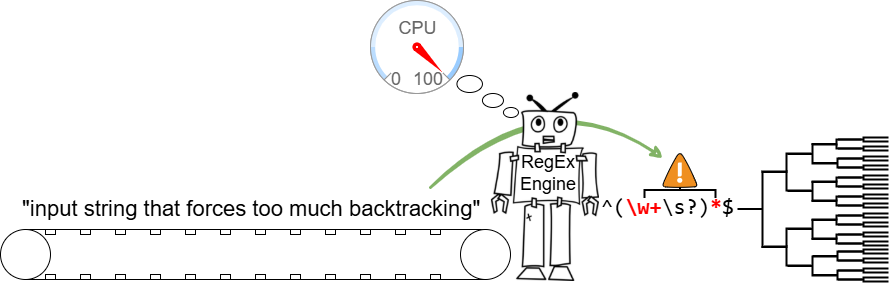
| The product uses a regular expression with a worst-case computational complexity that is inefficient and possibly exponential. |
|
Alternate Terms
| ReDoS |
ReDoS is an abbreviation of "Regular expression Denial of Service". |
| Regular Expression Denial of Service |
While this term is attack-focused, this is commonly used to describe the weakness. |
| Catastrophic backtracking |
This term is used to describe the behavior of the regular expression as a negative technical impact. |
Common Consequences
 This table specifies different individual consequences
associated with the weakness. The Scope identifies the application security area that is
violated, while the Impact describes the negative technical impact that arises if an
adversary succeeds in exploiting this weakness. The Likelihood provides information about
how likely the specific consequence is expected to be seen relative to the other
consequences in the list. For example, there may be high likelihood that a weakness will be
exploited to achieve a certain impact, but a low likelihood that it will be exploited to
achieve a different impact.
This table specifies different individual consequences
associated with the weakness. The Scope identifies the application security area that is
violated, while the Impact describes the negative technical impact that arises if an
adversary succeeds in exploiting this weakness. The Likelihood provides information about
how likely the specific consequence is expected to be seen relative to the other
consequences in the list. For example, there may be high likelihood that a weakness will be
exploited to achieve a certain impact, but a low likelihood that it will be exploited to
achieve a different impact.
| Impact | Details |
|---|---|
|
DoS: Resource Consumption (CPU) |
Scope: Availability
Likelihood: High Attackers can create crafted inputs that intentionally cause the regular expression to use excessive backtracking in a way that causes the CPU consumption to spike. |
Potential Mitigations
| Phase(s) | Mitigation |
|---|---|
|
Architecture and Design |
Use regular expressions that do not support backtracking, e.g. by removing nested quantifiers. Effectiveness: High Note: This is one of the few effective solutions when using user-provided regular expressions. |
|
System Configuration |
Set backtracking limits in the configuration of the regular expression implementation, such as PHP's pcre.backtrack_limit. Also consider limits on execution time for the process. Effectiveness: Moderate |
|
Implementation |
Do not use regular expressions with untrusted input. If regular expressions must be used, avoid using backtracking in the expression. Effectiveness: High |
|
Implementation |
Limit the length of the input that the regular expression will process. Effectiveness: Moderate |
Relationships
This table shows the weaknesses and high level categories that are related to this
weakness. These relationships are defined as ChildOf, ParentOf, MemberOf and give insight to
similar items that may exist at higher and lower levels of abstraction. In addition,
relationships such as PeerOf and CanAlsoBe are defined to show similar weaknesses that the user
may want to explore.
Relevant to the view "Research Concepts" (View-1000)
| Nature | Type | ID | Name |
|---|---|---|---|
| ChildOf |
 Class - a weakness that is described in a very abstract fashion, typically independent of any specific language or technology. More specific than a Pillar Weakness, but more general than a Base Weakness. Class level weaknesses typically describe issues in terms of 1 or 2 of the following dimensions: behavior, property, and resource.
|
407 | Inefficient Algorithmic Complexity |
Relevant to the view "Software Development" (View-699)
| Nature | Type | ID | Name |
|---|---|---|---|
| MemberOf |
 Category - a CWE entry that contains a set of other entries that share a common characteristic.
|
1226 | Complexity Issues |
Relevant to the view "Weaknesses for Simplified Mapping of Published Vulnerabilities" (View-1003)
| Nature | Type | ID | Name |
|---|---|---|---|
| ChildOf |
Class - a weakness that is described in a very abstract fashion, typically independent of any specific language or technology. More specific than a Pillar Weakness, but more general than a Base Weakness. Class level weaknesses typically describe issues in terms of 1 or 2 of the following dimensions: behavior, property, and resource.
|
407 | Inefficient Algorithmic Complexity |
Background Details
Modes
Of Introduction
The different Modes of Introduction provide information
about how and when this
weakness may be introduced. The Phase identifies a point in the life cycle at which
introduction
may occur, while the Note provides a typical scenario related to introduction during the
given
phase.
| Phase | Note |
|---|---|
| Implementation | A RegEx can be easy to create and read using unbounded matching characters, but the programmer might not consider the risk of excessive backtracking. |
| Implementation | Backtracking becomes a weakness if all of these conditions are met:
|
Applicable Platforms
This listing shows possible areas for which the given
weakness could appear. These
may be for specific named Languages, Operating Systems, Architectures, Paradigms,
Technologies,
or a class of such platforms. The platform is listed along with how frequently the given
weakness appears for that instance.
| Languages |
Class: Not Language-Specific (Undetermined Prevalence) |
Likelihood Of Exploit
High
Demonstrative Examples
Example 1
This example attempts to check if an input string is a "sentence" [REF-1164].
(bad code)
Example Language: JavaScript
var test_string = "Bad characters: $@#";
var bad_pattern = /^(\w+\s?)*$/i;
var result = test_string.search(bad_pattern);
The regular expression has a vulnerable backtracking clause inside (\w+\s?)*$ which can be triggered to cause a Denial of Service by processing particular phrases.
To fix the backtracking problem, backtracking is removed with the ?= portion of the expression which changes it to a lookahead and the \2 which prevents the backtracking. The modified example is:
(good code)
Example Language: JavaScript
var test_string = "Bad characters: $@#";
var good_pattern = /^((?=(\w+))\2\s?)*$/i;
var result = test_string.search(good_pattern);
Note that [REF-1164] has a more thorough (and lengthy) explanation of everything going on within the RegEx.
Example 2
This example attempts to check if an input string is a "sentence" and is modified for Perl [REF-1164].
(bad code)
Example Language: Perl
my $test_string = "Bad characters: \$\@\#";
my $bdrslt = $test_string;
$bdrslt =~ /^(\w+\s?)*$/i;
The regular expression has a vulnerable backtracking clause inside (\w+\s?)*$ which can be triggered to cause a Denial of Service by processing particular phrases.
To fix the backtracking problem, backtracking is removed with the ?= portion of the expression which changes it to a lookahead and the \2 which prevents the backtracking. The modified example is:
(good code)
Example Language: Perl
my $test_string = "Bad characters: \$\@\#";
my $gdrslt = $test_string;
$gdrslt =~ /^((?=(\w+))\2\s?)*$/i;
Note that [REF-1164] has a more thorough (and lengthy) explanation of everything going on within the RegEx.
Selected Observed
Examples
Note: this is a curated list of examples for users to understand the variety of ways in which this weakness can be introduced. It is not a complete list of all CVEs that are related to this CWE entry.
| Reference | Description |
|---|---|
|
server allows ReDOS with crafted User-Agent strings, due to overlapping capture groups that cause excessive backtracking. |
|
|
npm package for user-agent parser prone to ReDoS due to overlapping capture groups |
|
|
Markdown parser uses inefficient regex when processing a message, allowing users to cause CPU consumption and delay preventing processing of other messages. |
|
|
Long string in a version control product allows DoS due to an inefficient regex. |
|
|
Javascript code allows ReDoS via a long string due to excessive backtracking. |
|
|
ReDoS when parsing time. |
|
|
ReDoS when parsing documents. |
|
|
ReDoS when validating URL. |
Weakness Ordinalities
| Ordinality | Description |
|---|---|
|
Primary |
(where the weakness exists independent of other weaknesses) |
Detection
Methods
| Method | Details |
|---|---|
|
Automated Static Analysis |
Automated static analysis, commonly referred to as Static Application Security Testing (SAST), can find some instances of this weakness by analyzing source code (or binary/compiled code) without having to execute it. Typically, this is done by building a model of data flow and control flow, then searching for potentially-vulnerable patterns that connect "sources" (origins of input) with "sinks" (destinations where the data interacts with external components, a lower layer such as the OS, etc.) Effectiveness: High |
Memberships
This MemberOf Relationships table shows additional CWE Categories and Views that
reference this weakness as a member. This information is often useful in understanding where a
weakness fits within the context of external information sources.
| Nature | Type | ID | Name |
|---|---|---|---|
| MemberOf | Category - a CWE entry that contains a set of other entries that share a common characteristic. |
1416 | Comprehensive Categorization: Resource Lifecycle Management |
Vulnerability Mapping Notes
| Usage |
ALLOWED
(this CWE ID may be used to map to real-world vulnerabilities) |
| Reason | Acceptable-Use |
|
Rationale |
This CWE entry is at the Base level of abstraction, which is a preferred level of abstraction for mapping to the root causes of vulnerabilities. |
|
Comments |
Carefully read both the name and description to ensure that this mapping is an appropriate fit. Do not try to 'force' a mapping to a lower-level Base/Variant simply to comply with this preferred level of abstraction. |
References
| [REF-1180] |
Scott A. Crosby. "Regular Expression Denial of Service". 2003-08.
<https://web.archive.org/web/20031120114522/http://www.cs.rice.edu/~scrosby/hash/slides/USENIX-RegexpWIP.2.ppt>. |
| [REF-1162] |
Jan Goyvaerts. "Runaway Regular Expressions: Catastrophic Backtracking". 2019-12-22.
<https://www.regular-expressions.info/catastrophic.html>. |
| [REF-1163] |
Adar Weidman. "Regular expression Denial of Service - ReDoS".
<https://owasp.org/www-community/attacks/Regular_expression_Denial_of_Service_-_ReDoS>. |
| [REF-1164] |
Ilya Kantor. "Catastrophic backtracking". 2020-12-13.
<https://javascript.info/regexp-catastrophic-backtracking>. |
| [REF-1165] |
Cristian-Alexandru Staicu and Michael Pradel. "Freezing the Web: A Study of ReDoS Vulnerabilities in JavaScript-based Web Servers". USENIX Security Symposium. 2018-07-11.
<https://www.usenix.org/system/files/conference/usenixsecurity18/sec18-staicu.pdf>. |
| [REF-1166] |
James C. Davis, Christy A. Coghlan, Francisco Servant and Dongyoon Lee. "The Impact of Regular Expression Denial of Service (ReDoS) in Practice: An Empirical Study at the Ecosystem Scale". 2018-08-01.
<https://fservant.github.io/papers/Davis_Coghlan_Servant_Lee_ESECFSE18.pdf>. (URL validated: 2023-04-07) |
| [REF-1167] |
James Davis. "The Regular Expression Denial of Service (ReDoS) cheat-sheet". 2020-05-23.
<https://levelup.gitconnected.com/the-regular-expression-denial-of-service-redos-cheat-sheet-a78d0ed7d865>. |
Content
History
| Submissions |
||
|---|---|---|
| Submission Date | Submitter | Organization |
|
2021-01-17
(CWE 4.4, 2021-03-15) |
Anonymous External Contributor | |
 Modifications Modifications |
||
| Modification Date | Modifier | Organization |
|
2026-04-30
(CWE 4.20, 2026-04-30) |
CWE Content Team | MITRE |
| updated Background_Details, Common_Consequences, Description, Diagram, Modes_of_Introduction | ||
|
2025-12-11
(CWE 4.19, 2025-12-11) |
CWE Content Team | MITRE |
| updated Detection_Factors, Weakness_Ordinalities | ||
|
2023-06-29
(CWE 4.12, 2023-06-29) |
CWE Content Team | MITRE |
| updated Mapping_Notes | ||
|
2023-04-27
(CWE 4.11, 2023-04-27) |
CWE Content Team | MITRE |
| updated References, Relationships | ||
|
2023-01-31
(CWE 4.10, 2023-01-31) |
CWE Content Team | MITRE |
| updated Demonstrative_Examples, Observed_Examples | ||
|
2022-10-13
(CWE 4.9, 2022-10-13) |
CWE Content Team | MITRE |
| updated Observed_Examples, Relationships | ||
|
2022-04-28
(CWE 4.7, 2022-04-28) |
CWE Content Team | MITRE |
| updated Observed_Examples, Potential_Mitigations | ||
|
2021-10-28
(CWE 4.6, 2021-10-28) |
CWE Content Team | MITRE |
| updated Description | ||
|
2021-07-20
(CWE 4.5, 2021-07-20) |
CWE Content Team | MITRE |
| updated References | ||