Hi! My name is Chen Jin, and I’m a research scientist at the Centre for Artificial Intelligence (CAI) at Data Science & Artificial Intelligence, AstraZeneca (UK). My research focuses on Large Multimodal Generative Models, Vision-Language Human-Machine Interactions, Computer Vision and Natural Language Processing for Healthcare, and Predictive Models.
Previously, I was a research assistant at the Centre for Medical Image Computing (CMIC) at UCL’s AI Centre, where I worked on Multimodal-Multiscale-Multitask representation learning, image generation and mapping. I have also developed attention-based learnable sampling methods for either data efficient or computation efficient machine learning, and applied on segmentation of large volume high-resolution images.
Externally, I got the privilege to collaborate closely with Dr Ryutaro Tanno from Google DeepMind, Prof. Daniel Alexander from CMIC UCL and Prof Mihaela van der Schaar from Artificial Intelligence and Medicine at the University of Cambridge.
I obtained my PhD in Computational Geoscience at the Institute of GeoEnergy Engineering, Heriot-Watt University. My thesis was about developing a Hierarchical Digital Rock Analysis Workflow, involving machine learning-based multi scale-modal image fusion, reconstruction and fluid simulation.
News:
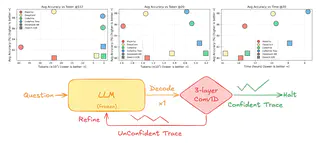
- Feb 2026: Our latest research Confidence-Guided Self-Refinement is out! We explored scalable oversight via confidence-guided reasoning; enables safe self-correction matching parallel decoding accuracy at orders-of-magnitude lower compute.
- May 2025: We have two papers accepted at ICML 2025: Diffusion Instruction Tuning and Segment Anyword: Mask Prompt Inversion for Open-Set Grounded Segmentation.
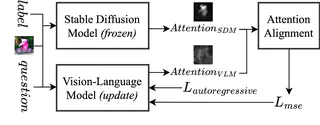
- Feb 2025: Our latest research Diffusion Instruction Tuning is out! Can Stable Diffusion’s visual expertise enhance Llama-3.2? We propose Lavender: efficiently fine-tunes advanced vision-language models by aligning their text-vision attention with Stable Diffusion.
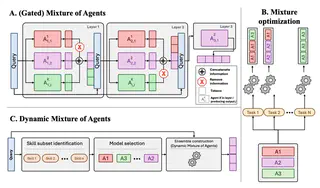
- Jan 2025: Our work Balancing Act: Diversity and Consistency in Large Language Model Ensembles is accepted by ICLR 2025. We introduce Dynamic Mixture of Agents (DMoA), a novel inference-time ensembling strategy that dynamically adapts to balance performance, diversity, and consistency, achieving state-of-the-art results.
- July 2024: Our work Local Diffusion is accepted by ECCV 2024, which explored Tackling Structural Hallucination in Image Translation.
- May 2024: Our work Multi-Concept Prompt Learning is accepted by ICML 2024, which explored language-driven concepts learning during human-machine interactions.
- Jan 2022: Our work on Learning to downsample is accepted by ICLR 2022, which aiming to adapt the computation/sampling budget to the difficulty of segmented pixel/region.
- July 2021: We are organizing the foveation project on MedICSS Summer School 2021.
- Sep 2020: a shorter version of our work on Foveation for Segmentation is accepted at MICCAI 2020, also check out full extensive version.
- Aug 2020: Our attempts on Disentangling human annotation error is accepted at NeurIPS 2020.
Featured Research
Chen Jin, Ryutaro Tanno, Tom Diethe, Philip Teare
January 2026 Preprint
Scalable oversight via confidence-guided reasoning; enables safe self-correction matching parallel decoding accuracy at orders-of-magnitude lower compute.
Chen Jin, Ryutaro Tanno, Amrutha Saseendran, Tom Diethe, Philip Teare
January 2025 ICML, 2025
Created Lavender, an SFT method aligning VLM text-vision attention with Stable Diffusion, boosting Llama-3.2-11B and MiniCPM-v2.5 by up to 30% on 20 tasks.
Zhihua Liu, Amrutha Saseendran, Lei Tong, Xilin He, Fariba Yousefi, Nikolay Burlutskiy, Dino Oglic, Tom Diethe, Philip Teare, Huiyu Zhou, Chen Jin
January 2025 ICML, 2025
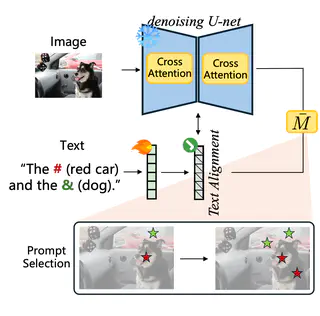
Training-free prompt learning for language-grounded segmentation using token-level cross-attention from a frozen diffusion model to generate object masks.
Abdullah Abdulaal, Chen Jin, Nina Montaña-Brown, Aryo Pradipta Gema, Daniel C Castro, Daniel C Alexander, Philip Teare, Tom Diethe, Dino Oglic, Amrutha Saseendran
November 2024 ICLR, 2025
A test-time LLM ensembling strategy that dynamically adapts to balance performance, diversity, and consistency, achieving state-of-the-art results.
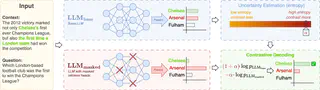
Ana-Paula Gema, Chen Jin, Abdullah Abdulaal, Tom Diethe, Philip Teare, Benjamin Alex, Pasquale Minervini, Amrutha Saseendran
October 2024 EMNLP, 2025
Training-free decoding that mitigates LLM hallucinations by contrasting a base model with a masked-retrieval variant, boosting summarisation by up to 18.6%.
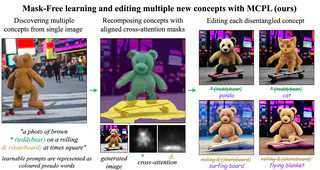
Chen Jin, Ryutaro Tanno, Amrutha Saseendran, Tom Diethe, Philip Teare
May 2024 ICML, 2024
Personalised image generation extending textual inversion for mask-free learning of multiple concepts from a single sentence–image pair (Stable Diffusion).
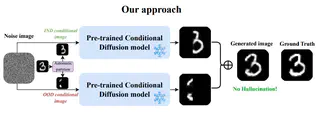
Seunghoi Kim, Chen Jin, Tom Diethe, Matteo Figini, Henry F. J. Tregidgo, Asher Mullokandov, Philip Teare, Daniel C. Alexander
April 2024 ECCV, 2024, Oral
Training-free diffusion framework that reduces hallucinations via multiple local diffusion processes, cutting hallucinations by 40% (medical) and 25% (natural).
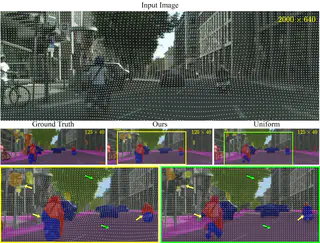
Chen Jin, Ryutaro Tanno, Thomy Mertzanidou, Eleftheria Panagiotaki, Daniel C. Alexander
January 2022 ICLR, 2022
We introduce a learned, adaptive downsampling method that prioritizes challenging regions, enabling efficient segmentation of high-res images on limited computing.
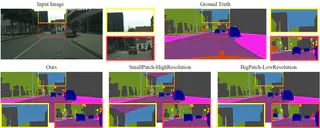
Chen Jin, Ryutaro Tanno, Moucheng Xu, Thomy Mertzanidou, Daniel C. Alexander
July 2020 arXiv, 2020
Building on our prior foveation work (MICCAI 2020), we introduce a more computationally efficient hard-gated categorical sampling method for FoV-resolution patch configurations with two differentiable solutions. We …
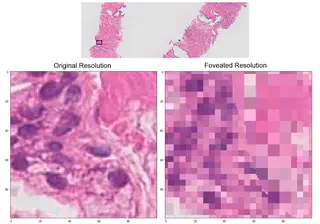
Chen Jin, Ryutaro Tanno, Moucheng Xu, Thomy Mertzanidou, Daniel C. Alexander
April 2020 MICCAI, 2020
We introduce a foveation module that dynamically adjusts patch FoV and resolution for ultra-high resolution image segmentation, achieving state-of-the-art results and significant accuracy boosts on challenging datasets.
Research Outputs
Explore the full publication list or jump to my Google Scholar profile.
*
Zhihua Liu, Amrutha Saseendran, Lei Tong, Xilin He, Fariba Yousefi, Nikolay Burlutskiy, Dino Oglic, Tom Diethe, Philip Teare, Huiyu Zhou, Chen Jin
January 2025 ICML, 2025
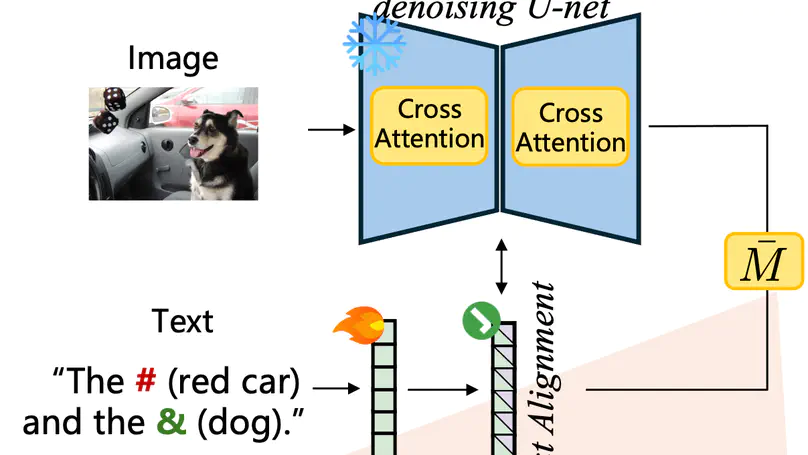
Training-free prompt learning for language-grounded segmentation using token-level cross-attention from a frozen diffusion model to generate object masks.
Abdullah Abdulaal, Chen Jin, Nina Montaña-Brown, Aryo Pradipta Gema, Daniel C Castro, Daniel C Alexander, Philip Teare, Tom Diethe, Dino Oglic, Amrutha Saseendran
November 2024 ICLR, 2025
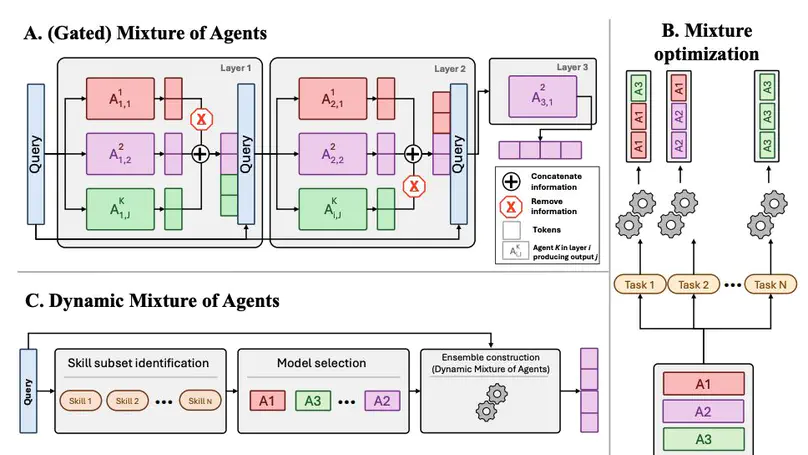
A test-time LLM ensembling strategy that dynamically adapts to balance performance, diversity, and consistency, achieving state-of-the-art results.
Seunghoi Kim, Chen Jin, Tom Diethe, Matteo Figini, Henry F. J. Tregidgo, Asher Mullokandov, Philip Teare, Daniel C. Alexander
April 2024 ECCV, 2024, Oral
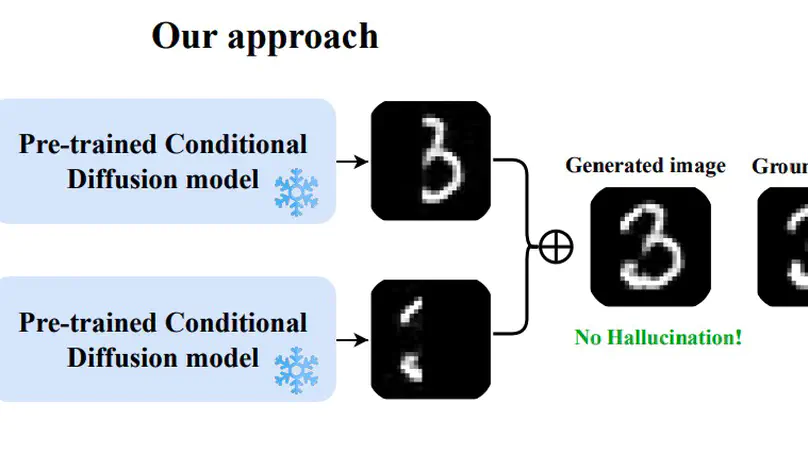
Training-free diffusion framework that reduces hallucinations via multiple local diffusion processes, cutting hallucinations by 40% (medical) and 25% (natural).
Recent Posts
Contact
- jinchen0227@gmail.com
- AstraZeneca, The Discovery Centre (DISC), Cambridge, UK
- My Google Scholar
- My Github
- My Twitter
- My Linkedin