I’ve written a few times about some explorations into triangular numbers1 and how they relate to other sequences (and other geometric objects). It was the driving curiosity that eventually led to Pell Puzzles, and I come back to the topic frequently when lying down in the dark on a sofa.2
The starting point for this whole saga is a tessellation doodle. Start with a regular shape in the middle, then add a strip containing two of those shapes, then three, winding the strips around the center and seeing when the aggregate construction makes a pleasingly convex whole. We did it with squares to make what I dubbed Pell Tiles. We did it with hexagons to make these honeycomb-ish shapes that I half-jokingly called Pellagons (and added to the OEIS!). There’s only one regular tessellator left: the blursed3 triangle.
(Big thanks as always to manim and the community around it.)
I have known the word “tetromino” from a very young age, possibly before I learned “domino”.4 It took an embarrassingly long time to realize the connection between the two, but in my defense it’s pretty uncommon to see an “-omino” in the wild outside of the games of dominoes and Tetris. There was a satisfying moment of clarity when I discovered the umbrella term polyomino5 and was able set the do- and tetro- examples in their respective places within my mind.
Many years later, when I happened upon polyiamonds, the brain blast was similar in kind and magnitude (and in the slight disappointment at the linguistic reverse engineering from diamonds). So in an effort to spread the brain blast to others, moving forward I’ll be referring to combinations of equilateral triangles as polyiamonds or polyiamond strips (since they are polyiamonds that never exceed 1-width).
When we were working in the world of hexagons and honeycomb, the definition of convex was a bit less intuitive than with squares. This is because any aggregation of hexagons is going to have jagged “edges” that make the construction not technically convex. We don’t have to find a way around this artifact with polyiamonds because the convex sets also represent geometrically convex shapes.
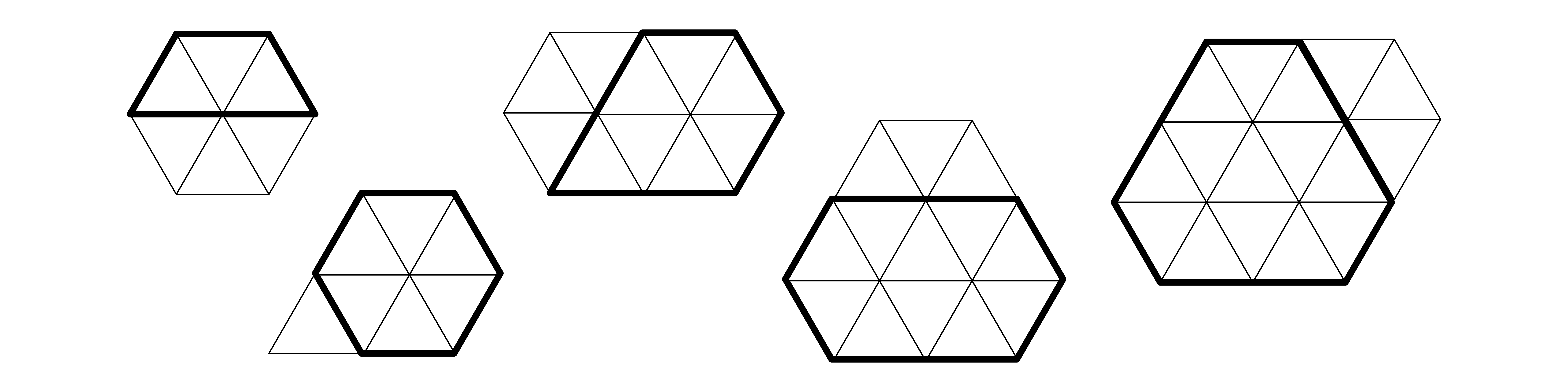
How does this sequence of minimally incrementing bounding polyiamonds grow?6 I researched this the same way I researched a lot of previous versions of this problem: sketching the doodle out by hand and then entering the first dozen or so terms into The On-Line Encyclopedia of Integer Sequences. This time, I was confident I had found the right sequence because 1) It was the only sequence in the encyclopedia that matched the starting terms I entered and 2) its name was “Maximum number of triangles in polyiamond with perimeter n“.
My favorite feature of studying and exploring mathematics is coming across apparent coincidences. I don’t mean this in a serendipitous or “what are the chances” way, but more literally. Co-incidence. These two things are connected exactly here in exactly this way, and they must be for anything to work. A lot of academic math (which is largely outside of my comprehension) deals with connecting concepts on different branches of the mathematical tree.
The other dimension of coincidence that I love is the connection to other people through time and space. Mathematical concepts bridge language and millennia like nothing else I know of. Maybe you’re studying geometry and there’s a proof that references Euclid’s Elements (300 BC), or maybe you’re digging around the comments in an integer library and you see the same name pop up a few times.7 I can’t help but feel a little fraternity to the other people in the world who might have filled notebooks or paced wordlessly while they turned the same problem over in their head.
That is a long-winded segue into finding the coincident sequence of these two sequences, their intersection. Both of our parent sequences are well-enough known and defined to have generating functions, which means we can set up a fairly simple script to march through each one and checking for equality along the way. What begins as a few doodle-able examples explodes very quickly.
\( 1, 3, 6, 10, 66, 253, 703, 1176, 2016, 12880, 49141, 136503, 228150, 391170, ...\)
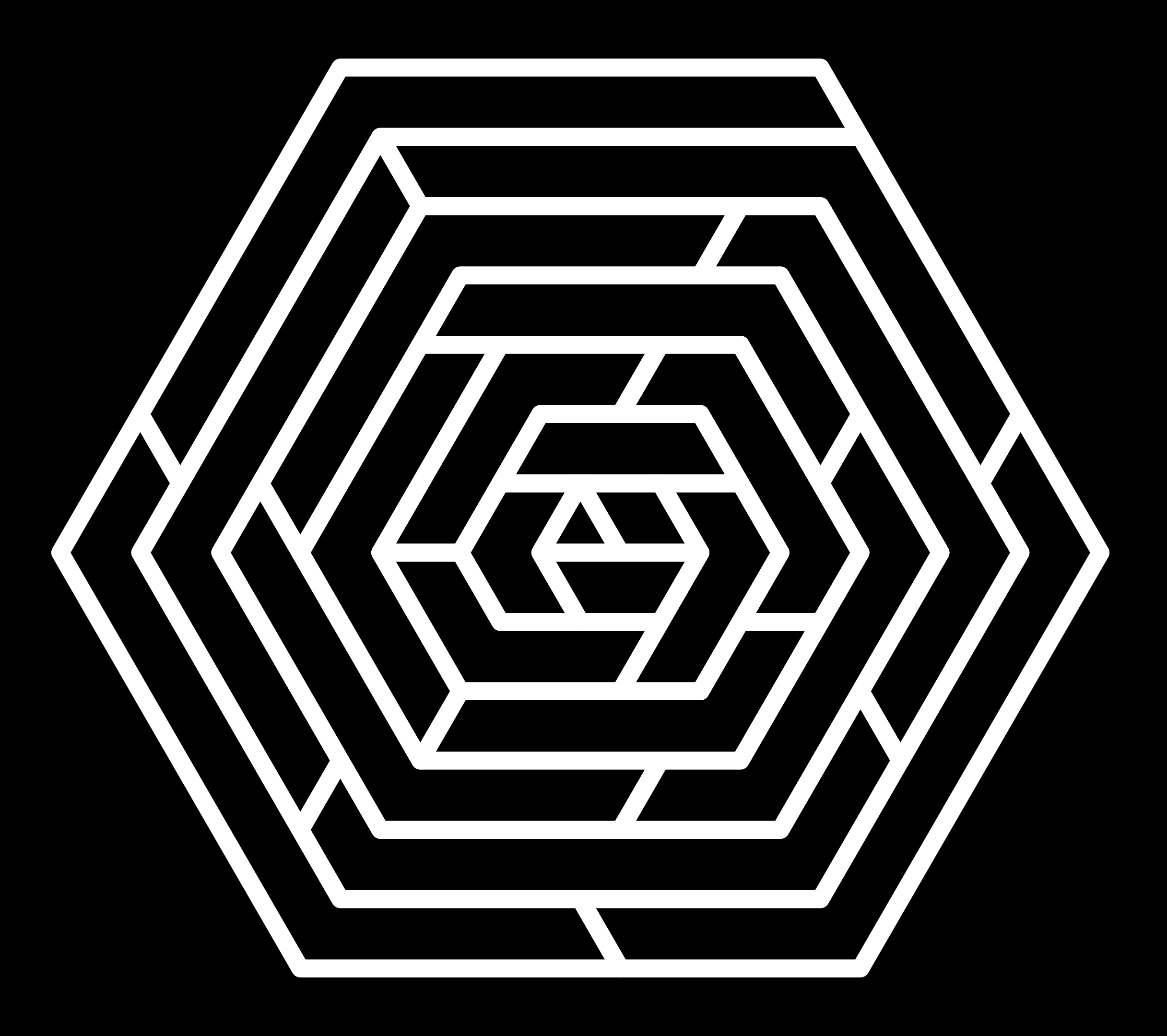
So begins the second notch on my belt of novel sequences. I got as far as 66 on paper before giving up, thankfully, because I doubt I would have had the diligence and patience to accurately sketch out this pseudo-hexagon at 253. Those solutions and more now live at A395193.
Something I wish I had more time to do. I’m referring to a quote from French Fields medalist Alain Connes: “Mathematicians usually have a hard time explaining to their partner that the times when they work with the most intensity are when they are lying down in the dark on a sofa.“
Blessed because it is so simple, minimal, strong. Cursed because its tesselation requires reflection/rotation and each element has 3 kinds of neighbors. It should really just form up into the superior hexagonal tesselation if we’re being honest.
Thanks for teaching me Tetris, mom.
Etymologically, domino came first. The “do-” was retconned into a prefix that conveniently aligned with other 2-based prefixes, and the “-omino” was retconned into a suffix.
Notice that these convex boundaries are not growing minimally. There are times when fewer triangles could be added while retaining convexity, but this would not be a shape achievable with our construction. Our strip-winding results in rounder/denser aggregates. See the next footnote for what this means in more formal terms.
In this case, it’s Winston Yang of the University of Wisconsin. He wrote his Computer Science PhD thesis “Maximal and minimal polyhexes” in 2002. I did not find it until after I finished Pellagons, but I unknowingly incorporated his work by exploring the A001399 sequence (he added an ASCII visual on that page that is its own work of art). He later applied this framework to polyiamonds in “Maximal and minimal polyiamonds”, which greatly supports the A069813 sequence.