Weakness ID: 614
Vulnerability Mapping: ALLOWED This CWE ID may be used to map to real-world vulnerabilitiesAbstraction: Variant Variant - a weakness that is linked to a certain type of product, typically involving a specific language or technology. More specific than a Base weakness. Variant level weaknesses typically describe issues in terms of 3 to 5 of the following dimensions: behavior, property, technology, language, and resource.
 Description
| The Secure attribute for sensitive cookies in HTTPS sessions is not set. |
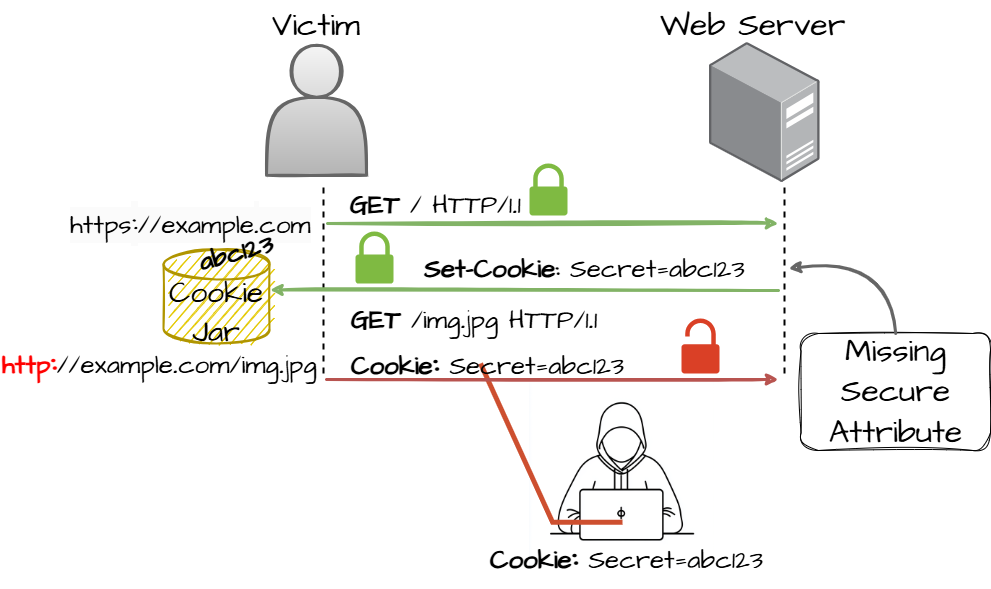
|
Common Consequences
 This table specifies different individual consequences
associated with the weakness. The Scope identifies the application security area that is
violated, while the Impact describes the negative technical impact that arises if an
adversary succeeds in exploiting this weakness. The Likelihood provides information about
how likely the specific consequence is expected to be seen relative to the other
consequences in the list. For example, there may be high likelihood that a weakness will be
exploited to achieve a certain impact, but a low likelihood that it will be exploited to
achieve a different impact.
This table specifies different individual consequences
associated with the weakness. The Scope identifies the application security area that is
violated, while the Impact describes the negative technical impact that arises if an
adversary succeeds in exploiting this weakness. The Likelihood provides information about
how likely the specific consequence is expected to be seen relative to the other
consequences in the list. For example, there may be high likelihood that a weakness will be
exploited to achieve a certain impact, but a low likelihood that it will be exploited to
achieve a different impact.
| Impact | Details |
|---|---|
|
Read Application Data |
Scope: Confidentiality
Omitting the secure flag makes it possible for the user agent to send the cookies in plaintext over an HTTP session. |
Potential Mitigations
| Phase(s) | Mitigation |
|---|---|
|
Implementation |
Always set the secure attribute when the cookie should be sent via HTTPS only. |
Relationships
This table shows the weaknesses and high level categories that are related to this
weakness. These relationships are defined as ChildOf, ParentOf, MemberOf and give insight to
similar items that may exist at higher and lower levels of abstraction. In addition,
relationships such as PeerOf and CanAlsoBe are defined to show similar weaknesses that the user
may want to explore.
Relevant to the view "Research Concepts" (View-1000)
| Nature | Type | ID | Name |
|---|---|---|---|
| ChildOf |
 Base - a weakness that is still mostly independent of a resource or technology, but with sufficient details to provide specific methods for detection and prevention. Base level weaknesses typically describe issues in terms of 2 or 3 of the following dimensions: behavior, property, technology, language, and resource.
|
319 | Cleartext Transmission of Sensitive Information |
Modes
Of Introduction
The different Modes of Introduction provide information
about how and when this
weakness may be introduced. The Phase identifies a point in the life cycle at which
introduction
may occur, while the Note provides a typical scenario related to introduction during the
given
phase.
| Phase | Note |
|---|---|
| Implementation |
Applicable Platforms
This listing shows possible areas for which the given
weakness could appear. These
may be for specific named Languages, Operating Systems, Architectures, Paradigms,
Technologies,
or a class of such platforms. The platform is listed along with how frequently the given
weakness appears for that instance.
| Technologies |
Class: Web Based (Undetermined Prevalence) |
Demonstrative Examples
Example 1
The snippet of code below, taken from a servlet doPost() method, sets an accountID cookie (sensitive) without calling setSecure(true).
(bad code)
Example Language: Java
Cookie c = new Cookie(ACCOUNT_ID, acctID);
response.addCookie(c);
Selected Observed
Examples
Note: this is a curated list of examples for users to understand the variety of ways in which this weakness can be introduced. It is not a complete list of all CVEs that are related to this CWE entry.
| Reference | Description |
|---|---|
|
python library for ML and data science does not use the Secure flag for session cookies |
|
|
A product does not set the Secure attribute for sensitive cookies in HTTPS sessions, which could cause the user agent to send those cookies in plaintext over an HTTP session with the product. |
|
|
A product does not set the secure flag for the session cookie in an https session, which can cause the cookie to be sent in http requests and make it easier for remote attackers to capture this cookie. |
|
|
A product does not set the secure flag for the session cookie in an https session, which can cause the cookie to be sent in http requests and make it easier for remote attackers to capture this cookie. |
|
|
A product does not set the secure flag for a cookie in an https session, which can cause the cookie to be sent in http requests and make it easier for remote attackers to capture this cookie. |
Weakness Ordinalities
| Ordinality | Description |
|---|---|
|
Primary |
(where the weakness exists independent of other weaknesses) |
Detection
Methods
| Method | Details |
|---|---|
|
Automated Static Analysis |
Automated static analysis, commonly referred to as Static Application Security Testing (SAST), can find some instances of this weakness by analyzing source code (or binary/compiled code) without having to execute it. Typically, this is done by building a model of data flow and control flow, then searching for potentially-vulnerable patterns that connect "sources" (origins of input) with "sinks" (destinations where the data interacts with external components, a lower layer such as the OS, etc.) Effectiveness: High |
Memberships
This MemberOf Relationships table shows additional CWE Categories and Views that
reference this weakness as a member. This information is often useful in understanding where a
weakness fits within the context of external information sources.
| Nature | Type | ID | Name |
|---|---|---|---|
| MemberOf |  Category - a CWE entry that contains a set of other entries that share a common characteristic. Category - a CWE entry that contains a set of other entries that share a common characteristic. |
966 | SFP Secondary Cluster: Other Exposures |
| MemberOf | Category - a CWE entry that contains a set of other entries that share a common characteristic. |
1349 | OWASP Top Ten 2021 Category A05:2021 - Security Misconfiguration |
| MemberOf | Category - a CWE entry that contains a set of other entries that share a common characteristic. |
1402 | Comprehensive Categorization: Encryption |
| MemberOf | Category - a CWE entry that contains a set of other entries that share a common characteristic. |
1437 | OWASP Top Ten 2025 Category A02:2025 - Security Misconfiguration |
Vulnerability Mapping Notes
| Usage |
ALLOWED
(this CWE ID may be used to map to real-world vulnerabilities) |
| Reason | Acceptable-Use |
|
Rationale |
This CWE entry is at the Variant level of abstraction, which is a preferred level of abstraction for mapping to the root causes of vulnerabilities. |
|
Comments |
Carefully read both the name and description to ensure that this mapping is an appropriate fit. Do not try to 'force' a mapping to a lower-level Base/Variant simply to comply with this preferred level of abstraction. |
Content
History
| Submissions |
|||
|---|---|---|---|
| Submission Date | Submitter | Organization | |
|
2007-05-07
(CWE Draft 6, 2007-05-07) |
Anonymous Tool Vendor (under NDA) | ||
 Modifications Modifications |
|||
| Modification Date | Modifier | Organization | |
|
2025-12-11
(CWE 4.19, 2025-12-11) |
CWE Content Team | MITRE | |
| updated Observed_Examples, Relationships, Weakness_Ordinalities | |||
|
2025-09-09
(CWE 4.18, 2025-09-09) |
CWE Content Team | MITRE | |
| updated Common_Consequences, Description, Diagram, Potential_Mitigations | |||
|
2023-06-29
(CWE 4.12, 2023-06-29) |
CWE Content Team | MITRE | |
| updated Mapping_Notes | |||
|
2023-04-27
(CWE 4.11, 2023-04-27) |
CWE Content Team | MITRE | |
| updated Detection_Factors, Relationships | |||
|
2022-06-28
(CWE 4.8, 2022-06-28) |
CWE Content Team | MITRE | |
| updated Relationships | |||
|
2021-10-28
(CWE 4.6, 2021-10-28) |
CWE Content Team | MITRE | |
| updated Relationships | |||
|
2020-02-24
(CWE 4.0, 2020-02-24) |
CWE Content Team | MITRE | |
| updated Applicable_Platforms, Relationships | |||
|
2017-11-08
(CWE 3.0, 2017-11-08) |
CWE Content Team | MITRE | |
| updated Taxonomy_Mappings | |||
|
2017-01-19
(CWE 2.10, 2017-01-19) |
CWE Content Team | MITRE | |
| updated Relationships | |||
|
2014-07-30
(CWE 2.8, 2014-07-31) |
CWE Content Team | MITRE | |
| updated Relationships | |||
|
2012-10-30
(CWE 2.3, 2012-10-30) |
CWE Content Team | MITRE | |
| updated Potential_Mitigations | |||
|
2012-05-11
(CWE 2.2, 2012-05-15) |
CWE Content Team | MITRE | |
| updated Relationships | |||
|
2011-06-01
(CWE 1.13, 2011-06-01) |
CWE Content Team | MITRE | |
| updated Common_Consequences | |||
|
2009-05-27
(CWE 1.4, 2009-05-27) |
CWE Content Team | MITRE | |
| updated Related_Attack_Patterns | |||
|
2009-03-10
(CWE 1.3, 2009-03-10) |
CWE Content Team | MITRE | |
| updated Name | |||
|
2008-10-14
(CWE 1.0.1, 2008-10-14) |
CWE Content Team | MITRE | |
| updated Observed_Examples | |||
|
2008-09-08
(CWE 1.0, 2008-09-09) |
CWE Content Team | MITRE | |
| updated Relationships, Taxonomy_Mappings | |||
|
2008-07-01
(CWE 1.0, 2008-09-09) |
Sean Eidemiller | Cigital | |
| added/updated demonstrative examples | |||
|
2008-07-01
(CWE 1.0, 2008-09-09) |
Eric Dalci | Cigital | |
| updated Potential_Mitigations, Time_of_Introduction | |||
| Previous Entry Names |
|||
| Change Date | Previous Entry Name | ||
| 2008-04-11 | Unset Secure Attribute for Sensitive Cookies in HTTPS Session | ||