Weakness ID: 311
Vulnerability Mapping: DISCOURAGED This CWE ID should not be used to map to real-world vulnerabilitiesAbstraction: Class Class - a weakness that is described in a very abstract fashion, typically independent of any specific language or technology. More specific than a Pillar Weakness, but more general than a Base Weakness. Class level weaknesses typically describe issues in terms of 1 or 2 of the following dimensions: behavior, property, and resource.
 Description
| The product does not encrypt sensitive or critical information before storage or transmission. |
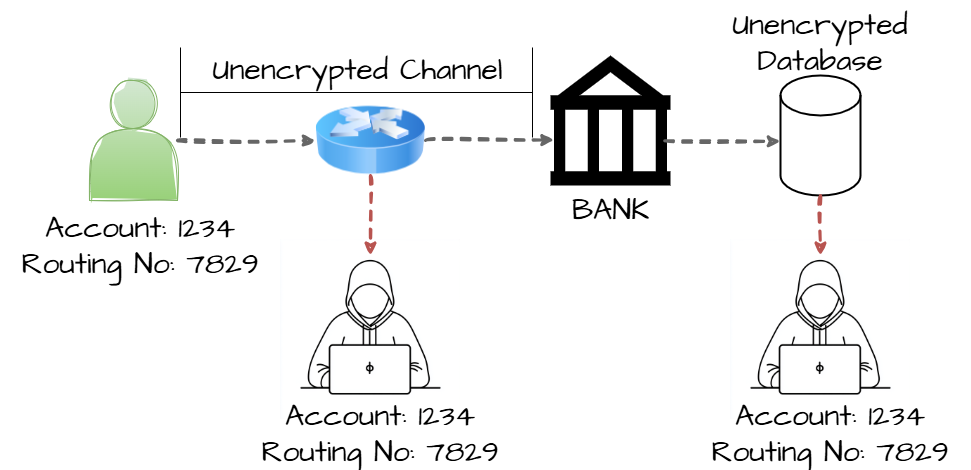
|
Common Consequences
 This table specifies different individual consequences
associated with the weakness. The Scope identifies the application security area that is
violated, while the Impact describes the negative technical impact that arises if an
adversary succeeds in exploiting this weakness. The Likelihood provides information about
how likely the specific consequence is expected to be seen relative to the other
consequences in the list. For example, there may be high likelihood that a weakness will be
exploited to achieve a certain impact, but a low likelihood that it will be exploited to
achieve a different impact.
This table specifies different individual consequences
associated with the weakness. The Scope identifies the application security area that is
violated, while the Impact describes the negative technical impact that arises if an
adversary succeeds in exploiting this weakness. The Likelihood provides information about
how likely the specific consequence is expected to be seen relative to the other
consequences in the list. For example, there may be high likelihood that a weakness will be
exploited to achieve a certain impact, but a low likelihood that it will be exploited to
achieve a different impact.
| Impact | Details |
|---|---|
|
Read Application Data |
Scope: Confidentiality
If the application does not use a secure channel, such as SSL, to exchange sensitive information, it is possible for an attacker with access to the network traffic to sniff packets from the connection and uncover the data. This attack is not technically difficult, but does require physical access to some portion of the network over which the sensitive data travels. This access is usually somewhere near where the user is connected to the network (such as a colleague on the company network) but can be anywhere along the path from the user to the end server. |
|
Modify Application Data |
Scope: Confidentiality, Integrity
Omitting the use of encryption in any program which transfers data over a network of any kind should be considered on par with delivering the data sent to each user on the local networks of both the sender and receiver. Worse, this omission allows for the injection of data into a stream of communication between two parties -- with no means for the victims to separate valid data from invalid. In this day of widespread network attacks and password collection sniffers, it is an unnecessary risk to omit encryption from the design of any system which might benefit from it. |
Potential Mitigations
| Phase(s) | Mitigation |
|---|---|
|
Requirements |
Clearly specify which data or resources are valuable enough that they should be protected by encryption. Require that any transmission or storage of this data/resource should use well-vetted encryption algorithms. |
|
Architecture and Design |
Ensure that encryption is properly integrated into the system design, including but not necessarily limited to:
Identify the separate needs and contexts for encryption:
Using threat modeling or other techniques, assume that data can be compromised through a separate vulnerability or weakness, and determine where encryption will be most effective. Ensure that data that should be private is not being inadvertently exposed using weaknesses such as insecure permissions (CWE-732). [REF-7] |
|
Architecture and Design |
Strategy: Libraries or Frameworks When there is a need to store or transmit sensitive data, use strong, up-to-date cryptographic algorithms to encrypt that data. Select a well-vetted algorithm that is currently considered to be strong by experts in the field, and use well-tested implementations. As with all cryptographic mechanisms, the source code should be available for analysis. For example, US government systems require FIPS 140-2 certification. Do not develop custom or private cryptographic algorithms. They will likely be exposed to attacks that are well-understood by cryptographers. Reverse engineering techniques are mature. If the algorithm can be compromised if attackers find out how it works, then it is especially weak. Periodically ensure that the cryptography has not become obsolete. Some older algorithms, once thought to require a billion years of computing time, can now be broken in days or hours. This includes MD4, MD5, SHA1, DES, and other algorithms that were once regarded as strong. [REF-267] |
|
Architecture and Design |
Strategy: Separation of Privilege Compartmentalize the system to have "safe" areas where trust boundaries can be unambiguously drawn. Do not allow sensitive data to go outside of the trust boundary and always be careful when interfacing with a compartment outside of the safe area. Ensure that appropriate compartmentalization is built into the system design, and the compartmentalization allows for and reinforces privilege separation functionality. Architects and designers should rely on the principle of least privilege to decide the appropriate time to use privileges and the time to drop privileges. |
|
Implementation; Architecture and Design |
When using industry-approved techniques, use them correctly. Don't cut corners by skipping resource-intensive steps (CWE-325). These steps are often essential for preventing common attacks. |
|
Implementation |
Strategy: Attack Surface Reduction Use naming conventions and strong types to make it easier to spot when sensitive data is being used. When creating structures, objects, or other complex entities, separate the sensitive and non-sensitive data as much as possible. Effectiveness: Defense in Depth Note: This makes it easier to spot places in the code where data is being used that is unencrypted. |
Relationships
This table shows the weaknesses and high level categories that are related to this
weakness. These relationships are defined as ChildOf, ParentOf, MemberOf and give insight to
similar items that may exist at higher and lower levels of abstraction. In addition,
relationships such as PeerOf and CanAlsoBe are defined to show similar weaknesses that the user
may want to explore.
Relevant to the view "Research Concepts" (View-1000)
| Nature | Type | ID | Name |
|---|---|---|---|
| ChildOf |
 Pillar - a weakness that is the most abstract type of weakness and represents a theme for all class/base/variant weaknesses related to it. A Pillar is different from a Category as a Pillar is still technically a type of weakness that describes a mistake, while a Category represents a common characteristic used to group related things.
|
693 | Protection Mechanism Failure |
| ParentOf |
 Base - a weakness that is still mostly independent of a resource or technology, but with sufficient details to provide specific methods for detection and prevention. Base level weaknesses typically describe issues in terms of 2 or 3 of the following dimensions: behavior, property, technology, language, and resource.
|
312 | Cleartext Storage of Sensitive Information |
| ParentOf |
Base - a weakness that is still mostly independent of a resource or technology, but with sufficient details to provide specific methods for detection and prevention. Base level weaknesses typically describe issues in terms of 2 or 3 of the following dimensions: behavior, property, technology, language, and resource.
|
319 | Cleartext Transmission of Sensitive Information |
| PeerOf |
 Class - a weakness that is described in a very abstract fashion, typically independent of any specific language or technology. More specific than a Pillar Weakness, but more general than a Base Weakness. Class level weaknesses typically describe issues in terms of 1 or 2 of the following dimensions: behavior, property, and resource.
|
327 | Use of a Broken or Risky Cryptographic Algorithm |
Relevant to the view "Weaknesses for Simplified Mapping of Published Vulnerabilities" (View-1003)
| Nature | Type | ID | Name |
|---|---|---|---|
| MemberOf |
 View - a subset of CWE entries that provides a way of examining CWE content. The two main view structures are Slices (flat lists) and Graphs (containing relationships between entries).
|
1003 | Weaknesses for Simplified Mapping of Published Vulnerabilities |
| ParentOf |
Base - a weakness that is still mostly independent of a resource or technology, but with sufficient details to provide specific methods for detection and prevention. Base level weaknesses typically describe issues in terms of 2 or 3 of the following dimensions: behavior, property, technology, language, and resource.
|
312 | Cleartext Storage of Sensitive Information |
| ParentOf |
Base - a weakness that is still mostly independent of a resource or technology, but with sufficient details to provide specific methods for detection and prevention. Base level weaknesses typically describe issues in terms of 2 or 3 of the following dimensions: behavior, property, technology, language, and resource.
|
319 | Cleartext Transmission of Sensitive Information |
Relevant to the view "Architectural Concepts" (View-1008)
| Nature | Type | ID | Name |
|---|---|---|---|
| MemberOf |
 Category - a CWE entry that contains a set of other entries that share a common characteristic.
|
1013 | Encrypt Data |
Modes
Of Introduction
The different Modes of Introduction provide information
about how and when this
weakness may be introduced. The Phase identifies a point in the life cycle at which
introduction
may occur, while the Note provides a typical scenario related to introduction during the
given
phase.
| Phase | Note |
|---|---|
| Architecture and Design | OMISSION: This weakness is caused by missing a security tactic during the architecture and design phase. |
| Operation |
Applicable Platforms
This listing shows possible areas for which the given
weakness could appear. These
may be for specific named Languages, Operating Systems, Architectures, Paradigms,
Technologies,
or a class of such platforms. The platform is listed along with how frequently the given
weakness appears for that instance.
| Languages |
Class: Not Language-Specific (Undetermined Prevalence) |
Likelihood Of Exploit
High
Demonstrative Examples
Example 1
This code writes a user's login information to a cookie so the user does not have to login again later.
(bad code)
Example Language: PHP
function persistLogin($username, $password){
$data = array("username" => $username, "password"=> $password);
setcookie ("userdata", $data);
}
The code stores the user's username and password in plaintext in a cookie on the user's machine. This exposes the user's login information if their computer is compromised by an attacker. Even if the user's machine is not compromised, this weakness combined with cross-site scripting (CWE-79) could allow an attacker to remotely copy the cookie.
Also note this example code also exhibits Plaintext Storage in a Cookie (CWE-315).
Example 2
The following code attempts to establish a connection, read in a password, then store it to a buffer.
(bad code)
Example Language: C
server.sin_family = AF_INET; hp = gethostbyname(argv[1]);
if (hp==NULL) error("Unknown host");
memcpy( (char *)&server.sin_addr,(char *)hp->h_addr,hp->h_length);
if (argc < 3) port = 80;
else port = (unsigned short)atoi(argv[3]);
server.sin_port = htons(port);
if (connect(sock, (struct sockaddr *)&server, sizeof server) < 0) error("Connecting");
...
while ((n=read(sock,buffer,BUFSIZE-1))!=-1) {
write(dfd,password_buffer,n);
...
While successful, the program does not encrypt the data before writing it to a buffer, possibly exposing it to unauthorized actors.
Example 3
The following code attempts to establish a connection to a site to communicate sensitive information.
(bad code)
Example Language: Java
try {
URL u = new URL("http://www.secret.example.org/");
HttpURLConnection hu = (HttpURLConnection) u.openConnection();
hu.setRequestMethod("PUT");
hu.connect();
OutputStream os = hu.getOutputStream();
hu.disconnect();
}
catch (IOException e) {
//...
}
Though a connection is successfully made, the connection is unencrypted and it is possible that all sensitive data sent to or received from the server will be read by unintended actors.
Selected Observed
Examples
Note: this is a curated list of examples for users to understand the variety of ways in which this weakness can be introduced. It is not a complete list of all CVEs that are related to this CWE entry.
| Reference | Description |
|---|---|
|
wireless battery product stores credentials and Personal Health Information (PHI) without encryption |
|
|
password and username stored in cleartext in a cookie |
|
|
password stored in cleartext in a file with insecure permissions |
|
|
chat program disables SSL in some circumstances even when the user says to use SSL. |
|
|
Chain: product uses an incorrect public exponent when generating an RSA key, which effectively disables the encryption |
|
|
storage of unencrypted passwords in a database |
|
|
storage of unencrypted passwords in a database |
|
|
product stores a password in cleartext in memory |
|
|
storage of a secret key in cleartext in a temporary file |
|
|
SCADA product uses HTTP Basic Authentication, which is not encrypted |
|
|
login credentials stored unencrypted in a registry key |
|
|
Passwords transmitted in cleartext. |
|
|
Chain: Use of HTTPS cookie without "secure" flag causes it to be transmitted across unencrypted HTTP. |
|
|
Product sends password hash in cleartext in violation of intended policy. |
|
|
Remote management feature sends sensitive information including passwords in cleartext. |
|
|
Backup routine sends password in cleartext in email. |
|
|
Product transmits Blowfish encryption key in cleartext. |
|
|
Printer sends configuration information, including administrative password, in cleartext. |
|
|
Chain: cleartext transmission of the MD5 hash of password enables attacks against a server that is susceptible to replay (CWE-294). |
|
|
Product sends passwords in cleartext to a log server. |
|
|
Product sends file with cleartext passwords in e-mail message intended for diagnostic purposes. |
Weakness Ordinalities
| Ordinality | Description |
|---|---|
|
Primary |
(where the weakness exists independent of other weaknesses) |
Detection
Methods
| Method | Details |
|---|---|
|
Manual Analysis |
The characterizaton of sensitive data often requires domain-specific understanding, so manual methods are useful. However, manual efforts might not achieve desired code coverage within limited time constraints. Black box methods may produce artifacts (e.g. stored data or unencrypted network transfer) that require manual evaluation. Effectiveness: High |
|
Automated Analysis |
Automated measurement of the entropy of an input/output source may indicate the use or lack of encryption, but human analysis is still required to distinguish intentionally-unencrypted data (e.g. metadata) from sensitive data. |
|
Manual Static Analysis - Binary or Bytecode |
According to SOAR [REF-1479], the following detection techniques may be useful: Cost effective for partial coverage:
Effectiveness: SOAR Partial |
|
Dynamic Analysis with Automated Results Interpretation |
According to SOAR [REF-1479], the following detection techniques may be useful: Cost effective for partial coverage:
Effectiveness: SOAR Partial |
|
Dynamic Analysis with Manual Results Interpretation |
According to SOAR [REF-1479], the following detection techniques may be useful: Highly cost effective:
Cost effective for partial coverage:
Effectiveness: High |
|
Manual Static Analysis - Source Code |
According to SOAR [REF-1479], the following detection techniques may be useful: Highly cost effective:
Effectiveness: High |
|
Automated Static Analysis - Source Code |
According to SOAR [REF-1479], the following detection techniques may be useful: Cost effective for partial coverage:
Effectiveness: SOAR Partial |
|
Architecture or Design Review |
According to SOAR [REF-1479], the following detection techniques may be useful: Highly cost effective:
Cost effective for partial coverage:
Effectiveness: High |
Memberships
This MemberOf Relationships table shows additional CWE Categories and Views that
reference this weakness as a member. This information is often useful in understanding where a
weakness fits within the context of external information sources.
| Nature | Type | ID | Name |
|---|---|---|---|
| MemberOf | Category - a CWE entry that contains a set of other entries that share a common characteristic. |
719 | OWASP Top Ten 2007 Category A8 - Insecure Cryptographic Storage |
| MemberOf | Category - a CWE entry that contains a set of other entries that share a common characteristic. |
720 | OWASP Top Ten 2007 Category A9 - Insecure Communications |
| MemberOf | Category - a CWE entry that contains a set of other entries that share a common characteristic. |
729 | OWASP Top Ten 2004 Category A8 - Insecure Storage |
| MemberOf | Category - a CWE entry that contains a set of other entries that share a common characteristic. |
803 | 2010 Top 25 - Porous Defenses |
| MemberOf | Category - a CWE entry that contains a set of other entries that share a common characteristic. |
816 | OWASP Top Ten 2010 Category A7 - Insecure Cryptographic Storage |
| MemberOf | Category - a CWE entry that contains a set of other entries that share a common characteristic. |
818 | OWASP Top Ten 2010 Category A9 - Insufficient Transport Layer Protection |
| MemberOf | Category - a CWE entry that contains a set of other entries that share a common characteristic. |
861 | The CERT Oracle Secure Coding Standard for Java (2011) Chapter 18 - Miscellaneous (MSC) |
| MemberOf | Category - a CWE entry that contains a set of other entries that share a common characteristic. |
866 | 2011 Top 25 - Porous Defenses |
| MemberOf | Category - a CWE entry that contains a set of other entries that share a common characteristic. |
930 | OWASP Top Ten 2013 Category A2 - Broken Authentication and Session Management |
| MemberOf | Category - a CWE entry that contains a set of other entries that share a common characteristic. |
934 | OWASP Top Ten 2013 Category A6 - Sensitive Data Exposure |
| MemberOf | Category - a CWE entry that contains a set of other entries that share a common characteristic. |
963 | SFP Secondary Cluster: Exposed Data |
| MemberOf | Category - a CWE entry that contains a set of other entries that share a common characteristic. |
1029 | OWASP Top Ten 2017 Category A3 - Sensitive Data Exposure |
| MemberOf | Category - a CWE entry that contains a set of other entries that share a common characteristic. |
1152 | SEI CERT Oracle Secure Coding Standard for Java - Guidelines 49. Miscellaneous (MSC) |
| MemberOf | View - a subset of CWE entries that provides a way of examining CWE content. The two main view structures are Slices (flat lists) and Graphs (containing relationships between entries). |
1340 | CISQ Data Protection Measures |
| MemberOf | Category - a CWE entry that contains a set of other entries that share a common characteristic. |
1348 | OWASP Top Ten 2021 Category A04:2021 - Insecure Design |
| MemberOf | Category - a CWE entry that contains a set of other entries that share a common characteristic. |
1366 | ICS Communications: Frail Security in Protocols |
| MemberOf | Category - a CWE entry that contains a set of other entries that share a common characteristic. |
1402 | Comprehensive Categorization: Encryption |
| MemberOf | Category - a CWE entry that contains a set of other entries that share a common characteristic. |
1441 | OWASP Top Ten 2025 Category A06:2025 - Insecure Design |
Vulnerability Mapping Notes
| Usage |
DISCOURAGED
(this CWE ID should not be used to map to real-world vulnerabilities) |
| Reason | Abstraction |
|
Rationale |
CWE-311 is high-level with more specific children available. It is a level-1 Class (i.e., a child of a Pillar). |
|
Comments |
Consider children or descendants. |
|
Suggestions |
Notes
Relationship
There is an overlapping relationship between insecure storage of sensitive information (CWE-922) and missing encryption of sensitive information (CWE-311). Encryption is often used to prevent an attacker from reading the sensitive data. However, encryption does not prevent the attacker from erasing or overwriting the data.
Taxonomy
Mappings
| Mapped Taxonomy Name | Node ID | Fit | Mapped Node Name |
|---|---|---|---|
| CLASP | Failure to encrypt data | ||
| OWASP Top Ten 2007 | A8 | CWE More Specific | Insecure Cryptographic Storage |
| OWASP Top Ten 2007 | A9 | CWE More Specific | Insecure Communications |
| OWASP Top Ten 2004 | A8 | CWE More Specific | Insecure Storage |
| WASC | 4 | Insufficient Transport Layer Protection | |
| The CERT Oracle Secure Coding Standard for Java (2011) | MSC00-J | Use SSLSocket rather than Socket for secure data exchange | |
| Software Fault Patterns | SFP23 | Exposed Data | |
| ISA/IEC 62443 | Part 3-3 | Req SR 4.1 | |
| ISA/IEC 62443 | Part 3-3 | Req SR 4.3 | |
| ISA/IEC 62443 | Part 4-2 | Req CR 4.1 | |
| ISA/IEC 62443 | Part 4-2 | Req CR 7.3 | |
| ISA/IEC 62443 | Part 4-2 | Req CR 1.5 |
References
| [REF-18] |
Secure Software, Inc.. "The CLASP Application Security Process". 2005.
<https://cwe.mitre.org/documents/sources/TheCLASPApplicationSecurityProcess.pdf>. (URL validated: 2024-11-17) |
| [REF-7] |
Michael Howard and David LeBlanc. "Writing Secure Code". Chapter 9, "Protecting Secret Data" Page 299. 2nd Edition. Microsoft Press. 2002-12-04.
<https://www.microsoftpressstore.com/store/writing-secure-code-9780735617223>. |
| [REF-44] | Michael Howard, David LeBlanc and John Viega. "24 Deadly Sins of Software Security". "Sin 17: Failure to Protect Stored Data." Page 253. McGraw-Hill. 2010. |
| [REF-265] |
Frank Kim. "Top 25 Series - Rank 10 - Missing Encryption of Sensitive Data". SANS Software Security Institute. 2010-02-26.
<https://www.sans.org/blog/top-25-series-rank-10-missing-encryption-of-sensitive-data/>. (URL validated: 2025-07-29) |
| [REF-62] | Mark Dowd, John McDonald and Justin Schuh. "The Art of Software Security Assessment". Chapter 2, "Common Vulnerabilities of Encryption", Page 43. 1st Edition. Addison Wesley. 2006. |
| [REF-267] |
Information Technology Laboratory, National Institute of Standards and Technology. "FIPS PUB 140-2: SECURITY REQUIREMENTS FOR CRYPTOGRAPHIC MODULES". 2001-05-25.
<https://csrc.nist.gov/files/pubs/fips/140-2/upd2/final/docs/fips1402.pdf>. (URL validated: 2025-05-21) |
| [REF-1479] |
Gregory Larsen, E. Kenneth Hong Fong, David A. Wheeler and Rama S. Moorthy. "State-of-the-Art Resources (SOAR) for Software Vulnerability Detection, Test, and Evaluation". 2014-07.
<https://www.ida.org/-/media/feature/publications/s/st/stateoftheart-resources-soar-for-software-vulnerability-detection-test-and-evaluation/p-5061.ashx>. (URL validated: 2025-09-05) |
Content
History
| Submissions |
|||
|---|---|---|---|
| Submission Date | Submitter | Organization | |
|
2006-07-19
(CWE Draft 3, 2006-07-19) |
CLASP | ||
| Contributions |
|||
| Contribution Date | Contributor | Organization | |
|
2023-11-14
(CWE 4.14, 2024-02-29) |
participants in the CWE ICS/OT SIG 62443 Mapping Fall Workshop | ||
| Contributed or reviewed taxonomy mappings for ISA/IEC 62443 | |||
 Modifications Modifications |
|||
| Modification Date | Modifier | Organization | |
|
2026-04-30
(CWE 4.20, 2026-04-30) |
CWE Content Team | MITRE | |
| updated Mapping_Notes | |||
|
2025-12-11
(CWE 4.19, 2025-12-11) |
CWE Content Team | MITRE | |
| updated Observed_Examples, Relationships, Weakness_Ordinalities | |||
|
2025-09-09
(CWE 4.18, 2025-09-09) |
CWE Content Team | MITRE | |
| updated Detection_Factors, References | |||
|
2025-04-03
(CWE 4.17, 2025-04-03) |
CWE Content Team | MITRE | |
| updated Description, Diagram | |||
|
2024-02-29
(CWE 4.14, 2024-02-29) |
CWE Content Team | MITRE | |
| updated Taxonomy_Mappings | |||
|
2023-06-29
(CWE 4.12, 2023-06-29) |
CWE Content Team | MITRE | |
| updated Mapping_Notes, Relationships | |||
|
2023-04-27
(CWE 4.11, 2023-04-27) |
CWE Content Team | MITRE | |
| updated References, Relationships | |||
|
2023-01-31
(CWE 4.10, 2023-01-31) |
CWE Content Team | MITRE | |
| updated Description, Potential_Mitigations | |||
|
2022-06-28
(CWE 4.8, 2022-06-28) |
CWE Content Team | MITRE | |
| updated Relationships | |||
|
2021-10-28
(CWE 4.6, 2021-10-28) |
CWE Content Team | MITRE | |
| updated Relationships | |||
|
2020-12-10
(CWE 4.3, 2020-12-10) |
CWE Content Team | MITRE | |
| updated Potential_Mitigations, Relationships | |||
|
2020-02-24
(CWE 4.0, 2020-02-24) |
CWE Content Team | MITRE | |
| updated References, Relationships | |||
|
2019-06-20
(CWE 3.3, 2019-06-20) |
CWE Content Team | MITRE | |
| updated Related_Attack_Patterns, Relationships, Type | |||
|
2019-01-03
(CWE 3.2, 2019-01-03) |
CWE Content Team | MITRE | |
| updated Related_Attack_Patterns, Relationships, Taxonomy_Mappings | |||
|
2018-03-27
(CWE 3.1, 2018-03-27) |
CWE Content Team | MITRE | |
| updated References, Relationships | |||
|
2017-11-08
(CWE 3.0, 2017-11-08) |
CWE Content Team | MITRE | |
| updated Likelihood_of_Exploit, Modes_of_Introduction, Potential_Mitigations, References, Relationships | |||
|
2017-05-03
(CWE 2.11, 2017-05-05) |
CWE Content Team | MITRE | |
| updated Related_Attack_Patterns | |||
|
2017-01-19
(CWE 2.10, 2017-01-19) |
CWE Content Team | MITRE | |
| updated Related_Attack_Patterns | |||
|
2015-12-07
(CWE 2.9, 2015-12-07) |
CWE Content Team | MITRE | |
| updated Related_Attack_Patterns | |||
|
2014-07-30
(CWE 2.8, 2014-07-31) |
CWE Content Team | MITRE | |
| updated Detection_Factors, Relationships, Taxonomy_Mappings | |||
|
2014-06-23
(CWE 2.7, 2014-06-23) |
CWE Content Team | MITRE | |
| updated Relationships | |||
|
2014-02-18
(CWE 2.6, 2014-02-19) |
CWE Content Team | MITRE | |
| updated Related_Attack_Patterns | |||
|
2013-07-17
(CWE 2.5, 2013-07-17) |
CWE Content Team | MITRE | |
| updated Relationship_Notes | |||
|
2012-10-30
(CWE 2.3, 2012-10-30) |
CWE Content Team | MITRE | |
| updated Potential_Mitigations, References | |||
|
2012-05-11
(CWE 2.2, 2012-05-15) |
CWE Content Team | MITRE | |
| updated Demonstrative_Examples, References, Relationships, Taxonomy_Mappings | |||
|
2011-09-13
(CWE 2.1, 2011-09-13) |
CWE Content Team | MITRE | |
| updated Potential_Mitigations, Relationships | |||
|
2011-06-27
(CWE 2.0, 2011-06-27) |
CWE Content Team | MITRE | |
| updated Relationships | |||
|
2011-06-01
(CWE 1.13, 2011-06-01) |
CWE Content Team | MITRE | |
| updated Relationships, Taxonomy_Mappings | |||
|
2011-03-29
(CWE 1.12, 2011-03-30) |
CWE Content Team | MITRE | |
| updated Demonstrative_Examples | |||
|
2010-12-13
(CWE 1.11, 2010-12-13) |
CWE Content Team | MITRE | |
| updated Demonstrative_Examples, Observed_Examples, Related_Attack_Patterns | |||
|
2010-09-27
(CWE 1.10, 2010-09-27) |
CWE Content Team | MITRE | |
| updated Potential_Mitigations | |||
|
2010-06-21
(CWE 1.9, 2010-06-21) |
CWE Content Team | MITRE | |
| updated Common_Consequences, Potential_Mitigations, References | |||
|
2010-04-05
(CWE 1.8.1, 2010-04-05) |
CWE Content Team | MITRE | |
| updated Related_Attack_Patterns | |||
|
2010-02-16
(CWE 1.8, 2010-02-16) |
CWE Content Team | MITRE | |
| updated Applicable_Platforms, Common_Consequences, Demonstrative_Examples, Description, Detection_Factors, Likelihood_of_Exploit, Name, Observed_Examples, Potential_Mitigations, References, Related_Attack_Patterns, Relationships, Taxonomy_Mappings, Time_of_Introduction | |||
|
2009-10-29
(CWE 1.6, 2009-10-29) |
CWE Content Team | MITRE | |
| updated Common_Consequences, Other_Notes | |||
|
2008-09-08
(CWE 1.0, 2008-09-09) |
CWE Content Team | MITRE | |
| updated Common_Consequences, Relationships, Other_Notes, Taxonomy_Mappings | |||
|
2008-08-15
(CWE 1.0, 2008-09-09) |
Veracode | ||
| Suggested OWASP Top Ten 2004 mapping | |||
|
2008-07-01
(CWE 1.0, 2008-09-09) |
Eric Dalci | Cigital | |
| updated Time_of_Introduction | |||
| Previous Entry Names |
|||
| Change Date | Previous Entry Name | ||
| 2010-02-16 | Failure to Encrypt Sensitive Data | ||
| 2008-04-11 | Failure to Encrypt Data | ||