

Movement is a modular execution layer (basically a specialized, super-efficient processing center that can handle complex transactions) that integrates the Move language (which is a big deal) into various ecosystems, like Ethereum, using an open-source development kit (SDK - for building custom blockchains and dApps), making it easier for people and their digital assets to travel between different systems.
The goal is to make a network that's quick, secure, and easy to use for everyone, from big companies to regular users who want to use digital money or fun apps (like Strava and Pinterest) without worrying about technicalities or high fees, while making the Move language more accessible, simplifying application deployment and enhancing security across blockchain networks.
The SDK’s modular design enables developers to mix and match components to create tailored applications, ensuring interoperability between ecosystems and broadening access to the Move language. Rather than building new communities around the language, Movement Labs brings the Move language to existing communities. Today Movement Labs (MOVE) has a Market Cap of ~$1.5B and a Fully Diluted Value (FDV) of ~$6.5B.
If you enjoy or get value from Financial Badvice, please help me get to 500 subscribers by the end of April by doing the following
Forward this email to friends and telling them to subscribe,
Share on LinkedIn, Twitter, and Facebook with a short note,
Share within your existing community or company Slacks.
Move was designed by Facebook in 2019 in a project called ‘Libra’, to introduce secure mainstream financial infrastructure to blockchain technology. Following the project's dissolution due to regulatory challenges, the development team split into two groups, resulting in the creation of Aptos and Sui, each offering a unique take on the Move language and overall philosophy, utilizing the Move language in varying capacities and iterations. Today, 0L.network and Supra Oracles, also use the Move language - further fragmenting the developer and user communities.
For non-developers, Move improves performance, safety, error handling, syntax, interoperability, and community collaboration. For developers, Move is to Rust what React is to JavaScript. Compared to Solidity (what most smart contracts are written in), Move reduces account checks by two-thirds. The smoother coding experience and higher security abstractions, play a crucial role in preventing hacks, which in 2023 averaged nearly $30 million per incident.
Movement Lab’s development framework is designed to unify diverse execution environments (virtual machines or VMs). The aim is to establish an industry-wide ecosystem that enables teams to deploy Move smart contracts anywhere, ensuring seamless operation across platforms, including the Ethereum Virtual Machine (EVM). By allowing Move-based smart contracts to function as a standard across ecosystems, existing infrastructure and application layers will remain unaffected.
At its core, Movement (Labs) operates on a Layer 1 blockchain (M1), which is currently in the testnet phase. M1 features a decentralized sequencer network for secure transaction validation. The flagship product is the Layer 2 blockchain on Ethereum, known as the "Movement Network," marking the first Move-based Layer 2 solution on Ethereum.
According to Rushi Manche the Movement Labs CEO, Move serves as an Ethereum scaling solution by leveraging the Move Bridge and Move VM to bring high-performance execution environments to decentralized finance (DeFi) applications. The goal is to combine the security and liquidity of Ethereum Layer 1 (L1) with the flexibility of the Move language and virtual machine (VM). Move empowers developers to build in its secure, Rust-based programming language while settling transactions back on Ethereum, where there is ample liquidity and mature developer tools.
The rising trend of modular blockchain infrastructure allows for mix-and-match solutions across sequencers, execution environments, and data availability layers. However, as modularity expands, consolidation is expected, akin to ‘pairings’ seen in the ecosystem (e.g., Optimism & Arbitrum, Solana & Avalanche). Move’s focus is to deliver impactful applications that drive user adoption, rather than relying solely on total value locked (TVL) metrics, which can be misleading.
The number of Solidity developers is significantly lower compared to the 3 million Rust developers and over 13 million C++ developers globally. Until recently, developers using languages other than Solidity were often siloed to building on alternative blockchains, which typically lack the same level of applications, activity, liquidity, and community support.
By using Movement Labs to build in the Move language, new developers do not need to master the complexities of coding smart contracts in Solidity. This is a significant point, as there are currently more developers employed at Facebook than in the entire crypto industry (for contrast/perspective), and onboarding new builders into crypto has the potential to lower development costs while fostering competition and driving innovation.
Since the Move language reduces the learning curve for new developers and has security embedded in its design, it allows developers to focus more on product innovation. Furthermore, Move originated from Facebook, a trusted name for many Web2 developers, explaining the growing number of developers transitioning from JavaScript and Rust, who appreciate the robust security and high performance.
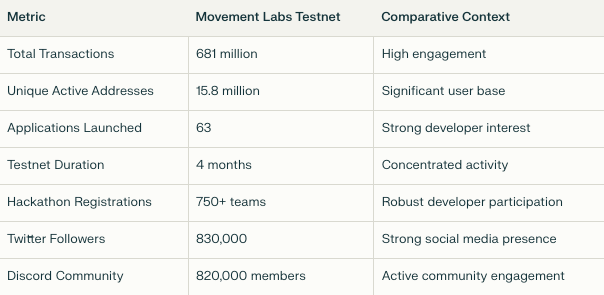
Notably, there are now more venture-backed teams building within the Movement (Labs) ecosystem than Movement Labs itself, signaling widespread interest and investment in Move’s potential to shape the next wave of DeFi innovation. Movement’s testnet activity is already notable, indicating significant developer interest and activity even before its mainnet launch.
In general, over the past 6 months, there has been a lot of institutional development on the Move language. The north star for the Movement Labs team is fundraised ecosystem projects with grassroots Move developers in the ecosystem, building successful applications.
At Genesis, 10 billion $MOVE tokens (represented on Ethereum as an ERC-20) were minted. The Movement (Labs) ecosystem and community are allocated 40% of this supply, valued at approximately $2.6 billion based on today’s price of $0.65 per token. The MOVE token serves multiple purposes, including decentralizing network ownership, rewarding data providers, delegators, restakers, and validators, as well as facilitating gas fees and native network activities such as asset liquidity, collateral, and payments.
Movement Labs has reached significant milestones, with its public testnet live and the mainnet launch imminent. Key advancements include decentralized sequencing, which will be integrated into the SDK.
The mainnet launch is anticipated in the coming weeks. Post-launch, Movement Labs will prioritize enhancing sequencing capabilities and implementing shared sequencers. The team is also developing a Move stack, similar to the Op stack, to simplify the creation of Move-based rollups and streamline application deployment.
Movement Labs successfully raised $41 million in a funding round led by Polychain Capital. Other notable investors included Binance Labs, Hack VC, Placeholder, Archetype, Maven 11, Robot Ventures, Figment Capital, Nomad Capital, Bankless Ventures, OKX Ventures, dao5, and Aptos Labs—the creators of Aptos.
From an investment perspective, Movement Labs has actively participated in nine investments over the past year, primarily in the gaming and DeFi sectors. These investments frequently involved co-investments alongside Aptos, highlighting a strong collaborative approach within the ecosystem.
Follow me on X for more insights
Housekeeping: If it appears that I have overlooked anything or any information is incorrect, please do get in touch. Happy to take feedback, discuss, rethink, and edit accordingly.
AJ
Comments
Nothing yet. Say the first thing.
Sign in to join the conversation.