
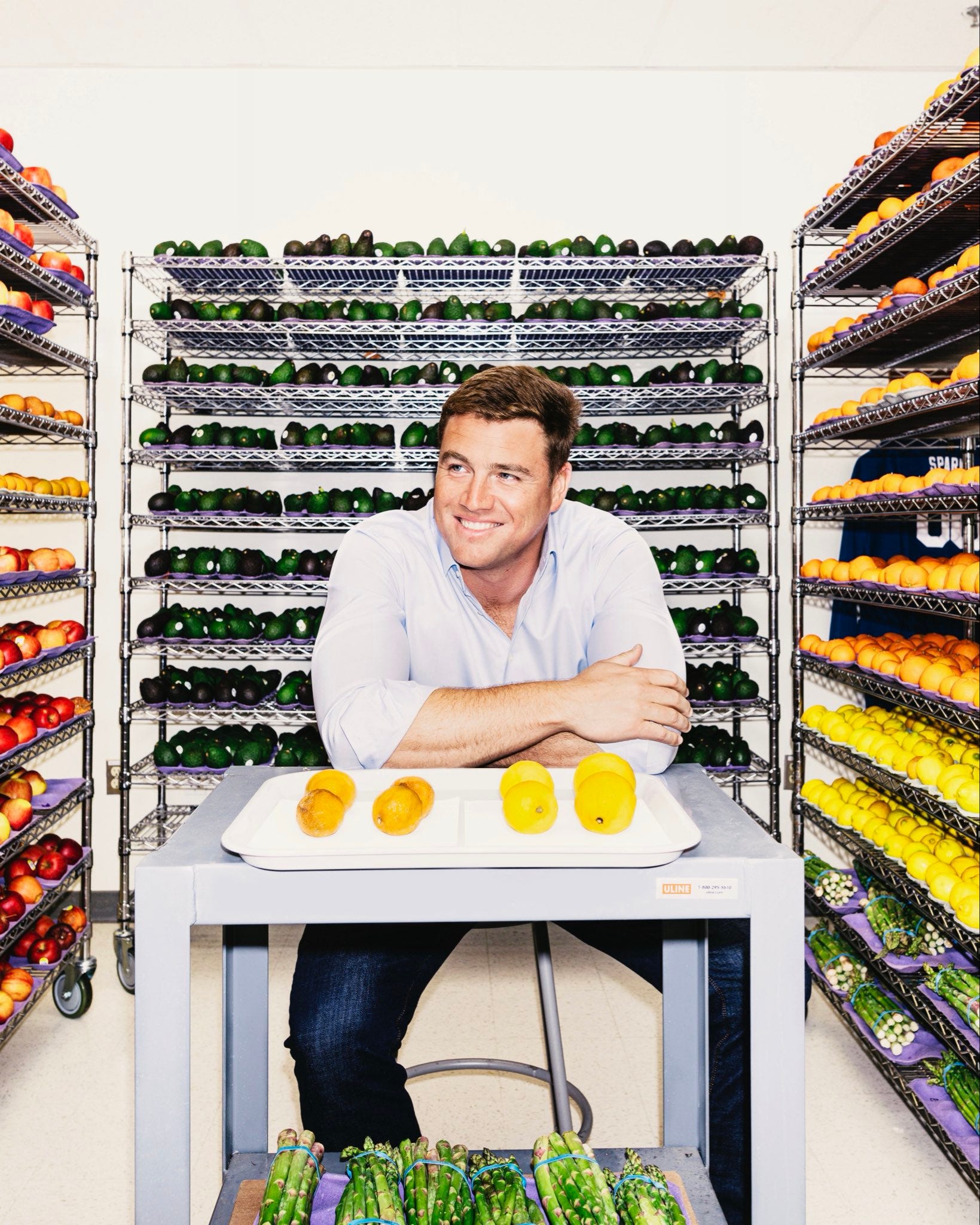
If you’re new here, welcome. I’m James, founder of Apeel.
The photo above is from years back when industry outsiders like Forbes, the Wall Street Journal, the New York Times and others were first starting to tell the Apeel story. Before most people inside the industry were willing to talk about what we were building, people outside of it were paying attention.
A lot has changed since that picture was taken.
Last week I was back in Berlin for Fruit Logistica, meeting with customers, partners, and colleagues I’ve worked alongside for more than a decade. It’s always a strange feeling being both deeply familiar with the room and completely out of step with it. Lots of energy and booths with loud colors and big fonts. Everyone trying to look different while largely selling the same thing.
The post-harvest industry has historically operated as one of the most invisible layers of our food system, designed to function quietly in the background. Where technologies exist, you’ll find them here, communicating to producers, hidden from consumers.
Fourteen years ago, when we introduced Apeel, that invisibility is exactly what we disrupted. Legacy chemical suppliers laughed, dismissed the science, and in some cases worked overtime to discredit it. Our coatings challenged a culture that preferred opacity over transparency. We weren’t just modernizing a small piece of an outdated system, we were talking openly about what happens to food after it’s harvested which is something the industry had intentionally avoided for generations.
Walking the conference floor last week, it was wild to see how much has changed and how much hasn’t. Apeel has become, in most cases, the only post-harvest technology people can actually name, largely because we chose to step into the light rather than operate behind it. That decision came with a lot of friction, pushback, and eventually a coordinated disinformation campaign that tried to stall adoption and distort public understanding. But it also forced a conversation this industry had long deferred around transparency, materials, and consumer trust.
What hasn’t changed is the fundamental reality that produce needs protection. Fresh food travels thousands of miles, crosses borders, sits in cold storage, and waits on shelves long before it reaches our kitchens. Without post-harvest protection, access would shrink dramatically, affordability would erode, and “fresh produce” would become far less available than it is today. The question has never been whether protection should exist but instead, what kind of protection we should rely on.
For decades, the industry has relied on synthetic fungicides, petroleum-based waxes, and chemical preservatives to do that job. Operationally, those systems “work,” but they were built in an era that prioritized durability and logistics over health, disclosure, or consumer awareness. Most people still don’t realize their apples may be close to nine months old by the time they eat them, or that coatings exist at all.
Plant-based protection is a better alternative. If food needs protection, why protect it with synthetic chemicals instead of plant-based materials? Why not use compounds that already exist in nature; materials our bodies and ecosystems understand? This question led us to develop a plant-based solution that extends shelf life using food, not toxic inputs, and in doing so challenged an industry that hadn’t been meaningfully challenged in decades.
The response went beyond skepticism. There were coordinated rumors, organized disinformation, and bad actors working to undermine the technology and slow adoption. Even today, we don’t fully know who orchestrated parts of those efforts. But our experience has harshly shown us that innovation in food doesn’t just require scientific progress, it requires narrative progress too.
Our food system badly needs both. For generations, fresh produce has depended on legacy coatings designed before the information age. Since our founding, we’ve believed that if produce requires protection, the inputs should be plant-based and openly disclosed. That principle continues to guide our work as we push toward a more abundant, accessible, and transparent food system.
Being back at Fruit Logistica showed me that Apeel is no longer the fringe outlier others once laughed at but the one pushing the industry forward. I saw many new products last week that reflected some of the early visions we had at Apeel. Only, we were a decade early. People are starting to ask the same question I had early on: how do we build a world with greater access to fresh produce without poisoning our food with toxic chemicals? Can food protect food?
It can and does. Just ask our customers.
Technology, at its best, is meant to make life safer, healthier, and more abundant for everyone it touches. It should expand access, reduce risk, and raise the baseline quality of everyday life. That’s exactly what Apeel was built to do: apply science inspired by nature to help food last longer, travel further, and reach more people in better condition.
Apeel exists to help the entire food system move in that direction. To support growers, retailers, and families at the same time.
A rising tide, the way technology should always work.
James
Food Fight is a space for honest conversation about the post-harvest industry, the challenges created by coordinated disinformation, and the work Apeel Sciences is doing to restore trust and choice in the food system. We focus on transparency, science, and American innovation, sharing updates, context, and insights that help explain what is on our food and why it matters. Our mission is to help build a future where consumers have clearer information, better options, and a food system that reflects both integrity and progress.
To learn more about Apeel, visit our website at apeel.com and follow our latest updates on Instagram, X, and LinkedIn.
No posts
Comments
Nothing yet. Say the first thing.
Sign in to join the conversation.