
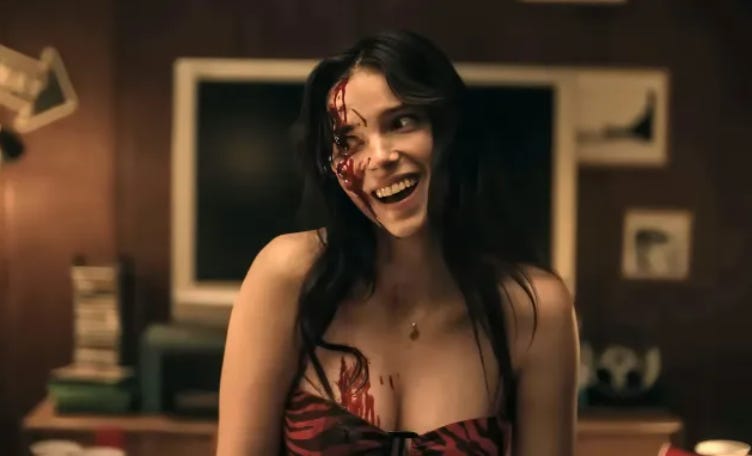
In an unromantic age where the erotic is served primarily as discourse fodder, pop culture has little use for limerence beyond a cautionary fable. In the case of Curry Barker’s Obsession, this fable has resulted in one of the best horror films of the decade. The use of light and shadow had me bracing for jump scares in ways few films have done since The Conjuring, though unlike that series, the shocks and jump scares in Obsession are few in far in between. The tension is ratched up through sheer dread, aided strongly in a career making performance by Inde Navarette. The exceptional power of her screams, movements, and facial expression makes her very presence, both off camera and on, an unnerving experience from the moment she snaps. Yet, it is difficult for a horror film in the 2020s to get much traction without making itself a discourse catalyst. For the most part, Obsession doesn’t overdo it, but it overdoes it just enough to undermine its titular theme. Despite my intonation for the rest of this piece, I recommend it to any fan of horror.
The Faustian premise is simple enough: shy, nerdy Bear pines over his close friend, the effortlessly cool Nikki, but cannot confess his feelings to her. He finds a magic toy that grants him one wish and wishes for her to fall in love with him. Nikki becomes seemingly possessed by a different person, develops an immediate infatuation with Bear, and they become a couple. Nikki’s obsession quickly goes from mildly offputting to deadly.
The wording of Bear’s wish is important, “I wished Nikki loved me more than anyone else in the fucking world,” if only to highlight the general looseness of the magic system at play here. Of course one can’t expect the protagonist of a Faustian tale to be told the precise terms and conditions of their bargain beyond the implications of their “wish” itself. Where Obsession falls apart very thematically is how unrelated to obsessive love some of her set pieces are: carving a dead cat into a sandwich, not as revenge for unreciprocated attention, but as a romantic gesture. You see, the problem with someone loving you “more than anyone else in the world” is they might find such a thing appetizing. They also might start urinating on the floor. Didn’t think that one through, did you Bear?
Of course, it is not really Nikki who is truly doing these things but something that has possessed her: is it obsession itself? The answer is more literal than that, as it is slowly revealed that there is a separate entity guiding Nikki’s actions, and she is but a passenger in her body. Bear discovers this too late, but the audience knows through her facial expressions, the blank eerie stare of a sexual assault victim when they consummate their relationship. This is confirmed when, laying in the bed Nikki begs Bear to kill her, before “she” wakes up. At this point Bear has already tried to unmake his wish, being told by the make-a-wish helpline he might have to kill himself for the spell to be undone. “Just spitballing,” the operator says after, in one of the film’s funnier lines. This also means Nikki herself has no agency beyond the first fifteen or so minutes of the film. Her “obsession” is compelled by magic and Bear’s dissipates once she stops acting like a human. Hardly the insightful commentary of “co-dependent relationships” the film purports to be.
The supernatural workings of this narrative make this film less about obsession than consent. Who really invited this third party demonic entity? Though ultimately helpless once the wish is made, both critical consensus and the film itself treat Bear as the one holding some invisible power. “This is your fault. You wished for this!” a demon possessed Nikki says as she murders a mutual friend that she sees as a romantic rival. Even from the film’s opening credits, Michael Johnston plays Bear to be almost unnervingly offputting in his own right. As he discovers his deceased cat and starts sobbing loudly, the ominous music rises and the title card is shown. Here we have our villain. I was expecting a reveal that he himself murdered the cat to elicit sympathy, but no such reveal came. It’s as if the raw display of awkward male emotion should be signalling of dastardly intent enough on its own. We are meant to feel very little sympathy for him.
So the prosecution charges our protagonist with casting a spell on our leading actress that forces her to love him, against her will. Thus even after the spell, knowing she was not in control of herself and still going along with their relationship anyways. But what about the defense? For most of the film, Bear just wants to know if Nikki’s love is “real.” He doesn’t truly want her for a puppet, even if he does lack the moral courage to face the facts of her new nature. He simply wanted a grandiose love that proved beyond his ability to handle, one he may have erroneously hoped involved less urine.
However short he might fall of being leading man material of any dark romance novel, Bear can only truly be a true monster given one of two conditions: 1. He knew the whole time he was in a horror film and made that wish anyways. 2. The mere desire for an all consuming love is inherently devious; given this is not a Godard or Charlie Kaufman film, we can safely eliminate the first option. And yet I go further: the mere existence of a painful limerence as inherently indicative of an abuse of power is an inextricable component of the dianoia underlying perhaps this film, but more essentially the culture at large. With the therapeutic worldview on one side of the culture war axis and the will to power on the other, such a totalizing 19th century type of love as what Bear yearns inherently pathetic at best and predatory at worst. As male yearning and romantic discontent became more and more pathologized as a condition inherently concomitant with inceldom, gone were our Smiths (Robert and Elliot), our Conor Obersts, our Peter Steeles, our River Phoenixes, and in come our Robert Tates and Claviculars to take their places in mass culture among the predominant “outsider” male archetypes. As idealized romance cannot be measured, leveraged or optimized, it has no place in the twenty-first century imagination.
And yet, Obsession does give us something of its idealized romance in the character of Sarah, played by Megan Lawless. After Bear begins to regret his wish, they sit in the car and have a moment of small mutual yearning, in which Sarah says (I’m paraphrasing this exchange) “Maybe you need someone more chill.” “Someone like you?” “Well I was sitting to the left” (during the party game in which Bear was meant to kiss the person to his left before Nikki “ruined” it). This chaste, casual, microwaveable romance is surely more Bear’s speed despite his previous yearning for something more intense: leave the possessed Nikki to the likes of a Gomez Addams or Dmitri Karamazov or someone who could love her madness with the self annihilation it demands. The real case against Bear isn’t that he was too romantic, he was not romantic enough. If he were a critic of this movie rather than the protagonist, he too would declare it a brilliant exploration of toxic masculinity.
Yet, Tristan Unde Isolde this is not, and the possibility of a totalizing love revealing something absolute in its self-destruction is for a different genre. Horror does its best magic when it affirms our most puritanical values. A fixation on the erotic ideal is a transgression that even the hedonic heights of “hookup culture” was as much a repression and sublimation of as painting, jogging or taking the eucharist. Let this not be considered a takedown review: the punishing of transgressions is what a good horror film does. So long as the culture industry can keep producing horror films as competent as this one, we can feel safe in the sterility of modern life. Assured that the tepid routine of dating apps, situationships, and Netflix binge watching sessions as no doubt certain teenagers in the 80s could be assured in their decisions to avoid sex and sleepaway camps. Horror promotes chastity of one kind or another. And yet, what greater horrors lie in the irrationality of deepest desires beyond a naive, slightly entitled nerd and his magic box? Surely the irrational nature of eros could reveal things both more beautiful and sublime than the mere psyche, but good luck getting that kind of script produced.
The Pensive Pejorative is a reader-supported publication. To receive new posts and support my work, consider becoming a free or paid subscriber.
Comments
Nothing yet. Say the first thing.
Sign in to join the conversation.