
If there’s one commonality between great art and truly horrendous art, it’s the tendency of both to unpleasantly intrude on the psyche. Neither will “entertain” in the conventional sense. This is especially true for high art in mediums one hasn’t deeply engaged with. I am not a cinephile; my favorite film of last year was A Real Pain, of 2007: There Will Be Blood, 1999: probably Being John Malkovich or something, of all time: The Good, The Bad, and The Ugly. Very entry level, very top 10 IMDB. Out of the hundreds of films I’ve watched in the last decade, few would qualify as cinema, and not because I don’t like cinema, but because I never know where to find it. It would therefore follow that any truly great piece of cinema, any genius host of the muse that has carried out her orders over that of the producers and general public while retaining the funding to do so would go right over my head, sour my palette, have me frequently pausing to see how much time remains. In the past few months only three films have had this sort of intrusion on my psyche: Joker: Folie a Deux, Megalopolis, and Tarkovsky’s Stalker. Two of these I’m sure are actually just terrible films and one of them my lack of constant enjoyment had so much to do with the mirror held at my own psychic discomfort—only amplified by its stunning visuals and glacial pace—than legitimate boredom. But enough about Joker.1
As I imagine a good deal of my readers have seen Tarkovky’s Stalker already, I’ll sum up the premise as briefly as possible: the Stalker is a guide who leads people through an area called “The Zone,” heavily guarded by the military, to a secret room that grants the innermost desires of all who enter it. He brings two gentlemen along in this journey, “The Professor” and “The Writer,” their desires seemingly made plain by their aliases. The Stalker himself never enters the room, he only guides others to it.
For all its artistic defamiliarization, this film feels very current thematically. “The Writer” is introduced with an opening monologue with the sentiments of many a 2020s Substacker: the world is boring now, our sense of mystery destroyed by scientific progress, life was more exciting in the Middle Ages when every Church had a God, every house had a goblin, and everyone was still young. With his writerly peacoat and cool haughty countenance, he is less your reactionary traditionalist and more the type of ironic Catholic hipster to show up in a Matthew Gasda play. His yearning for terror and awe isn’t a question of authenticity but one of vitality. He can pine for such things in theory but not when confronted with it face to face. He is therefore out of depth in the Zone, hiding his resignation behind a sort of indignation at Stalker’s devotion to such an inscrutable realm, clinging to his materialism like a lifevest.
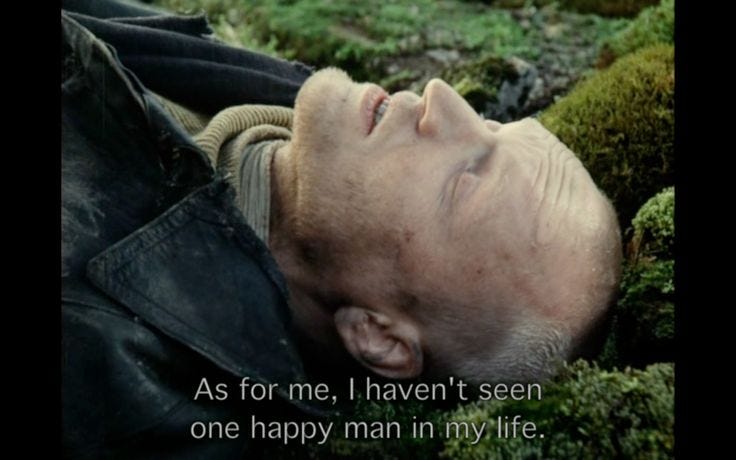
Which brings me to the Stalker himself. He initially appears as a stock Hollywood anti-hero: a smuggler who spent five years in prison, stoic, laconic, strained relationship with his wife and a Melvillean flightiness from domesticity. If it were an American film, this mystique would reveal either a trauma plot, a skeleton in the closet, or both. Tarkovsky does neither of these things. Stalker’s motives turn out to be almost entirely altruistic, leading others to the secret room in hopes he might guide them to happiness, refusing to go in himself partially to abide by the Zone’s law but more importantly, he doesn’t need it. His purpose is to lead others to their happiness, not to enter the room himself. The Zone, with its rejection of laws of both physics and metaphysics, is a place where the progress and rationalism of the modern world are null. It is where Tarkovksy uses the whole color spectrum, the rest of the world falling to a yellow sepia. Yet this is not a wholly pure altruism; his wife and child both suffer from his Peter Pan like excursions.
In defining this character I come up with a term both contradictory and seemingly self refuting: The Blakean Knight of Faith. I say “contradictory” because anyone familiar with William Blake knows the most prominent Blakean Hero: Milton’s Satan, whose rebellion against the inherent order of things is wholly opposite of the Knight’s2. I say “self-refuting” because Stalker too operates with the same self-subjugation as the Knight of Faith, bending to any of the Zone’s laws which he can perceive. The Zone’s perilous path requires a child’s imagination to achieve gnosis. Midway through the film, he paraphrases Lao Tzu.
Weakness is a great thing, and strength is nothing. When a man is just born, he is weak and flexible. When he dies, he is hard and insensitive. When a tree is growing, it's tender and pliant. But when it's dry and hard, it dies. Hardness and strength are death's companions. Pliancy and weakness are expressions of the freshness of being. Because what has hardened will never win.
Stalker’s trusts his own insights that people he brings to the Zone will not use it to do the world harm, not always taking into account they might mean harm to the Zone itself. The rules for its navigation, letting it guide him by intuition, instead of taking the straightest path might very well exist only in the Stalker’s imagination. We never see any tangible external danger in the Zone, no alien creatures, no trapdoors. The horrors here lie in the soul. During a fifteen-minute scene where all characters are lying down for a rest by a stream, between monologues of despair, the ultimate uselessness of art, the otherworldly cinematography, the constant flow of water, Tarkovsky puts the viewer in their own contemplative trance. You cannot help but feel the weight of existence the characters must all rest from. It’s tormenting, renewing, genius. I must have paused five different times waiting for the film to move along. I wanted that scene to end and yet have not stopped thinking about since. Tarkovsky said he wanted his art to “prepare you for death” and I struggle to think of any film that does so in quite the same way.
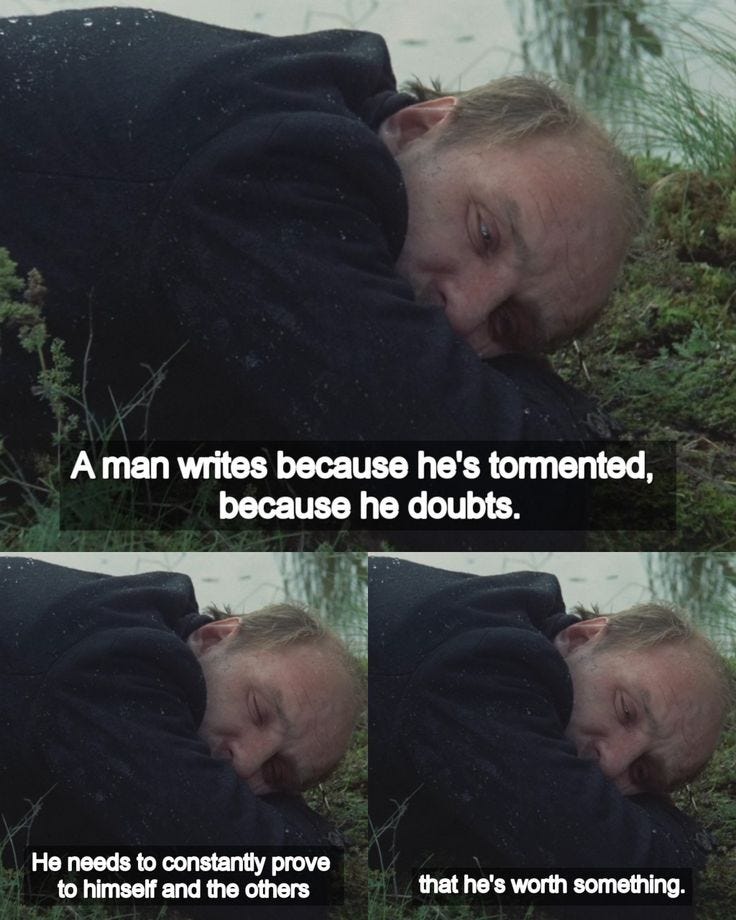
Had I not been in the middle of László Krasznahorkai’s The Melancholy of Resistance, I would have struggled to think of a character even coming close to this archetype. His central character, Valuska, is also a Knight of Faith, though far more childlike despite his grey hair and thirty-five years, steadfast in his belief in spiritual renewal through celestial harmony. The novel revolves around a “circus” featuring a stuffed whale and the bloodthirsty mob under its spell. Valuksa’s confrontation with discord and decay as the defining principles not just of his community but the universe ultimately leads to his downfall. His childlike wonder and selflessness only cripple him in Krasznahorkai’s nihilistic vision. He has held truer to Lao Tzu’s principle than Stalker, who has developed just enough hardness to protect his faith and pliability to the unknown. In Stalker, it is ultimately despair and cynicism that lead to people’s downfall, preventing both The Writer and the Professor from entering the Room once it’s revealed to grant your innermost desire and not what you necessarily wish for. Their lack of faith is ultimately in themselves. The Stalker can lead you to water but even if you drink he can’t ensure your salvation. Neither Crusader nor Christ figure, he is a helmsman of the inner seas, where the Zone makes its final judgement. This is why he is confident as he crosses the Zone’s border and the military personnel stop chasing them. “They will not follow us here. They’re too afraid.” Mock him and his vision until your dunghill of spite gains you safe moral high ground, he will still weep for your failure.3
Though even Satan is only so much a Blakean hero as he walks on the “perilous path,” rejecting the natural order of things. Blake had fawningly accused Milton of being of “the devil’s party” because Satan is the most fully realized figure of Paradise Lost. I’ve seen a lot of criticism of this interpretation as if Blake were simplistically painting Satan as a rebel figure to God’s tyrant, though I don’t think the fact that Milton painted Satan as the ultimate tyrant was in any way lost on Milton. My own reading of Paradise Lost was that Milton intended to show we are all of “the devil’s party.” That in our fallen state, it only makes sense that we should identify so much with the fallen angel, as we are much more similar to him than we are to God.
And weep he does, in a cathartic scene with his wife. He thus fails not only the role of Sensitive Young Man played by Tom Holland and Timothee Chalamet helplessly waiting for Zendaya to save the day, but he fails the Strong Silent Type role that certain “cultural commentators” often bemoan the SYM displaced. He’s neither Daniel Craig’s Bond or Sean Connery’s Bond, Spiderman or Jack Reacher, Walter White or Aragorn. Neither the trad warrior, anti-hero, or man of eternal progress. Just a man walking the perilous path out of the material mundane through vision alone. To those who want stories transcending the culture wars, take note.
Comments
Nothing yet. Say the first thing.
Sign in to join the conversation.