
When I wrote about Hild a few weeks ago, I mentioned that I would be reading the sequel the next weekend, as it had forecast to snow heavily. That weekend turned out to be bright and sunny and Menewood stayed on my shelf until the next snowy Sunday a few weeks later, which wound up being a full on blizzard and even more snowy than the first one. Annoying to walk on the sidewalk in NYC, but a good excuse to crack into this tome:
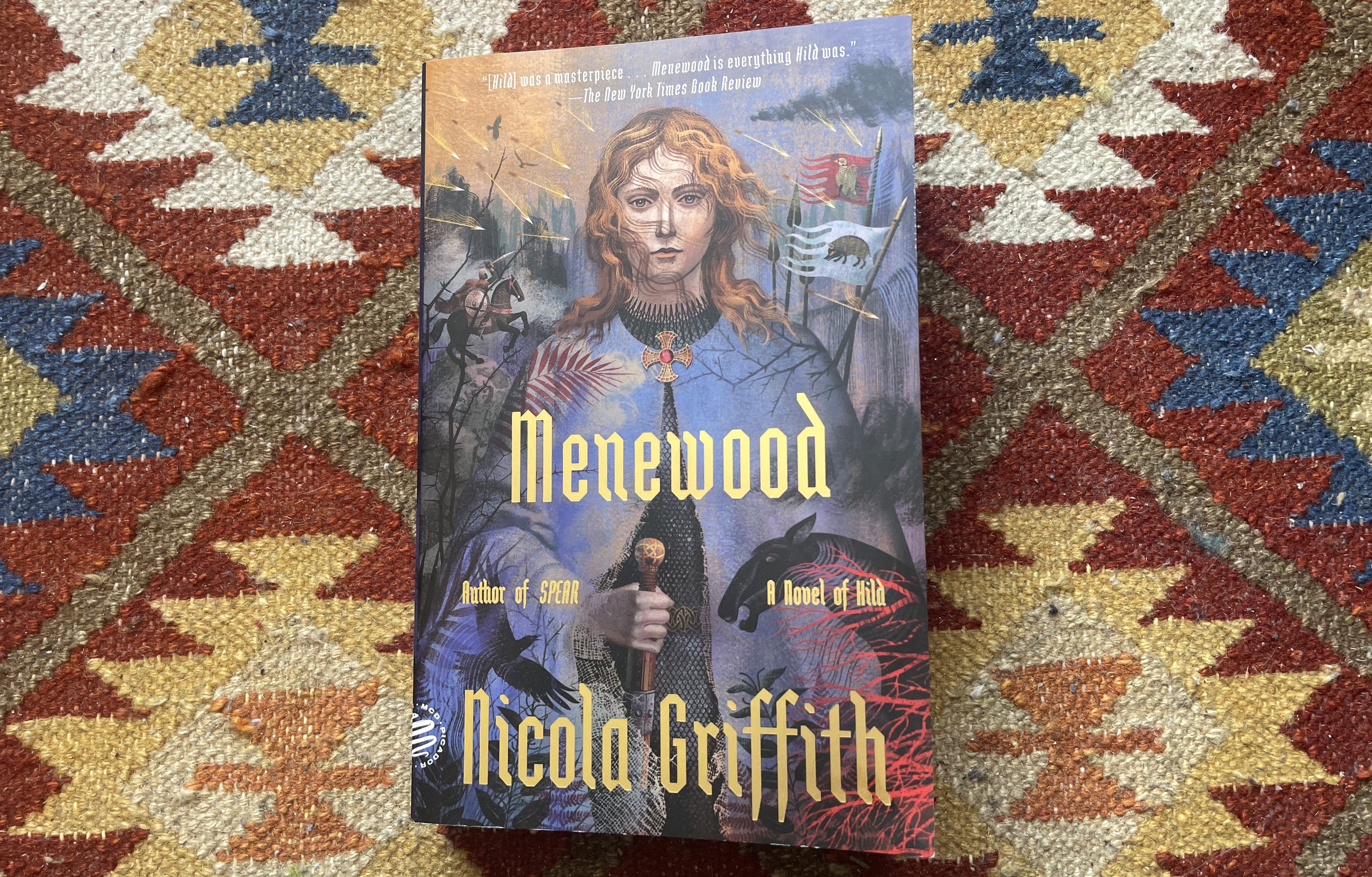
As I read, I found myself echoing the same thoughts and emotions I had while reading Hild. This is still a very immersive story, with a focus on the natural world, that shows how being observant in a world of limited knowledge could be such an asset. There is a lot to chew over on the spread and shift of religion, and one passage especially that I loved from Hild’s explanation of the religion.
“I’m not a seer, I watch. I name the patters that anyone could see, if they also watched.” She lifted her cross out from under her dress and weighed it, then lifted it off and held it in both hands. “I was baptized in Christ. But who is Christ? Who is Woden or Eorde? They are all parts of the pattern. The pattern is in everything. We are all part of it. We make the pattern; the pattern makes us. The pattern is the way a bird’s feather grows one way but not the other. The fold of a beetle’s wing. The—” She looked around, plucked a daisy. “Look. It’s the whorl at the heart of the flowers, the pattern of its pollen. It’s the same pattern on a snail’s shell. Wait. Wait. Don’t move.” She went to her pack where her belt lay, and the. pouch fastened to it. Brought back the snake stone.1 “See? The same pattern.”
As I mentioned in my first post, Hild was a real person. Most of her life was lost to history but we know that in her later years she was a well respected woman to both the church and the kings of the time. This book shows her through an extremely unstable transition of power from one King, her uncle, to another. This is definitely what I appreciate the most about this book, the way that it illustrates what life would have been like for people within kingdoms and regions that were always restructuring and falling apart and following different leaders. Its a time I’ve tried to learn about on my own through cataloguing dates and names, but I’m realizing that sometimes fictional accounts can be a great tool to get a deeper understanding of the politics of a time very unlike our own.
This book is very realistic in a lot of ways, how long things take, and how many people would have been around and involved in court and these types of epic situations. However, that means that things can get pretty confusing and a bit overcrowded, and leave the reader without really anything to hang onto. I understand the reason this is, but it definitely makes the core of this story Hild and her relationship to herself rather than anyone else who appears in the story, and the thing that kept me reading were the wider historical concerns than any interpersonal story.
I say it is very realistic, but something I found a little incredulous was the fact that Hild leads her men into battle and her people support her to the point of wanting her to be king. Maybe not incredulous, because I know there were women warriors through the Middle Ages, but rather I found it a bit disappointing that we always have to center battle as the biggest show of strength and competence. I’m aware that I might just be saying this because I don’t find battle scenes to be interesting to read or watch at all, but I don’t know why all stories about women finding power through oppression all have to pick up a sword to do so. Hild is extremely smart, she sees things through observation that many people miss, why isn’t that enough? This is not a huge part of the book but it really does feel a bit like “not like other girls” to me, the radical exception, and it might just be me personally but I am being more drawn to stories that are more subtle and common, a deeper look into how people did well with what they had. This might be a confusing paragraph, but that’s because I’m not quite solid on my opinion here, at least in reference to this book specifically. I think its disappointing because there’s already so much about the importance of women working within a fragile system that doesn’t demean what they do into “women’s work” in this novel, that having Hild ride off into battle doesn’t really seem necessary. I don’t know, my reactions to stories like this are evolving and I think I’ll keep trying to articulate what I mean for a while, especially as I read more historical fiction (which is a trend I don’t anticipate slows down anytime soon.)
As I mentioned in the first post, very little is known about Hild, but the author clearly had done her research and reconstructed the world around her and found her most likely place within it. That being said, (and I know this is a novel and she is the protagonist) at some points I felt like Griffith was inserting Hild a bit too far into the center of things. Not that I don’t believe that Hild could have been so singularly transformative, but there was something about her machinations that felt too fluid, like everything went right for her and she was the puppet master pulling the strings. More than anything, I think this is a result of working backwards from history, there were not enough surprises or twists because the story existed at the end first, and was written into existence backwards. Does that make any sense?
Mostly, I really appreciate both of these books for their reconstruction of a time so far in the past, and making it and its politics comprehensible to me. The more I read the more I understood, among all the great descriptions and scenes about nature and the world moving.
This book only covers Hild’s life from around 18 to 22, so there’s still quite a long way to go to Whitby, and I’m assuming, unfortunately, there will be quite a wait for any third book. But I discovered that the author has an Arthurian retelling that I’ve been eying in the meantime…
No posts
Comments
Nothing yet. Say the first thing.
Sign in to join the conversation.