
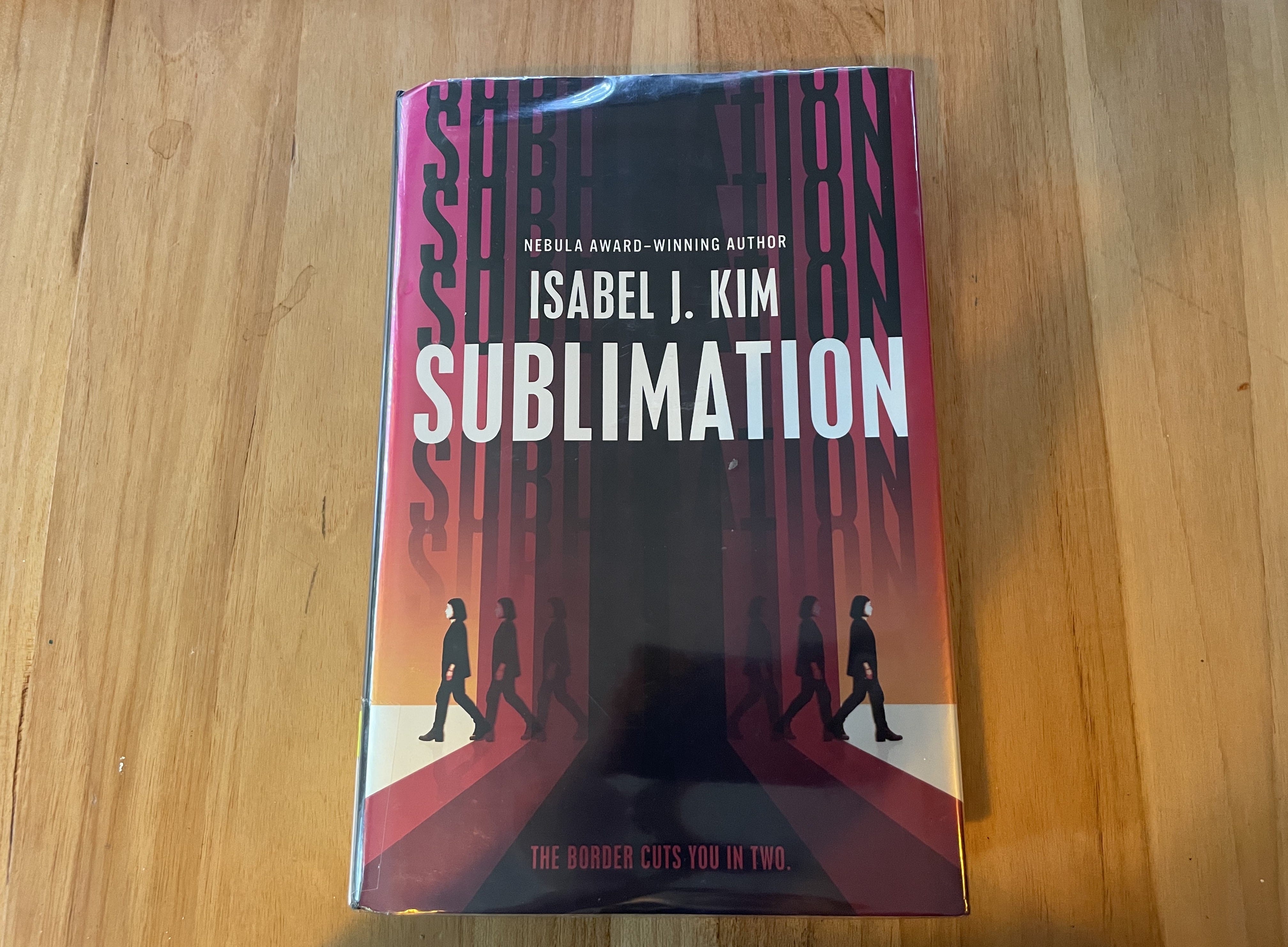
Surprise: I actually read a book! It’s a miracle! Sublimation was put on my radar by my friend Leandra recently and while she was talking about it I pulled out my phone and requested it from the library.
The premise is that whenever someone immigrates to another country, a second self is left behind, called an instance. This type of story is what I’ve starting thinking about as a Buffy Metaphor.1
An instance captures a static moment. A feeling in a specific time and place. The heart at the moment of stepping over a border. The mind when it knows it is leaving. A life is made of many static moments. What’s felt when walking up to the tarmac is a different thing from what is felt sitting in a park two weeks later. What’s felt when crossing a river with your belongings held above your head is a different thing from what is felt in the detention facility. What’s felt when your mother tells you that you’re leaving and puts you in your best coat is different from what you feel when you are twenty years older, sitting on the plane, returning. The only constant is what people want will change, and the administrative state is there to log the outcomes. (pg 10)
Now, I just want to say that I’ve been watching Sex and the City lately and what I’ve been mostly preoccupied with is the logistics of someone writing about and publishing her friends private relationship and sex stories, often quite embarrassing and vulnerable. It’s crazy that they all just… let her write about this stuff??? I know it undermines the whole conceit of the format for the show but that is what is always at top of mind. Why are any of these people friend with Carrie? I’d hate her if she was publishing all that about me! Same w/ her bearing all about her insecurities/cheating/thoughts on a relationship, do Big and Aiden not read her column??? I’m in the third season and this has come up briefly with regards to one guy she’s dating who’s in the public eye, but I would expect the ramifications of her making these stories public to be sooo much more impactful, no???
I share this to underline the fact that I’m by nature a buzzkill, rigid and unable to overlook leaps of “artistic license” faith when it comes to certain logical inconsistencies in stories. In other words, these problems are my own and do not necessarily diminish the value of the work as a whole. (sex and the city is so iconic for a reason, I am enjoying it)
So, all that being said, I have so many questions about the conceit of this novel. When an instance is created (the version leaving and the version staying are both called instances, in a confusing choice that does nothing to clarify who we’re talking about) who gets all of that person’s money? Who gets their possession? Do they split it up or is one of them left completely destitute?
Talk about overpopulation, right??? How many people are in the world in this novel? Are food sources and water sources not an issue?
What about historical migrations of people? What about the Visigoths and the Saxons and other invaders who roamed around? What about the goddamned vikings2?? What about religious persecution and refugees? What happened to the version of people who stayed? It would have completely changed the outcome of those historical events— all of history would have been different???What about when communities and borders are absorbed and redefined during the creation of empires? I would have loved some exploration of what people thought about this when they were conquered by the Romans, did they still instance when they went to another territory of the empire? How does this affect, or not affect, people like the Romani or Travelers? For all that this book does to explain instancing and establish it as the norm, so much is left un explored. Some of these questions are nodded to when talking about the main character’s grandfather, who left Pyongyang for Seoul right in the midst of the separation of Korea into North and South, and he never knows if he left an instance behind. However, this is one thread that is lightly alluded to and I think a lot more could have been done with it. The grandfather is has just died at the beginning of the novel and we never really meet him, which diminishes the emotional weight of this detail as it never really comes back with any weight or consequence.
There are references in the book to an instanced version of the Odyssey, as well as a traditional folk tale. How far back does this thing go? was it known before borders were created? Did it affect the way that people drew borders or the concept was created?
And it’s clear that the author has thought about some of these things, but they are most definitely not explored or defined in the text.
Crossing a border creates an instance. Creating a border manifests the capability for instances. (Pg 23)
But what kind of border is recognized? What about neolithic age borders when homosapiens weren’t the only humanoid? were they instancing when they were hunter-gatherers and migrating? When did it start?
basically, this was me reading this book:
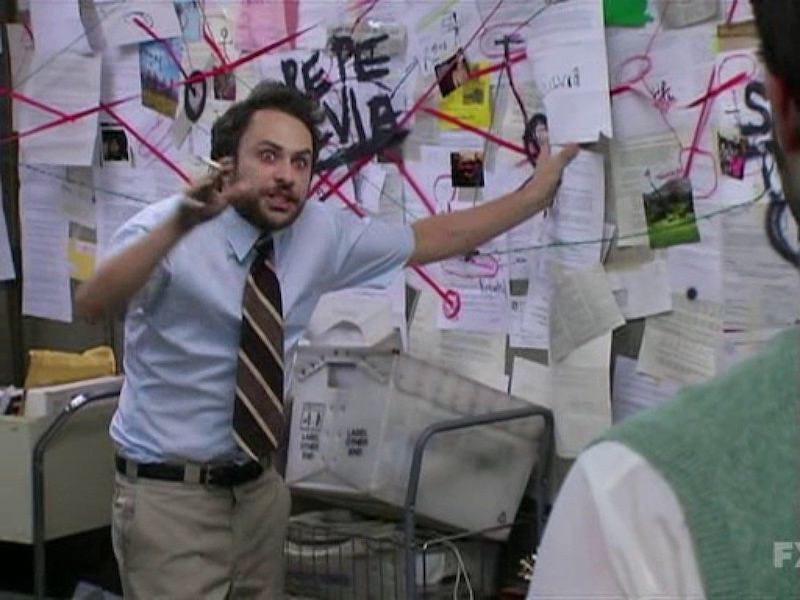
I think that if there had been some more modern reason for instancing, even like post-roman empire or something like that, I would not have spiraled as much as I did. but I really really did spiral!!! I know this is just a conceit to explore the immigrants experience but man it would have saved me a grey hair or two for some of these questions to be answered.
Despite all the logical repercussions that had my mind spinning, I was able to still enjoy this book on a more immediate level because (much like SATC) the interpersonal questions and emotions and implications are well rendered and interesting to think about. Seeing both sides of the situation, the one who stayed and the one who left, how they understand each other and what they expect from each other, is really fun to follow along with.
There are a few characters and versions of instances (both who have left and who have stayed, once again the mononym of “instance” is not as technical or specific as I would like.) who get perspectives in this book, and those who are separate instances are written in the “you” voice, which I found a really interesting choice. The first third or so follows Soyoung and Rose, two instances of the same person, and so the first third is essentially in the second person. Something that you don’t see much and I think it really payed off, especially once other perspectives are introduced (without spoiling) and the second person gets broken up with a more authorial third. I love when a craft choice is well thought out or effectively employed and this is definitely one of them.
On the other hand: so each chapter is broken up into character’s POV, and the titles are the characters names. However, there is this omniscient third authorial voice that creeps in at the end of most of these second person chapters, and the voice itself is well used and I actually really like the tone that this voice adds to the story, making it a bit more tense or something like that, but it’s always wrapped up in other people’s perspective, which makes it feel a little sloppy. It is the structural quirk itself that I have a problem with, but I don’t know how I would fix it because like I said I think this voice is pretty integral to the narration as a whole. It clarifies things about the world and provides context and commentary to what the characters are experiencing. But I just don’t like that it’s mixed in with each character’s sections. I know stuff like this is hard to get right, it’s kind of impossible to balance, but nevertheless I don’t think it has been balanced so I’m remarking on it.
When a character joins together with their instance, there’s more great and interesting writing about the brain, about the joining of two perspectives or dual strands of one person’s life. I’ll give you a quote with blocked out names and pronouns in an attempt to avoid spoilers, although it might seem silly, but I really like this little excerpt
It’s not so much that [instance1] and [instance2]’s perspectives are separate or like there’s a clean divide between the two of them. (…) There is no split point of view, no dual vision, just that on the inside it feels almost like there is a lens that dials in. It’s subtle, sometimes. A shade towards one life or another.
The uncanny thing is when [their] thoughts feel normal. Regular. It feels like [their] decisions are organic and clean, the perfect route from thought to action, that this is who [they] is and these are the choices [they’re] making. And then hours later, when [they] looks back at [their] thoughts, they’ve become alien. This is the part that scares [them].
That, and the way that she no longer knows what [they] wants. [Instance 1] and [INstance 2] had both known. They had known so hard they have, functionally, died for it, but that’s an uncharitable thought, towards people who no longer exist. There is no point hating the past self. Selves.
So interesting!
Back to more technical crafts stuff, as these non-instanced (or re-instanced?) characters join the narration, that omniscient voice becomes more normalized because there are more 3rd person chapters. Towards the beginning and middle of the book, there are a lot of asides that really do a lot to fill out the world and establish the way that instancing has affected the public’s consciousness.
A popular horror-gore story told by labor and delivery nurses is that of the fetus that instances when it drops out of the mother’s womb, leaving a copy stillborn inside. There is no record of this ever happening, but that doesn’t stop trainee nurses from discussing the possibility. They discuss other horror stories too: twins who turn out to be instances, babies and toddlers who instances when getting on a plane. International adoption agencies prefer to adopt out babies under the age of two, to conclusively prevent an instantiation event. When the children are older, adoption staff are instructed to lie to the toddlers, and promise that the children are going to return. That they are just going on a little trip. That this leave-taking isn not permanent. This usually works because children don’t know anything about borders, permanence, or death. (pg 156)
However, the omniscient voice really devolves into shorter and shorter fragments and frequent references to the Odyssey and the folk tale. I liked the idea of the parallels the author was making with these stories, but they cropped up way too often and took away from the rhythm of the story. I think they were intended to add intensity and poignancy, especially towards the end when the plot really comes to a head, but those sections really overstayed their welcome, and just weighed down the rest of it. I felt like I was being overexploited to, and told exactly what was important.
As far as the plot, I think I liked the first half of the book much more than the second, but this might be a personal preference. The beginning shows Rose (the American Instance) returning home to Korea after a call from Soyoung (her Korean instance) to say that their grandfather has died, and she should come to the funeral. The tension between these two versions of the same person with separate lives and upbringings is really interesting and explored very well without being melodramatic. The whole thing does function really well as a metaphor for returning to a place you used to call home and imagining what your life would be if you never left, but it also works as straight speculative. Each character has their own psychologies, impacted by which side of situation they grew up on, and I think they are really well rendered and I loved seeing them play off of each other, and interact with the other people in Soyoung’s life.
This includes, most prominiently, Yujin. He an old childhood friend —so Rose has memories of him from before she instanced— who reconnected with Soyoung in their 20’s when he unexpectedly instanced after a semester of living in NY and sought out someone he knew who was also an instance. Seeing the way that both Soyoung and Rose interact with this person that they have varying contexts for is really interesting. having everyone’s perspectives almost feels kaleidoscopic.
The second half of the book becomes almost political espionage or a more true sci-fi action story? Not exactly, but I'm not sure how to categorize it. Definitely whatever genre is talking about technology a lot, that’s what this is. Yujin’s instance, YJ, works for a company in NY called MERGEBREAK that keeps instances from rejoining with each other when they are physically close (because all it takes is them touching each other to become one again)
The cast of characters who wind up in NY (I’m trying to avoid spoilers but I might be failing) winds up uncovering a truth about Mergebreak’s new program, which is being advertised as a way to break up the re-joined two halves after they have been reintegrated into each other. However, YJ is promoted to be in charge of this new program, and the old head who has left drops some smoking-gun type evidence of what they program is really setting out to do. All of the characters have their own motivations for wanting to go along with this secret or whistleblowing it and, I’m going to be so so honest: I didn’t totally understand the implications or the ramifications of this top-secret whistleblowing-worthy information. It has something to do with mass implication and the borders and border control, and I think it was trying to be a metaphor for immigration, but I think that this was stretching the extended metaphor a bit too far. Here’s a good little quote that tries to (or does) square the tone-shift from the beginning of the novel:
“That would ruin my life,” he finally says.
“Well, I guess some things are worth that,” Soyoung says, feeling like she’s ripping words out of a TV drama. Three months ago, her biggest problem was what she was going to do for brunch.
It might just be that I was blinded by all of the in-world ramifications that weren’t really explored by this whole concept of instancing (see crazed image above) but I couldn’t really figure out how I was supposed to feel about the ramifications of this technology. This quote might be a bit spoiler-y so skip it if you are opposed to that kinda thing:
This was revolutionary. It was the biggest leap forward in instancing technology since the MERGEBREAK had been developed. It was the biggest leap forward in human technology since fire, since the printing press, since the jet plane.3 It could eradicate instancing. It could force every single person crossing a border to instance. It could delete an instance’s memories upon reintergration—would that be murder? (pg 228)
Essentially the characters are forced to contend with the possibility of instancing not happening, and this really shakes their world. However, since instancing isn’t real to me, I couldn’t really get behind it being a bad thing? Or at least, I don’t think the stakes there were really as explored as they could be. Here’s kind of the extent of it:
Imagine a world without instances. A world where leaving is perfect absence, where there is no ghost left behind. Imagine never knowing the parallel, leaving the past in the past, a world where desire doesn’t matter, where there is no blunt knowledge of the implicit truth of the human heart. Imagine a world where leaving is a single choice, where there is the kind blindness of never knowing and the cruel promise that you will stay singular. (pg 202)
now, on a metaphorical level, this is poignant and interesting. On a speculative level, I think it’s quite hard to establish a fictional world with a very different mechanism than we have in reality, try to get the reader on board with this internal logic, and then ask the reader to imagine a world without this made-up construct. It’s like, yeah. I can imagine that. it’s my reality.
So, essentially, I liked this book a lot more when it was a more introspective and interpersonal exploration of moving to another country and dealing with the ghosts of possible parallel lives. This is might just be because it’s more my speed as a reader, as I tend to gravitate towards more literary fiction. It also was interesting to me as someone who did live in another country for a good chunk of my 20’s, and it had me introspecting on whether at one point I would have instanced when I was in the thick of living there or not, as well as thinking about the other non-spaniards I met in my time living their who did build a whole life there. A lot of thoughts.
When the book becomes more technology based, with corporations and governments involved, I do think it loses something. It’s impossible to know if that’s just my personal preference, and I think I know it slightly is so I'm hedging my bets, I really don’t think that this section was executed as well as it could be. Maybe that’s where I’m ending up. There were a lot of big ideas being played with, and some worked more than others. It wasn’t necessarily a dissatisfying end, and I appreciate the way the novel kind of took a risk in taking kind of a pretty big left turn, even if I didn’t think it was as strong as the first part.
I’ll leave you with another quote on someone else’s experience of reintegration, because it’s some of the best writing in the novel. Also LMK if you think this is too many quotes for you… did you skip over them or is it nice? I’m trying something new be nice to me.
Reintegration doesn’t feel like the movies make it feel. It’s not a slideshow of memories, not like watching a clip show of moments. It’s like being stranded in deep water. It’s like feeling seaweed wrap around your legs and pull you under, every thought dragging up a new set of associations, memories. [Instance 1]’s apartment is suddenly familiar, foreign. It’s home, it’s alien, it’s home again. Whatever [they]’re thinking about is being magnified through two perspectives.
I’d love for someone else to read this book and talk with me about it! Also, I'm still on my summer schedule so I'll see you in two weeks. Enjoy the dog days!
What’s a Buffy Metaphor, Phoebe you may ask?? If you’d taken my advice to watch Buffy you’d already know! Essentially it’s when an extended metaphor is taken to its most literal logical conclusions, often to supernatural and sci-fi ends. Almost every episode of Buffy is a metaphor for adolescence or growing up, but it never feels too on the nose.
I've been listening to a podcast about the history of the monarchs of England and Scotland, so that history is top of mind- how a person can live in the same place their whole life and be subject to different rulers just by a matter of changing power systems… the way that kingdoms ebbed and flowed after the fall of the Roman Empire especially is really interesting to me, but that’s a story for another day and actually pretty well covered in my post about Hild and Menewood by Nicola Griffith
On a line level, I have some problems with this sentence. The list should be in the opposite order to maintain some sense of logic. “Biggest leap forward since the jet plane, since the printing press, since fire.” As it stands, I don’t think it makes sense to list things in actual order that they were invented, because if it’s the biggest thing since fire, than it already surpasses the printing press and the jet plane, so there is no reason to mention the later two. If the sentence starts with the jet plane, however, it could be argued that the narrative is reaching back further through time to heighten the hyperbole, correcting themself to heighten the statement, from jet plane to printing press to fire. does this make any sense????
No posts
Comments
Nothing yet. Say the first thing.
Sign in to join the conversation.