
Key results
| Evaluation point | n | Mean PPL | Median PPL | p95 PPL |
|---|---|---|---|---|
| Original texts | 256 | 16.24 | 15.17 | 25.1 |
| Codec reconstructions | 256 | 37.26 | 27.36 | 98.91 |
| AR baseline | 251 | 30.98 | 23.27 | 56.11 |
| Token-space MDLM | 256 | 44.74 | 38.42 | 93.6 |
| Code-space MDLM | 256 | 30.01 | 26.55 | 59.36 |
Key result. Most of the observed quality loss is introduced before generation; code-space diffusion still reduces median perplexity by 30.9% versus token-space diffusion.
- Dataset
- TinyStories
- Sample size
- 256 paired reconstruction samples; 251–256 generated samples per mode; four matched geometry settings.
- Metrics
- External GPT-2 perplexity: mean, median, p95, and maximum; Codebook usage and support size; SBERT, BERTScore, MAUVE, and an LLM-judge summary for geometry runs
- Uncertainty
- The reported comparisons are descriptive single runs; confidence intervals and multi-seed significance estimates were not computed.
- Conditions
- GPT-2 token sequences of length 64 compressed to 16 top-level codes with a hierarchical VQ-VAE-2; all generation modes use the shared external scorer.
CSVJSONMarkdownExternal mirror:Hugging Face dataset card
PDF & citation
Cite this paper BibTeX is the recommended format. Every variant below is generated from the same publication record.
@inproceedings{Gavrilov2026WhereQuality,
  title      = {Where Quality Breaks in Compressed Short-Text Generation: Staged Bottleneck Localization},
  author     = {Gavrilov, Alexey and Gazzaev, Alan-Barsag and Muravyov, Sergey},
  booktitle  = {2026 39th Conference of Open Innovations Association (FRUCT)},
  publisher  = {IEEE},
  year       = {2026},
  pages      = {69--76},
  doi        = {10.23919/FRUCT70069.2026.11506553},
  url        = {https://doi.org/10.23919/FRUCT70069.2026.11506553},
  isbn       = {978-952-65246-5-8},
}
APA textIEEE textRISCSL-JSONSchema.org JSON-LDOAI-DC XMLOpenAIRE v4 XMLMODS XMLJATS 1.4 metadata XMLFull-text JATS 1.4 XMLRDF TurtleLink Set (JSON)Link Set (HTTP)RO-Crate
Full guide
Full research guide
Method
The paper uses one scorer across three evaluation stages so that each additional transformation can be associated with a measurable quality gap.
Reconstruct
Encode each 64-token TinyStories sample into 16 top-level codes and decode it immediately to measure codec reconstruction loss.
Generate
Generate either text tokens or discrete latent codes with MDLM, then decode code-space samples through the same trained codec.
Compare
Score originals, reconstructions, and generated texts with the same external GPT-2 protocol, including median and tail statistics.
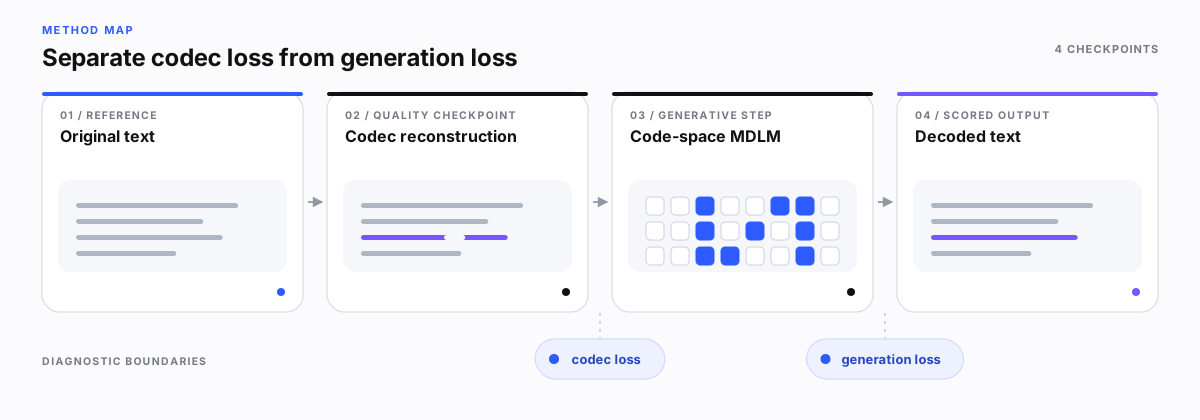
Key idea
A downstream generator cannot recover information that the codec has already discarded. The reconstruction stage must therefore be audited before interpreting latent-generation results.
Difference from nearby approaches
Standard end-to-end comparisons report one final generation score. This protocol inserts a paired reconstruction checkpoint and separates health metrics in latent space from evidence on decoded text.
What is new
The contribution is a reusable staged diagnostic methodology for one concrete compressed-text pipeline, rather than a new denoising algorithm.
Questions this paper helps answer
Open a question for a concise answer grounded in the paper. Detailed evidence boundaries are listed in Limitations.
- Where does quality break in compressed short-text generation?
In the tested TinyStories 64-to-16 pipeline, the dominant degradation appears at codec reconstruction, before latent generation begins. Median external GPT-2 perplexity increases from 15.17 for original text to 27.36 after reconstruction, while p95 increases from 25.10 to 98.91. This is a result for one configuration rather than a universal codec ranking.
- How can codec loss be separated from latent-generation loss?
The staged protocol evaluates originals, paired codec reconstructions, and final generated text with one shared external scorer. The original-to-reconstruction gap estimates the codec contribution, while the reconstruction-to-generated-output comparison helps localize the additional generation-stage loss. Latent health metrics are reported separately from decoded-text evidence.
- How should discrete-latent text generation be evaluated?
The paper recommends checking reconstruction fidelity before comparing generators, applying the same decoded-text scorer at every stage, and reporting central and tail statistics. It also treats codebook usage, geometry, and other latent proxies as diagnostics rather than substitutes for the quality of decoded text.
- Does code-space diffusion outperform token-space diffusion?
Under the shared scorer and tested setup, code-space MDLM reduces mean, median, and p95 perplexity by 32.9%, 30.9%, and 36.6% relative to token-space MDLM. The comparison is descriptive and configuration-specific: it does not establish a universal ranking across datasets, compression ratios, codecs, or diffusion architectures.
- Do better latent geometry metrics guarantee better generated text?
No. In the available matched runs, geometry-aware regularization improved local latent-space proxies but did not improve decoded-text metrics. The result supports auditing every proxy gain at the final decoded output and treating the absence of transfer as a useful negative result rather than evidence of generation improvement.
Comparison with nearby approaches
| Approach | Representation | Control / diagnosis | What is preserved or measured |
|---|---|---|---|
| Token-space diffusion | Text tokens | Generation quality in token space | Fluency and scorer behavior of direct generation |
| Compressed latent generation | Discrete latent codes via a codec | Final end-to-end generation quality | Combined codec and latent-generator behavior |
| Staged bottleneck localization | Text, codec reconstructions, and discrete latents | Separate codec loss from generation loss | Where quality degrades under one shared scorer |
The comparison distinguishes evaluation scope and evidence; it is not a universal ranking of the approaches.
Relevance & scope
The staged protocol is useful when a generative pipeline contains both a learned codec and a latent-space generator, but the source of degraded output quality is unclear.
Compressed and discrete-latent text generation
Codec reconstruction fidelity in generative pipelines
Masked diffusion language modeling in code space
Bottleneck localization and stage-consistent evaluation
Auditing latent-space proxy improvements against decoded text
Limitations
- The empirical study uses TinyStories only.
- The main analysis covers one aggressive 64-to-16 compression regime.
- The evaluated system combines one hierarchical VQ-VAE-2 codec family with one MDLM generator.
- Comparisons are based on single runs and are descriptive rather than multi-seed statistical estimates.
- External GPT-2 perplexity is a shared diagnostic, not a universal semantic-quality metric.
- The conclusions should not be transferred directly to all datasets, codec architectures, or compression ratios.
References cited by the paper
These entries correspond to the numbered References section in the paper PDF.
- Subham Sekhar Sahoo, Marianne Arriola, Yair Schiff, Aaron Gokaslan, Edgar Marroquin, Justin T Chiu, Alexander Rush, Volodymyr Kuleshov. . Simple and Effective Masked Diffusion Language Models. Advances in Neural Information Processing Systems.
- Aaron van den Oord, Oriol Vinyals, Koray Kavukcuoglu. . Neural Discrete Representation Learning. Advances in Neural Information Processing Systems.
- Ali Razavi, Aaron van den Oord, Oriol Vinyals. . Generating Diverse High-Fidelity Images with VQ-VAE-2. Advances in Neural Information Processing Systems.
- Jacob Austin, Daniel D. Johnson, Jonathan Ho, Daniel Tarlow, Rianne van den Berg. . Structured Denoising Diffusion Models in Discrete State-Spaces. Advances in Neural Information Processing Systems.
- Aaron Lou, Chenlin Meng, Stefano Ermon. . Discrete Diffusion Modeling by Estimating the Ratios of the Data Distribution. Proceedings of the 41st International Conference on Machine Learning.
- Xiaochuang Han, Sachin Kumar, Yulia Tsvetkov. . SSD-LM: Semi-autoregressive Simplex-based Diffusion Language Model for Text Generation and Modular Control. Proceedings of the 61st Annual Meeting of the Association for Computational Linguistics.
- Xiang Lisa Li, John Thickstun, Ishaan Gulrajani, Percy Liang, Tatsunori B. Hashimoto. . Diffusion-LM Improves Controllable Text Generation. Advances in Neural Information Processing Systems.
- Huiwen Chang, Han Zhang, Lu Jiang, Ce Liu, William T. Freeman. . MaskGIT: Masked Generative Image Transformer. Proceedings of the IEEE/CVF Conference on Computer Vision and Pattern Recognition.
- Marjan Ghazvininejad, Omer Levy, Yinhan Liu, Luke Zettlemoyer. . Mask-Predict: Parallel Decoding of Conditional Masked Language Models. Proceedings of the 2019 Conference on Empirical Methods in Natural Language Processing and the 9th International Joint Conference on Natural Language Processing.
- Emiel Hoogeboom, Didrik Nielsen, Priyank Jaini, Patrick Forré, Max Welling. . Argmax Flows and Multinomial Diffusion: Learning Categorical Distributions. Advances in Neural Information Processing Systems.
- Alec Radford, Jeffrey Wu, Rewon Child, David Luan, Dario Amodei, Ilya Sutskever. . Language Models are Unsupervised Multitask Learners. OpenAI Technical Report.
- Nils Reimers, Iryna Gurevych. . Sentence-BERT: Sentence Embeddings using Siamese BERT-Networks. Proceedings of the 2019 Conference on Empirical Methods in Natural Language Processing and the 9th International Joint Conference on Natural Language Processing.
- Tianyi Zhang, Varsha Kishore, Felix Wu, Kilian Q. Weinberger, Yoav Artzi. . BERTScore: Evaluating Text Generation with BERT. International Conference on Learning Representations.
- Krishna Pillutla, Swabha Swayamdipta, Rowan Zellers, John Thickstun, Sean Welleck, Yejin Choi, Zaid Harchaoui. . MAUVE: Measuring the Gap Between Neural Text and Human Text using Divergence Frontiers. Advances in Neural Information Processing Systems.
- Lianmin Zheng, Wei-Lin Chiang, Ying Sheng, Siyuan Zhuang, Zhanghao Wu, Yonghao Zhuang, Zi Lin, Zhuohan Li, Dacheng Li, Eric P. Xing, Hao Zhang, Joseph E. Gonzalez, Ion Stoica. . Judging LLM-as-a-Judge with MT-Bench and Chatbot Arena. Advances in Neural Information Processing Systems, Datasets and Benchmarks Track.
Resources & reproducibility
- Publisher
- IEEE
- Local text PDF
- Final accepted manuscript (author-posted version with DOI)
- Publication resources
- The public manuscript, results tables, explanatory figure, and citation files are available here. Implementation code and checkpoints are not publicly released.
Data statement
- Source
- TinyStories, as described in the paper.
- License
- Use of TinyStories remains subject to the dataset's own terms; no dataset files are redistributed by this site.
- Preprocessing
- GPT-2 tokenization, fixed 64-token inputs, and hierarchical temporal compression from 64 to 32 to 16 positions.
- Split
- The publication reports 256 paired reconstruction samples and 251–256 generated samples per mode; it does not publish a reusable train/validation split manifest.
- Format
- Short text samples, GPT-2 token sequences, discrete code sequences, generation logs, and summary tables.
- Version / checksum
- A dataset checksum or immutable TinyStories snapshot identifier is not reported in the paper.
- Acquisition
- A public acquisition script is not released with the publication page.
- Use limits
- The evidence covers short synthetic stories and should not be treated as a benchmark for unrestricted natural-language generation.
Versions
The published DOI is the primary bibliographic identifier. This page remains the single canonical project URL across versions.
Comments
Nothing yet. Say the first thing.
Sign in to join the conversation.