
One of the most shocking paintings in the marvellous Turner and Constable exhibition at Tate Britain is of the Palace of Westminster in flames in 1834.
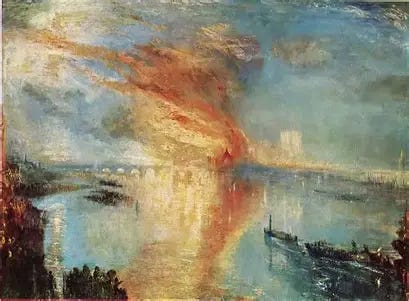
The picture now hangs in Cleveland Ohio, so Londoners should see it as often as they can while it is in the Tate and ask themselves the relevant question of what we should do to preserve the Parliament buildings erected in place of the Palace which was burnt to the ground three years before Queen Victoria came to the throne.
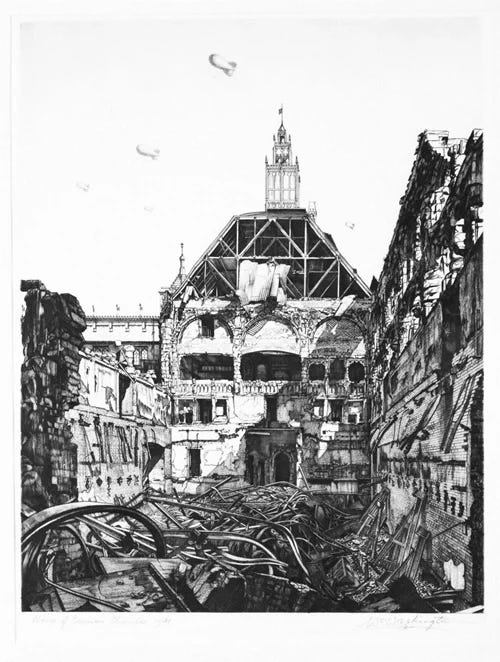
A little over a century after accident destroyed the Palace of Westminster, German bombardment looked as if it might destroy the buildings of Barry and Pugin.,
My photo shows the damage inflicted by the Luftwaffe on the Palace of Westminster.When news broke some weeks ago that
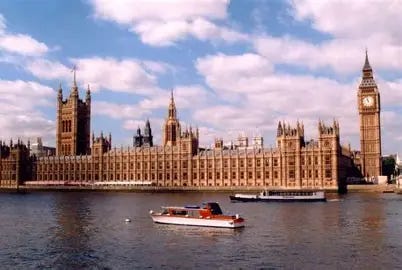
the Palace of Westminster was in a state of advanced decay, there was a range of mixed reactions.
Matthew Parris, contrarian commentator and former Tory MP, thought that the solution would be to pull the whole bulding down and start again. Others huffed and puffed about the Mother of Parliaments.
I have just had the most enthralling guided tour by Dr Simon Thurley

and felt privileged to be accompanying bigwigs such as the Chairman of the Victorian Society, actor Griff Rees Jones, round the bowels of the building.

We walked through the Chamber of the Commons, and then, having woven our way through Gothic corridors and panelled pseudo-olde-tyme Victorian rooms, we wernt down into the Guy Fawkes parts, and crawled past antiquated pipe-work, innumerable wonky-looking antique electric wiring; and it was all too believable that the dear olf place was in need of a bit of repair. It is going to be horrendously expensive.
What I had not realized, until Simon Thurley, assisted by the team of conservationists, restorers et al, explained, was that making a decision about the matter will be a complicated matter. The Palace of Westminster is not owned by the Crown, and it is not controlled by the Government. The two HOuses of Parliament are in a position a little like tenants or leaseholders, and it is up to them to appoint spokespeople to decide which course of action to follow.
Should they close the whole place down , possibly for decades, while they restore it? Or is it possible, as the optimistic Dr Thurley told us, to do it piecemeal and have a few periods when, say, the Commons sit in the House of Lords, and the House of Lords maybe over the road in the Queen Elizabeeth II Conference Chamber ?
Thurley asked us interesting questions - whether our (unwritten) constitution is in part shaped by the geography of the building. The proximity of the two chambers: does that partly shape the way the whole system works? If they closed for decades, and the Commons met in London and the Lords in some farflung spot, would this not radically alter the way Parliament, hence our democracy, functions?
Deep waters. We were shown a doorway which had been closed, and then opened again and then closed, in the course of centuries of the building’s changing use. Griff made the brilliant remark that the whole point of Victorian architecture was - he cited the only semi-penetrable John Rylands Library in Manchester - the DIFFICULTY of access. They deliberately did not want to be visitor-friendly. He did not make any heavy point, but that, like the decay of pur Parliament building itself, seemed like a metaphor.
What I had not realized, until today’s absolutely rivetting tour, was how much of the OLD Palace, survives. We met in the Cloisters, which I did not even know existed. They were built in the time of Cardinal Wolsey, and have wonderful fan vaulting of the 1520s. They must be among the most beuatiful architecture in London. They got a direct hit in the Second World War, but only some of the cloister was destroyed (and rebuilt). The rest is authentic, with ceiling bosses in the lovely (Caen stone) vaulting, showing the heraldic emblems and devices of Wolsey and Catherine of Aragon and (spit, spit) Henry VIII.
After the Second World War these cloisters became offices for politicians and in one little niche, which had formally been a chapel in the medieval college, which was housed there, is something called the Cromwell Room. Legend ( false apparently) had it for years that this was where Cromwell signed the death warrant for Charles I.
Its last use as an office was for Gordon Brown.
I had been in two minds about what should happen to the Palace of Westminster until I had this tour. I now think it MUST be saved for the nation, and that it could not be in a better pair of hands than those of Simon Thurley. He is a positive, energetic figure, who says an EVERLASTING YEA to life. He said that MOST of the work will be done underground, to all the Heath-Robinson wiring, heating, plumbing etc. He said that the bulk of it could probably done in about eight years. Assuming that building work always takes longer than the builders promise, that is surely good news - the Palace of Westminster could be repaired within the next twenty years,,, IF Parliament gets a move on, and IF they vote to pay the necessary costs.
Speaking personally, I’d rather have a perfectly restored Parliament than a nuclear war-head, and if we scrapped our nuclear capability, would this not pay for the whole job? More later, but these were some early first impressions.
No posts
Comments
Nothing yet. Say the first thing.
Sign in to join the conversation.