
My distaste for E.M.Forster grows with the years, and my opinions of his over-rated novels declines. Last time I tried Passage to India, I gave up after a hundred pages. He thinks he is being so brave, attacking the coarse-grained English; and so big-hearted, romanticising the Indians, but in fact his atttitude to the Indians came over as an odious combination of priggish and unintentionally racist; the imperialist Kipling, in KIM, which I then re-read, is much better informed about Indian religion, culture, languages, and , although Kipling was as coarse-grained as the English Forster satirized, he is also in every way a bigger writer, a larger imagination.
At least he would never have given utterance to E.M. Forster's fatuous statement ,"If I had to choose between betraying my country and betraying my friend, I hope I should have the guts to betray my country."
It sounds so beautiful, doesn’t it, but it is a meaningless statement. Since when was it ever an alternative? It is often trotted out as having some relevance to the Cambridge spy ring, not least, one supposes because Forster was sitting comfortably in his rooms in King’s College while Philby and co , only yhards away from Forster’s comfortable ‘set’ , were being recruited by their Soviet minders, and going on to betray almost every personal friendship, every marriage, every relationship into which they entered, while wallowing in the thrill of betraying their country. They enjoyed plum jobs, they got richly rewarded for their murderous activities, they ate and drank themselves silly in clubland and they died in their beds. They also , of course, betrayed the agents in the field and the peoples of the Ukraine, Poland, and other parts of the Soviet bloc, who looked to Britain to help them, as they suffered under the most appalling tyranny ever known to human history. Agents betrayed by Kilby were tortured, and their families were compelled to look at their mutilated bodies which were put on public display in the Ukraine. Only one of many details laid bare in an absolutely magnificent new book about the whole story by Antonia Senior - STALIN’S APOSTLES. The double-meaning of the title is alone brilliant: for these defenders of the indefensible were both advocates for a regime which enslaved millions of human beings for two generations, but also part of the prissy intellectual group in Cambridge which was nicknamed ‘the Apostles’. No one, not even Cambridge was to blame, Auden wrote in a very different context. Reading this book, you feel the opposite, EVERYONE is to blame, and especially Cambridge.
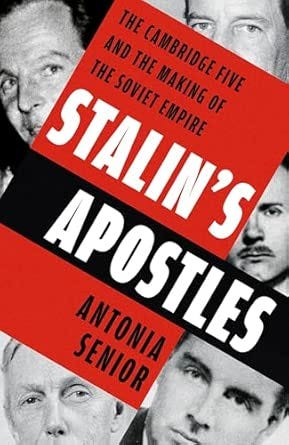
It is a horribly upsetting story, and not just because
Comments
Nothing yet. Say the first thing.
Sign in to join the conversation.