
History has a way of humbling even the most carefully curated displays of power. Standing in the Green Vault in Dresden, I carried out a question that had begun forming in that jewel-filled chamber: what survives when ego does not?
The very city Augustus labored to immortalize—his Florence on the Elbe—was reduced to rubble in February 1945. Allied firebombing consumed Dresden in flames so fierce they seemed to mock humanity’s longing for permanence. The Frauenkirche collapsed. Palaces burned. Streets that once echoed with ceremony filled with ash.
The Green Vault did not escape.
Its treasures were hastily evacuated for safekeeping. Then, in the chaotic aftermath of war, they vanished.
When the Soviet Red Army entered Dresden, much of the collection was taken to the Soviet Union as war reparations. For years, the jewels—including Aurangzeb’s birthday court—remained hidden in Russia.
What had been assembled to glorify empire was now boxed, transported, displaced.
Emperors across continents had sought permanence through splendor. Yet their legacies were packed into crates and carried off by soldiers indifferent to symbolism.
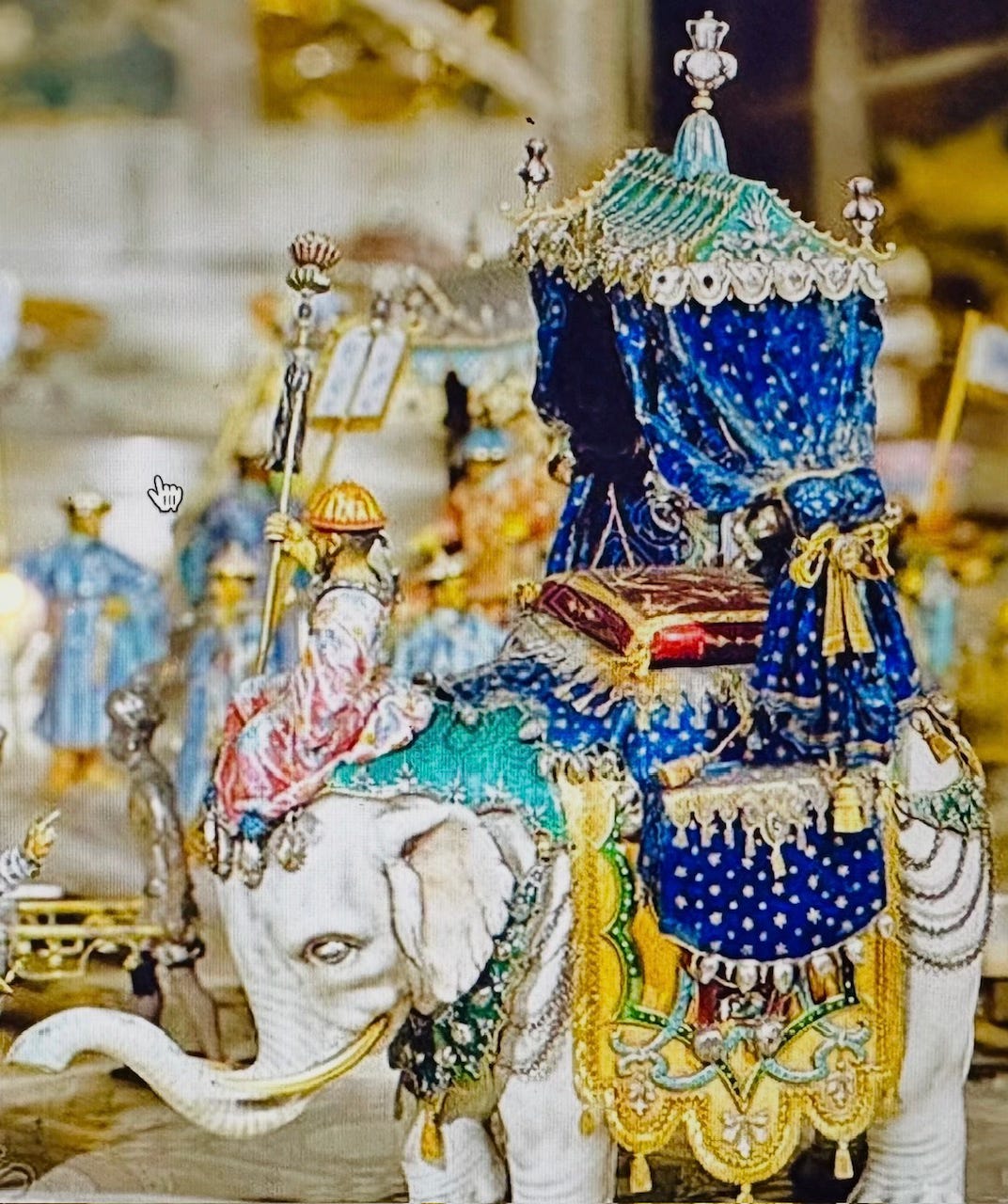
Gold survived, but only the care that shaped it truly endured. The diamonds, rubies, emeralds, and pearls remained intact through ambition, war, exile, and return. The empires that glorified them dissolved into memory. The rulers who believed themselves permanent became footnotes.
If reflections like this resonate, you can subscribe here.
What endured was not conquest. Not spectacle. Not ego.
What endured was craftsmanship.
Patient creation.
Work done in absorption rather than domination.
The Bhagavad-gītā reminds us that the reward of action is not the applause it earns, but the unfolding of one’s own inner perfection.
yataḥ pravṛittir bhūtānāṁ yena sarvam idaṁ tatam
sva-karmaṇā tam abhyarchya siddhiṁ vindati mānavaḥ
From whom all beings arise and by whom all this is pervaded
by worshipping Him through one’s own work, a person attains perfection.
(Bhagavad-gītā, Chapter 18, verse 46)
Dinglinger’s hands are gone. Augustus and Aurangzeb are dust. Yet the quiet integrity of Dinglinger’s work still refracts light centuries later.
Text within this block will maintain its original spacing when published
Standing there in Dresden, the lesson turned inward. If the work is what endures, then each of us is called to attend carefully to our own small corner of it—whether that means shaping a sentence, raising a child, tending a classroom, or building something with our hands.
The realization settled gently: the ego longs to be remembered. The Self is truth— Sat–Chit–Ananda.
In devoted work, truth quietly shines.
The world dazzles us with power and splendor. Yet what sustains humanity is something far quieter—work aligned not with the need to dominate, but with the discipline to create.
Beauty born of ego flashes brightly.
Beauty born of absorbed work endures.
And that, I suspect, is the real treasure in the Green Vault.
Not Aurangzeb.
Not Augustus.
Not even Dinglinger.
But the work itself.
Meaningfully yours,
Anu Prabhala
P.S. This reflection is adapted from a chapter of my book-in-progress, Imperfectly Perfect: Love Letters to the World, where I explore how travel, history, and spiritual philosophy converge around a single question: what truly endures when power fades?
If this reflection spoke to you, feel free to share it with someone who values history, craft, or quiet endurance.
No posts
Comments
Nothing yet. Say the first thing.
Sign in to join the conversation.