
There it stood, inside the Green Vault of Dresden Castle—a glittering diorama fashioned from 5,223 diamonds, 189 rubies, 175 emeralds, 53 pearls, two cameos, and a single sapphire.
I briefly wondered who had the patience to count them, and whether they trusted their own arithmetic.
At first, all I saw was excess. Sparkle. Spectacle.
And then I recognized him.
An emperor I had first encountered in school textbooks half a world away, in Mumbai, India. Aurangzeb.
I had not expected to meet him clad in diamonds. In Germany, no less.
Standing there, I felt that peculiar warmth that arrives when distances collapse—the quiet comfort of realizing the world is smaller than you thought.
Here I was, face-to-face with the fiftieth birthday celebration of a Mughal ruler in Dresden, Germany—not exactly the detour one expects on a European museum itinerary.
The piece bore its grand title without hesitation: The Royal Household at Delhi on the Occasion of the Birthday of the Grand Mogul Aurung-Zeb.
Subtlety, clearly, was not the point here.
I stood stunned.
What was this Mughal ruler doing here, in the heart of Europe?
And why did I feel, irrationally, as though I had just bumped into a warm ancestor at a dinner party—when history insists he was anything but?
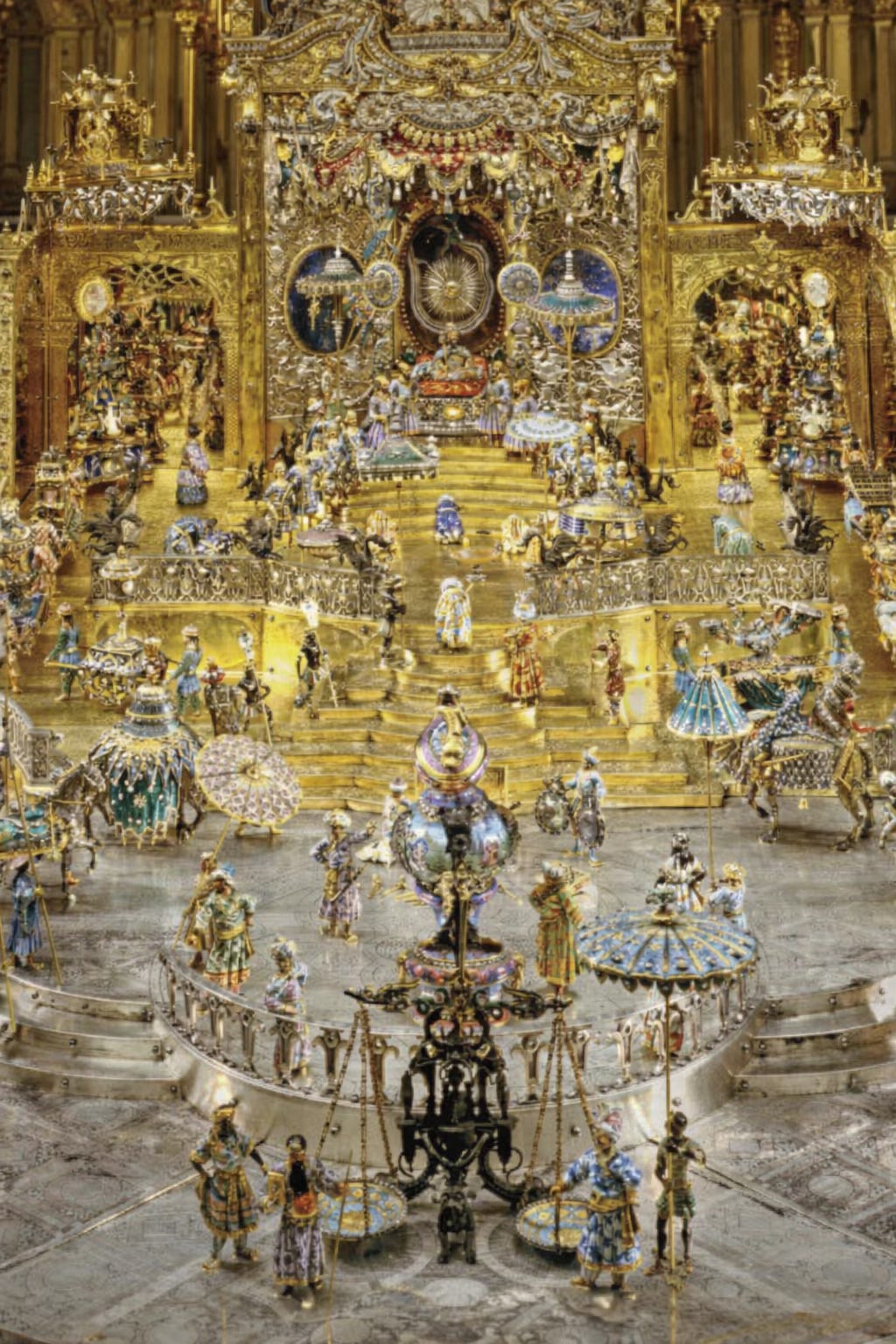
The answer, in many ways, was already present in the moment. Despite oceans, empires, and centuries that separate us, someone here had been paying close attention to a history I once thought was mine alone.
For a moment, the map seemed to rearrange itself. What lesson was this encounter offering?
Text within this block will maintain its original spacing when published
If reflections like this resonate with you, consider subscribing to my Substack.
The diorama itself was modest in size—barely four feet wide and less than two feet deep—but staggering in workmanship. At its center sat a gilded Aurangzeb, enthroned beneath a jewel-studded canopy, elevated unmistakably above all others.
He was even depicted during the Tulā-dān ceremony—the ritual in which the sovereign is weighed against gold and precious stones on his birthday. One pan of the balance held Aurangzeb himself; the other overflowed with treasure, destined for alms.
The symbolism was blunt and breathtaking: a ruler whose worth could be measured in jewels.
It was power made literal—not an ounce of modesty in sight, yet almost refreshingly honest.
Courtiers clustered around him, their turbans, robes, and sashes rendered in diamonds, rubies, emeralds, and pearls. Each face was individualized. Each posture choreographed. Elephants loomed at the edges, adorned with gem-encrusted trappings. Horses appeared mid-step, bridles flashing. Musicians held instruments frozen as if sound itself had been suspended.
Nothing was casual. Nothing accidental. It was all part of the master plan of the eighteenth-century goldsmith Johann Melchior Dinglinger, who labored for eight years to complete this work. The work was not commissioned. It was created to demonstrate mastery—to prove what human devotion to craft could achieve.
Eight years.
That kind of patience is not ambition. It is absorption. In Vedanta, this is karma yoga—the absorption in action where the doer and the deed dissolve into one.
Dinglinger worked alongside his brothers—one an enamel artist, the other a goldworker—bringing to life a Mughal court he had never seen, relying on travelers’ accounts and imagination. Devotion traveled where he could not.
But devotion to craft rarely remains unseen.
The sheer excess of the piece—its hierarchy, spectacle, and visible power—caught the eye of Augustus the Strong, Elector of Saxony.
Augustus purchased the diorama for an enormous sum, said to exceed the cost of constructing one of his castles.
He did not see a miniature Delhi court.
He saw himself.
Augustus did not choose Aurangzeb by accident. He recognized him.
Not morally, but energetically.
I could see it so clearly in Augustus.
Standing there, it felt as though the ego speaks a universal language across continents and cultures. It understands hierarchy. It reveres spectacle. It seeks immortality through form.
The diorama did not merely depict a Mughal emperor. It mirrored a Saxon ruler who, too, believed that legacy could be secured through splendor.
Two empires.
Two men who would never meet.
One shared conviction: that power, if made visible enough, might endure.
And yet as I stood there beneath the vaulted ceilings of the Green Vault, surrounded by diamonds that had crossed oceans and centuries, another question began to surface—quieter, but more unsettling.
Aurangzeb is gone. Dinglinger is gone. Augustus is gone.
The diamonds still glitter.
If ego recognizes ego across time and distance, what survives when ego does not?
That was the real treasure hidden in the glass case.
And I had not yet reached it.
— To be continued —
P.S. This essay is adapted from a chapter of my book-in-progress, Imperfectly Perfect: Love Letters to the World, where I explore how travel reveals deeper truths about ego, impermanence, and what endures. Part 2 continues this reflection.
If this reflection sparked something for you, share it with someone who loves history, travel, or big questions.
No posts
Comments
Nothing yet. Say the first thing.
Sign in to join the conversation.