
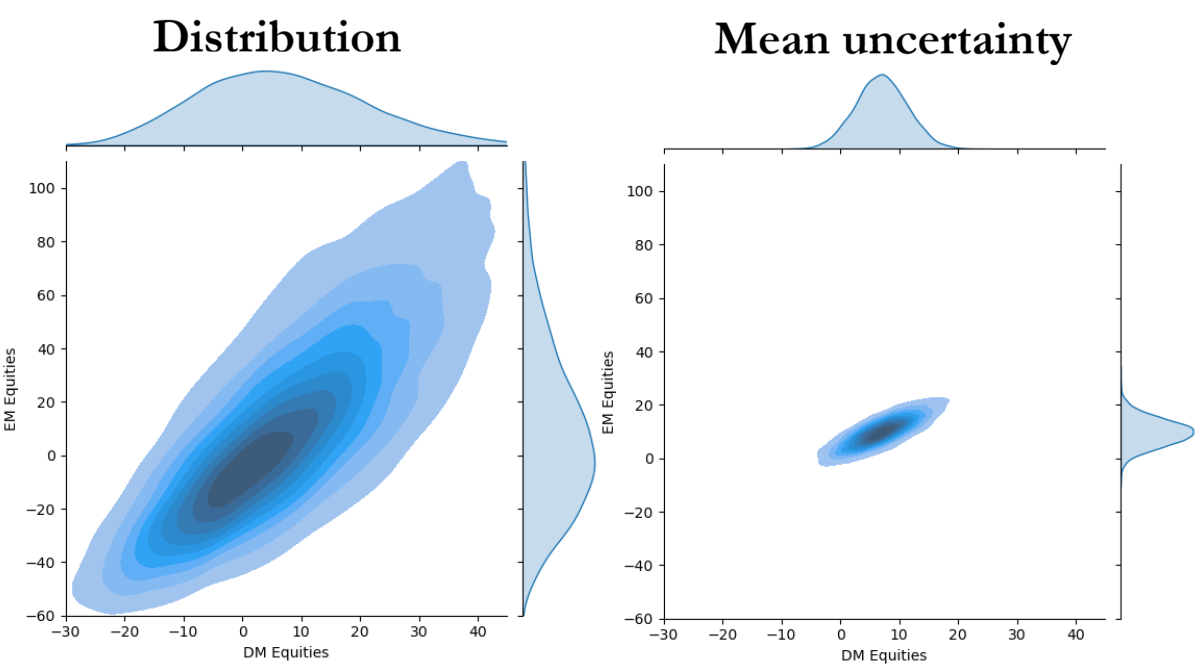
It is well known that portfolio optimization results are sensitive to the market model input, in particular the expected returns which are arguably also the hardest to estimate.
Various approaches have been proposed to handle the parameter sensitivity, designed to reduce the effect on optimal exposures due to relatively minor changes in the market model.
In practice, we experience that some variant of resampled portfolio optimization is preferred due to its versatility. You can learn much more about resampled portfolio optimization in the Portfolio Optimization and Parameter Uncertainty article and Chapter 6 of the Portfolio Construction and Risk Management book, which introduces the Resampled Portfolio Stacking approach. Lecture 10 from the Applied Quantitative Investment Management course gives a thorough video walkthrough of all the above.
In this Python case study, we will examine how sensitive CVaR portfolio optimization is to changes in expected returns when the problem is properly set up with overall portfolio risk targets and risk budgets, see Section 6.3 in the Portfolio Construction and Risk Management book.
We will use the P&L simulation from the Portfolio Management Framework for Derivatives Python case study and introduce three benchmarks similar to the Tactical Asset Allocation Lower Performance Lower Bound case study.
Using the three benchmarks, the following CVaR portfolio optimizations are performed:
Target risk optimization with and without transaction costs.
Target risk and CVaR tracking error constraints optimization with and without transaction costs.
All the above using the Resampled Portfolio Stacking approach that properly uses Entropy Pooling to introduce consistent derivatives parameter uncertainty.
For all the cases above, we will adjust the expected return estimates on key asset classes to assess how they are affected by these changes.
Note that compared to some alternative methods, there is an explicit optimization of the risk-adjusted return, ensuring that it is as good as possible given the particular constraints and parameter uncertainty.
The PDF of the Jupyter notebook below uses the Investment Analysis module for all the computations, with the overall conclusion also summarized below.
Comments
Nothing yet. Say the first thing.
Sign in to join the conversation.