
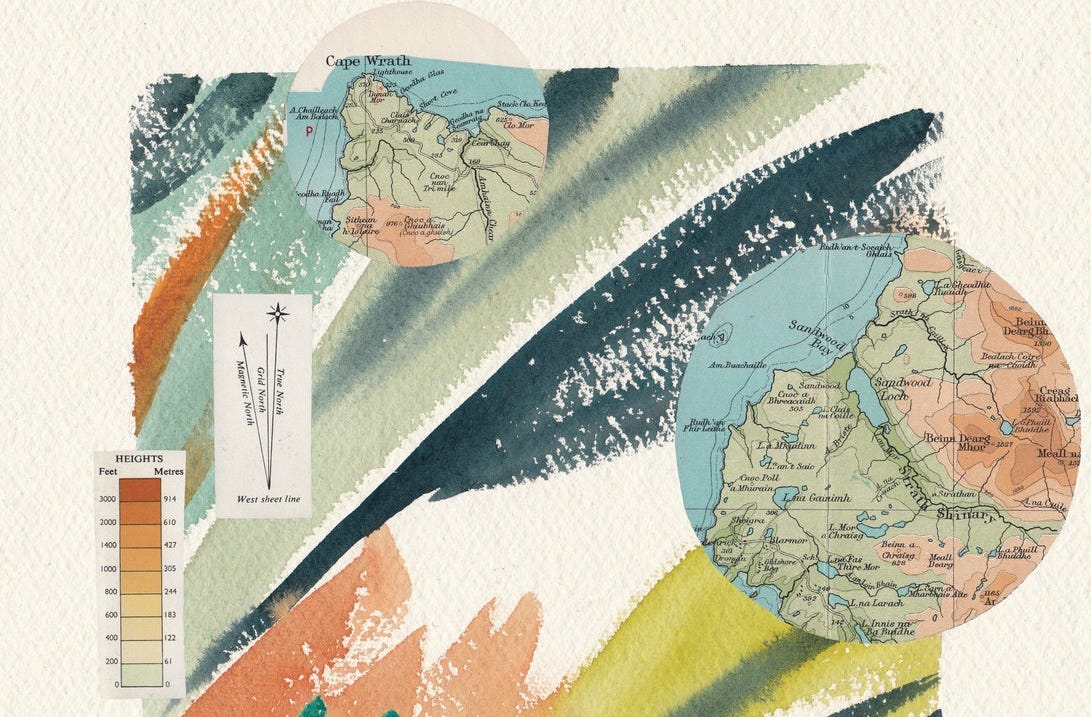
In the summer of 2023, Jenny Sturgeon walked 864km across Scotland, from Kirk Yetholm near the border with England, to Cape Wrath Lighthouse, at the far north west of the mainland. This album is a sound diary of her journey, the length of each track corresponding to the distance walked that day (6 seconds per kilometre), and named after the what3words location where it was recorded. A slow listen that brings you down to Sturgeon’s pace, paths.made.walking is an intimate portrait of a landscape at ground level, and an invitation to attend to the details of environments through which we pass. Sturgeon also includes instructions for listening (using headphones at around 1/3 of the full volume, to match the ambient sounds outside), inserting her recordings into the environments in which they’re being re-encountered. (Thanks to Tommy Perman for the tip!)
Staying in Scotland for something altogether different, Cupar Grain Silo is both the name of and site where Sam Annand composed his debut release for Blackford Hill Audio. Initially part of a project on reverberant spaces, the silo’s 60-metre tower has a reverberation time (the time it takes for sound to fade) of 36.5 seconds, which is three times that of St Paul’s Cathedral. Leaning into its acoustic properties and weaving the silo’s reverb into his own electronic productions, the resulting album plays with the sonic properties of this unique piece of architecture, referring back to Scotland’s industrial heritage in the process.
The collection I did not know I needed, and maybe you didn’t either. Four hours of field recordings and soundscape compositions stitched together from the warbling, freewheeling, stridulating melange of acoustic signals and “non-human semantics” of the animal kingdom. What does that mean in pratice? Maybe just what you’d expect: “Little-known vibroscapes of insects, the hiccuping calls of hammer-headed bats, the peculiar gurgles of rock ptarmigans, the eerie signals of ribbon seals, the formic attacks of ants, a detour to the rhythm of yeast, the rustles of pink river dolphins, and the whimsical cries of tropical frogs.” For more from (forms of minutiae) you can read my interview with label foudner Pablo Diserens here.)
The release that proves once and for all that Kate Carr can make music out of literally anything. Carr and Iain Chambers’ Rubbish Music project has previously used sophisticated, playful foley techniques to question our relationship with waste, but none has tackled quite such a gargantuan task as the monstrous subterranean conglomeration of wet wipes, nappies, food waste and oil known as the fatberg. A deeply unsettling, fabulously strange listen, and my pick for this year’s Christmas #1.
Multi-disciplinary artist An-Ting 安婷 delves into the frenzied, confusing world of interspecies communication on a record that abstracts our relationship with both birdsong and the brooding electronics she folds them into. Featuring binaural recordings made in the UK, Mongolia, Sichuan, Hong Kong and Taiwan, each track riffs on a different bird, whose idiosyncratic chirping cues up the sonic world that is created for it to dwell in. In some ways perhaps an interesting companion piece to Kate Carr’s A Field Guide to Phantasmic Birds, which she discussed in our interview on the newsletter last year.
Sound captures change in a way that images capture instances. Having lived in Estonia for 20 years, John Grzinich has become acquainted with the mutable temperaments of ice, dynamic shifts of which occur over time and are often registered as sonic events. These recordings document ice in its transitional states, and aside from emphasising what a fluid entity ice can be, also reveal some of its more haunting qualities. Or to quote Chris Thompson, to whom I sent this a few weeks ago: “It’s no surprise people hundreds of years ago had such fantastic myths and mysteries. It’s the middle of the night and you catch those noises from the depths of the darkness. A pure feast for the imagination!”
I came across this release recently on Bandcamp’s monthly field recording rundown (which is also worth checking out), and loved both the gentle nature of the music and the simplicity of the idea - featuring three water-powered instruments that Tassie designed with Sam Underwood to be played by the water of the Rivelin Valley in Sheffield. “Playing beside the water meant becoming attuned to its sounds and pace,” Tassie explains, “to the way the river played the instruments, to how the environment dictated the tempo and feeling of a track.” An unsentimental nod to the mills and water-wheels of the region’s industrial heritage, and an original take on the compositional potential it contains.
Since it launched in 2023, I’ve been doing a bit of work for Thea H-D’s ODDA Recordings, whose catalogue of releases engages among other things with ideas of memory and landscape. That I didn’t work on this one gives me even more licence to include it here (after I was alerted to it again by Eoin Murray’s excellent Irish music newsletter Anois, Os Ard). Blending traditional Irish fiddle with field recordings from Connemara, the windswept region on the West Coast of Ireland where Fohn’s father’s family is from, Seanteach (which translates as ‘old house’) is thick with a spectral melancholy that reminded me of a provocation sound artist Cathy Lane once posited: “do past lives and past events leave sonic traces and how can we hear them in the present?”
Lots of spine-tingling bubbles, gurgles and ripples to get stuck into here on French artist Clarice Calvo-Pinsolle’s new project as Lamina. Tactile, visceral recordings of water swill in and out of focus so effortlessly it’s sometimes hard to know where the organic ends and the synthetic begins. Theoretical frameworks come in the form of hydrofeminist and posthuman ideas, such as that of Astrida Neimanis’ Bodies of Water. I’ve had this on a few times now and each time I’ve found myself submerged in the best possible way.
Expansive drones and detailed field recordings weave their way into the texture of Lagos-based composer Ibukun Sunday’s new record Harmony/Balance. I came across this on Marc Weidenbaum’s recommendations column from his This Week in Sound newsletter (well worth checking out too) and gracefully defer to The Guardian’s astute description of Harmony/Balance as a record that “sometimes flirts with dystopian horror, but always resolves itself, throbbing and glistening with a quietly ecstatic joy.”
It’s always a joy to encounter a new Félicia Atkinson record and on Space as an Instrument she positions her inquiry at the intersection of the self and universe, the voice and the void. Interested in temporal and spatial scales, and the blurring of internal and external environments, Atkinson plays with depth and intimacy through the use both of her own spoken word and field recordings which shimmer and slip through the fabric of the work. The centrepiece for me - and perhaps of the record as a whole - is the unsettling ‘Thinking iceberg’, written in response to Olivier Remaud’s book Thinking Like An Iceberg, which explores a more-than-human perspective on the relationship between ice, time and culture. Through delicate syncopations of found sound and synth drones, it is a composition of contrasts - both stark and poetic, vast in its scope and sensitive to the smallest details.
“One hears it without listening as one breathes without thinking,” Nan Shepherd wrote of a river she encountered in Scotland’s Cairngorm Mountains. “But to a listening ear the sound disintegrates into many different notes.” Listening, for Shepherd, was a conscious act and one that connected her with the natural world. This new EP by singer-songwriter and sound artist Alice Boyd was inspired by 4 days spent retracing the Shepherd’s footsteps across the Cairngorms, featuring five compositions that draw on elegiac folk and chamber pop instrumentation, while also leaning into Boyd’s work as a field recordist. I’ve only heard ‘Little River’ so far, but I love how it conveys something of the wonder and sadness of a landscape I’d previously only encountered in Shepherd’s words.
I had intended to start this section flagging a recent Short Cuts episode on Sound Waves that was aired on BBC Radio 4 and which you can listen back to here. But with news that the BBC has decided to bring the series to an end, it feels even more important to point to the wonderful archive of audio documentaries and adventurous sound works that Short Cuts has broadcast over the last 12 years.
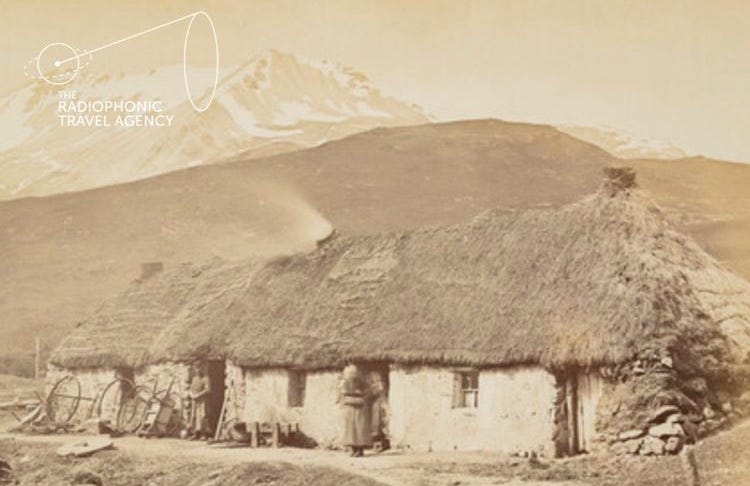
The Radiophonic Institute (responsible for the Sound of the Year awards, Museum of Sound and Oram Awards among other things) has launched a new podcast called The Radiophonic Institute Travel Agency promising imaginative sonic journeys across time and space. The first is a piece of fictional time-travel recalling Scotland Before & After the Highland Clearances, while the latest episode takes a trip to the Maunsell Forts in the Thames estuary - abandoned WW2 platforms that have variously been squatted by pirate radio broadcasters and utopian micronation builders.
Jana Winderen’s sound piece The River is currently installed at the Natural History Museum. Recorded beneath the River Thames and presented on a large array of spacialised speakers, it is one of the few installations that you’d actually be justified to call “immersive”. There’s also something quite surreal about hearing the aquatic life and boat engines merge with the thundering footsteps of over-stimulated children, who are really only there to see the dinosaurs.
At The Serpentine this autumn is Holly Herndon & Mat Dryhurst’s The Call, which makes a case for collaborative sound making in the age of AI. I love Herndon’s music and her exploration of artificial intelligence as a viable creative tool is a breath of fresh air in a debate that tends towards extremes. Here, the duo use the choral tradition of call-and-response as their medium through which to encourage collaboration between visitors and the machine learning models they’ve trained.
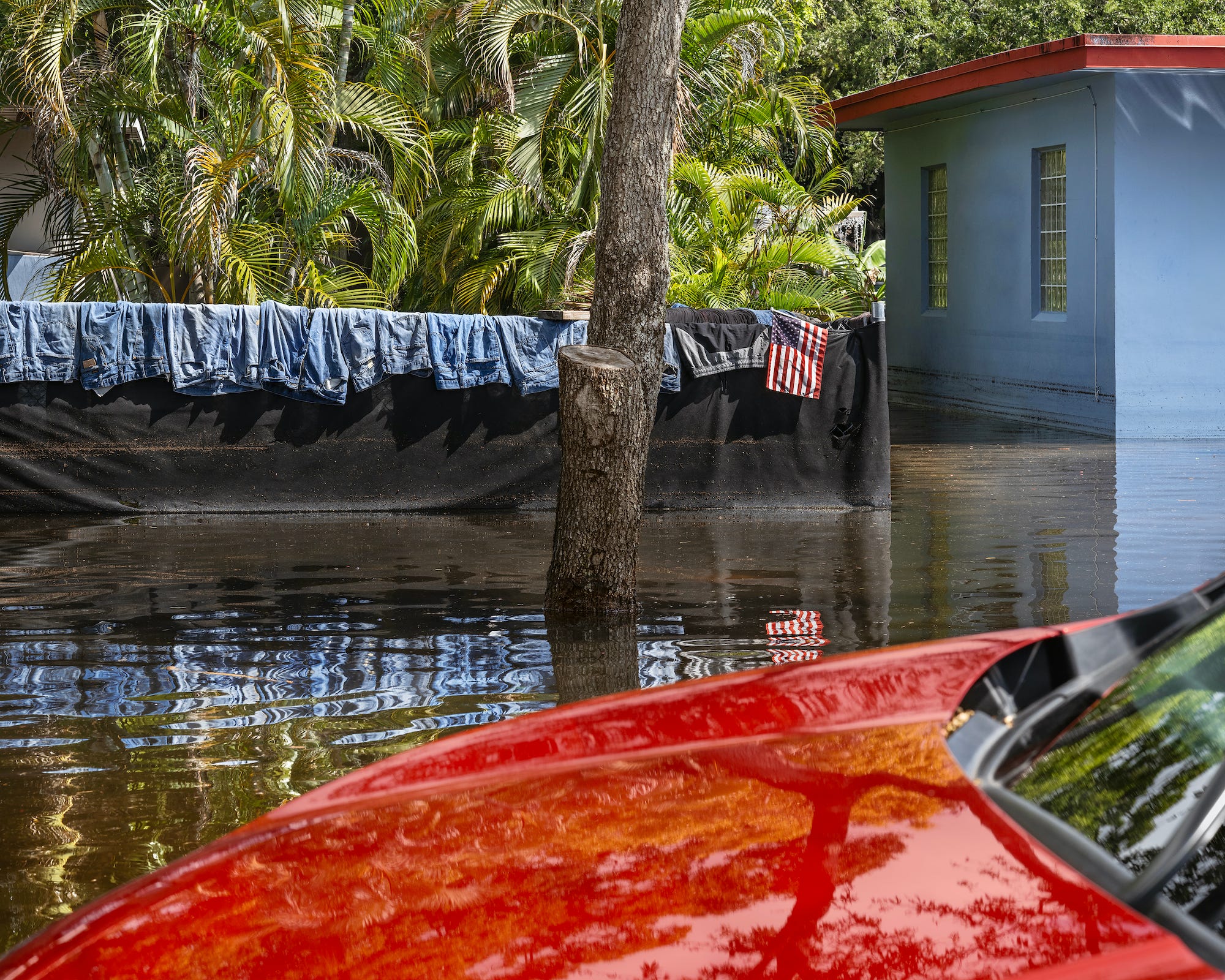
Photographer Anastasia Samoylova’s Adaptation opened this month at the Saatchi Gallery. In work that engages with the often absurd post-natural landscapes we live amongst, Samoylova captures the rising tides of late capitalism in eerie and painterly tones. The work is full of puzzles and subtle juxtapositions, linking the climate crisis, inequality and advertising in ways that feel all the more pertinent following the reelection of Donald Trump.
“I am concerned with the power of sound! And what it can do to the body and the mind.” This quote from Pauline Oliveros sits at the centre of a new collection of writings called Bodies of Sound: Becoming a Feminist Ear. Edited by Irene Revell and Sarah Shin, and published by Silver Press, it “offers a resonant exploration of feminist sonic cultures and radical listening in over fifty contributions.” I’ve only managed to dip into it since picking up a copy last week but have already enjoyed pieces by Sara Ahmed, Cathy Lane, Christina Hazboun and Tomoko Hojo.
Sonic Faction is a new collection edited by Justin Barton, Maya B. Kronic and Steve Goodman exploring the audio essay as medium and method. Here contributors include Lawrence Abu Hamdan, Angus Caryle and Kodwo Eshun, among others.
Another edited collection on the academic side of things is The Routledge Companion to the Sound of Space, which is edited by Emma-Kate Matthews, Jane Burry and Mark Burry. Needless to say the proposition to explore the conceptual and practical relationships between sound and space lends itself to a wide variety of approaches, which open out to include “technical, creative, cultural, political, philosophical, psychological, and physiological perspectives”.
Palestinian poet Mosab Abu Toha’s latest collection Forest of Noise has been published in the UK. Like his previous collection Things You May Find Hidden in My Ear (which inspired this post on the sound of war last year), there is a sonic quality to Toha’s writing which expresses in immediate clarity the resilience and struggle of living under occupation and unfolding genocide. This interactive feature by The Guardian also does a powerful job of communicating the trauma of life in Gaza “amid the incessant sounds of war.”
The LCC / CRiSAP Autumn Sound Arts lecture series has a few more dates lined up before the end of the year, including sound artist and architect Mhamad Safa on 5th December and composer, turntablist and performer Mariam Rezaei a week later on the 12th December. Free ticket sign-up is here.
Also on the 12th December, Safa will be in conversation with Gascia Ouzounian to discuss ‘counter-listening’ or “listening against official and hegemonic narratives of contested events, including in the contexts of war and genocide; and listening for sounds and voices that have been occluded and erased, particularly in the aftermath of mass violence.” The talk is part of the RCA School of Architecture's programme "Sonic Architectures", and you can sign up here.
And finally… Werner Herzog listening to seals. When possibly he could have been listening to dolphins too.
If you’ve made it this far, well done! Hopefully with more regularity these round-ups won’t be quite so long. If there’s something you’d like to recommend for next time, stick it in the comments below.
No posts
Comments
Nothing yet. Say the first thing.
Sign in to join the conversation.