
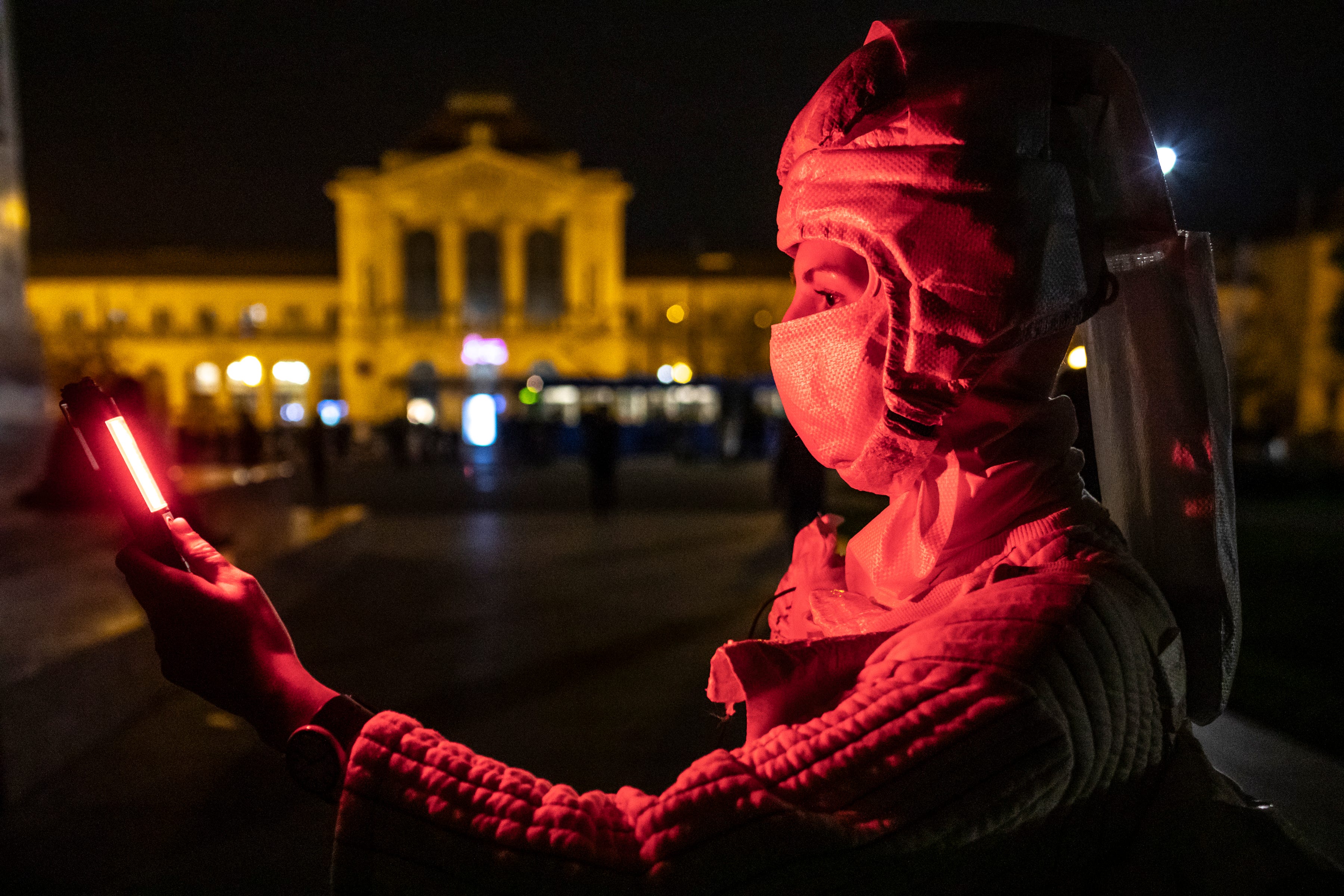
Maja Zećo lived through the Bosnian War and the siege of Sarajevo in the early 1990s, but considers herself lucky it took place before the era of military drones. As a survivor of conflict, her interest in exploring the experiences of war has become an important part of her work, particularly in relation to how it manifests in questions of migration, displacement and environmental change.
In 2025 she ran a soundwalk workshop through London called Emitters & Receivers - Listening with Aerial Drones in which participants were given the sounds of military drones to play from their phones as they walked through the city. The impact was confronting for both participants and the people they passed on the street, and it is in staging these jarring encounters that Zećo’s work thrives.
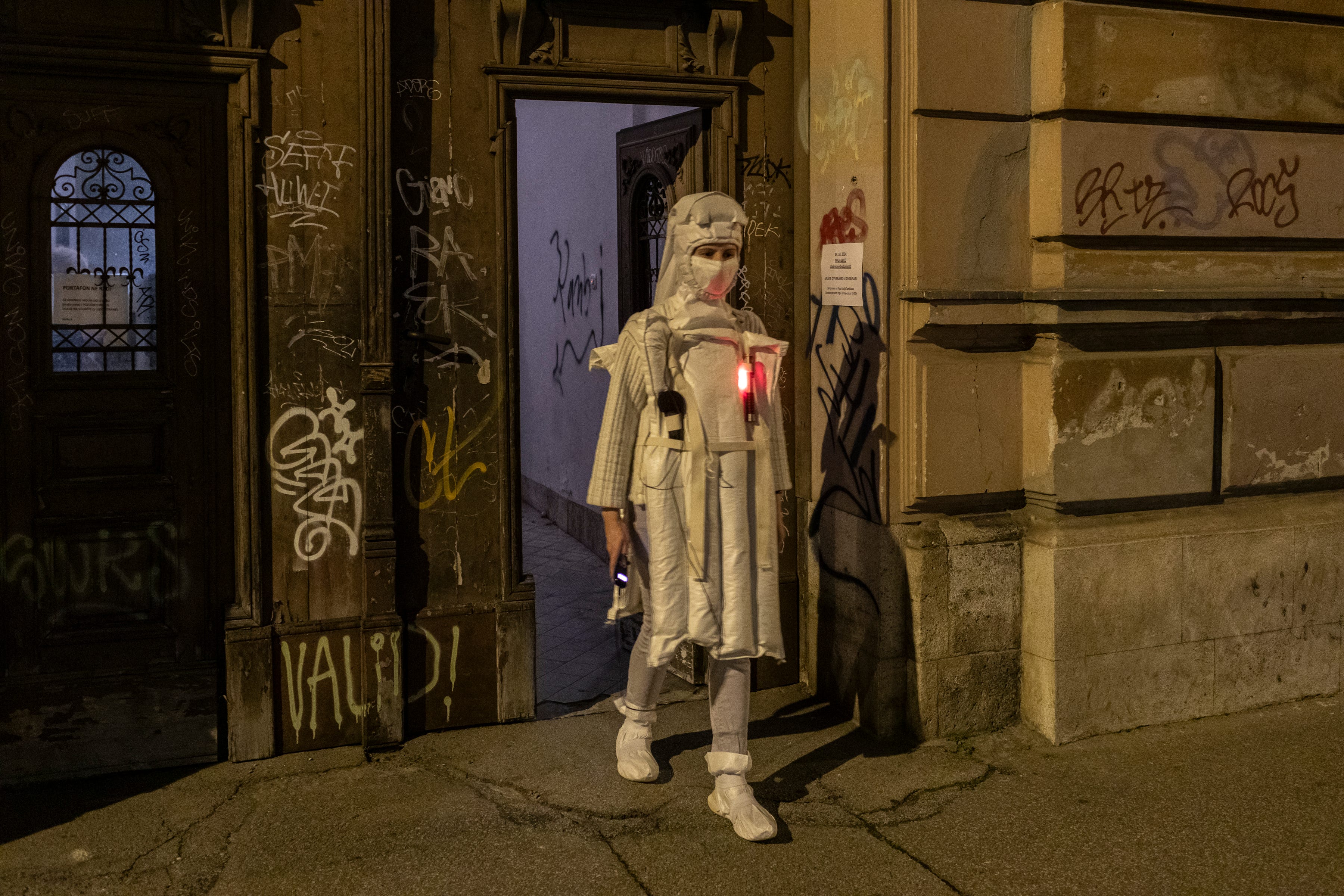
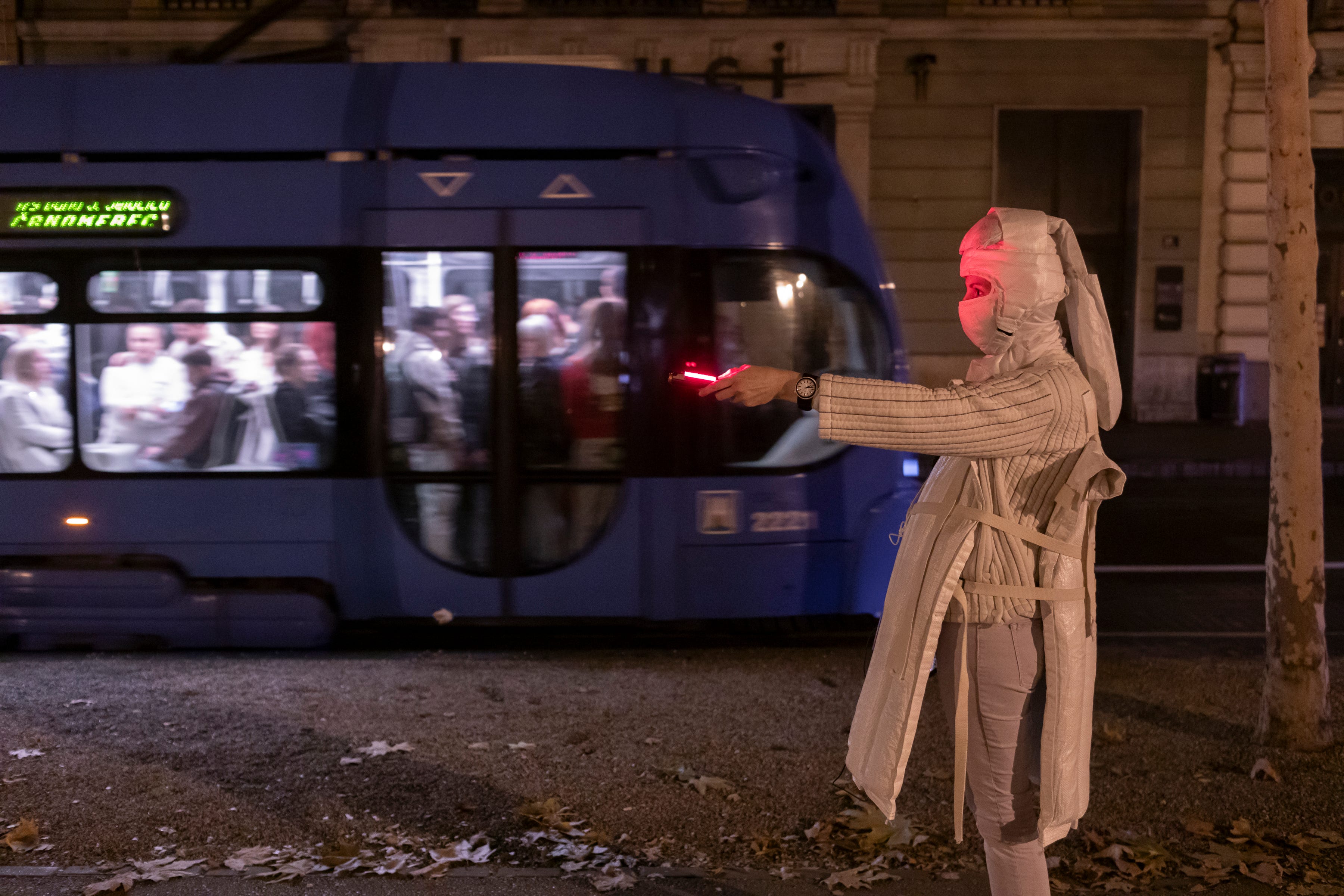
It was after this project that we had our first conversation, exploring Zećo’s practice, her memories of war and the other projects, such as Silencer and Defend & Protect, that she has performed on the streets of Aberdeen and Zagreb respectively. The first involved Zećo wandering the city in a custom sound-proofed suit, sonically insulated from the outside world, and the second as a spectral figure, protected by sandbags and a face mask, emitting drone frequencies into the night. They were collected with other pieces at an exhibition called Discomfited Futures, curated by Jon Blackwood in 2024.
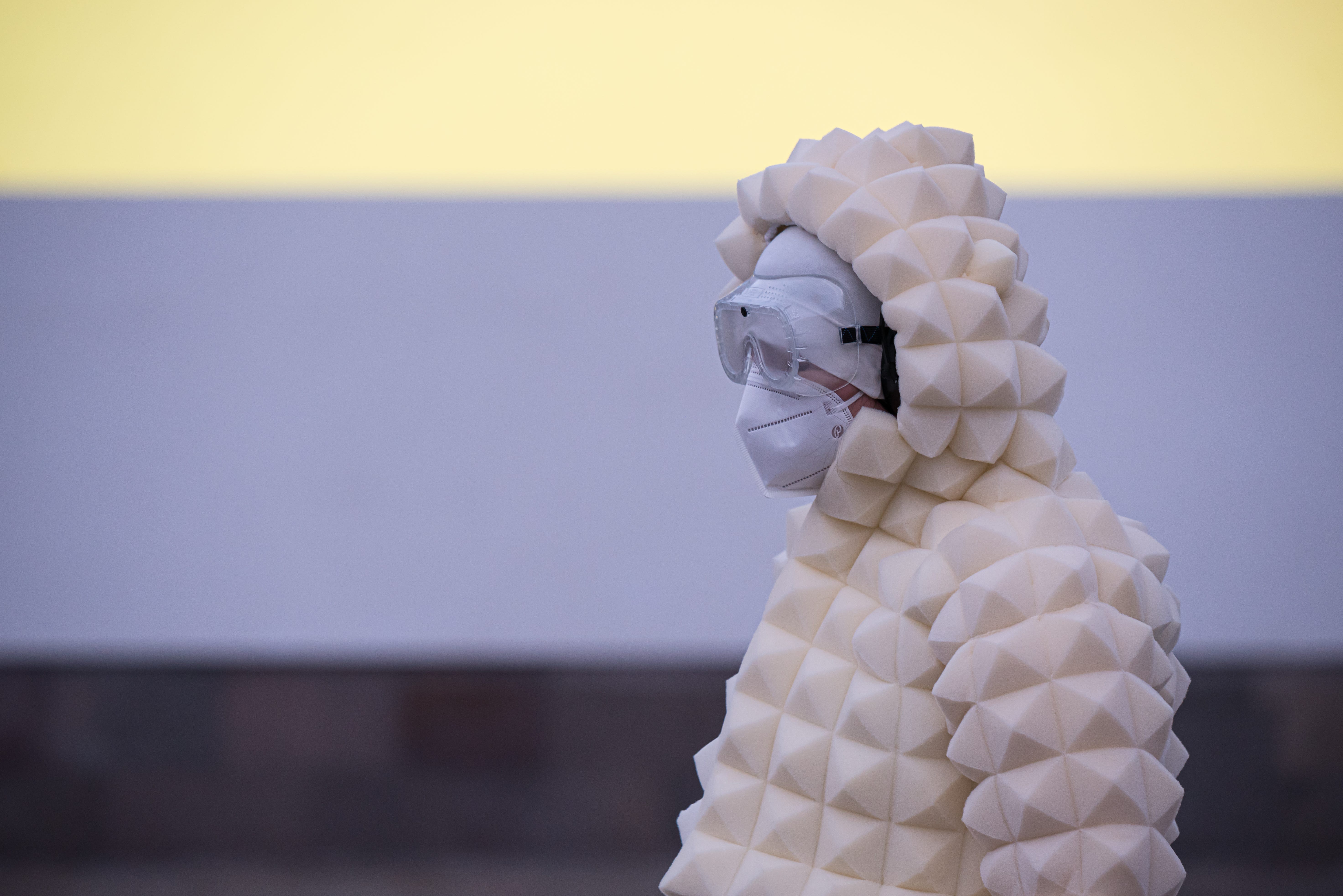
A resident in Aberdeen for 10 years, Zećo’s work has also turned to her new home and the tensions and contradictions arising from the green energy transition, specifically in the St Fittick’s Park area of the city. In February 2026, she co-led a day-long workshop that I was invited to attend discussing the role of arts methodologies in how environments and communities are changed by green energy, such as windfarms. These ideas are further developed in Zećo’s forthcoming exhibition The Attuning Zone at Peacock & the worm in Aberdeen, exploring how people experience the sounds, textures and atmospheres of energy transition.
Although some time has passed since our initial conversation, the workshop and exhibition offer a new reason to publish this interview. In the context of the ecalating violence of the US and Israel’s wars on Iran and Lebanon - enacted in part through the brutal and detached use of drones - much of what we discussed has taken on a new urgency.
Your work covers many different themes, and I wondered if we could start by exploring what brings them together for you?
Embodied experience resurfaces in my work in different ways. I always choose to organise soundwalks in very complex spaces, where there is a sense of loss, either related to ecology or class or other sorts of political situations. My practice deals with memory and experiences of sound, or how memories inform our experience of soundscape. I’m only now starting to work specifically with drone noises, and it came to me with urgency and a question of how we can create a sense of empathy with people living under constant threats, and how we can relate to that experience from the relative safety of the West.
You did this by staging these drone sounds in the centre of London.
There was of course discussion of consent, because you’re emitting these sounds in a formal space, it’s almost a form of protest. A lot of these sounds are extremely abstract. They sound like military planes and engines. There were a few people who asked us what was happening.
I think it’s an interesting political action, even if personally we can’t immerse ourselves in the possible danger that these sounds might represent. Because drones are often not visible but are heard on the ground, it is quite profound to play those noises in a powerful political centre such as London.
Acquainting the city with the sounds of drone warfare people might not have experienced in person?
Yes, but I would say the question remains how far we are from a possible world conflict and how vulnerable we are. We are in a bubble of safety, and people like myself never feel fully safe and far from conflict. We are hyper vigilant in a sense that people around us are not.
This question of sonic memory seems very relevant, particularly in relation to past trauma.
Exactly and it’s something that I explored in my PhD research, asking questions of how memories inform our experience of soundscapes today. In Bosnia, if you interview someone now and ask them what their favourite sound is, or the sound of their home or neighbourhood, within ten minutes everyone mentions the war. For me that was really fascinating, because I went there consciously with the intention not to ask about that history. I suspect that’s how the experience of conflict came into my work as well, because I never really wanted to deal with it explicitly.
Sarajevo is full of sites of memory because it was under siege for four years, so as soon as you stop, tune in and potentially record the sonic environment, it can take you into the past and open up that whole dimension. I’d ask someone about the sound of the river, and they’d say, “yeah, I don’t like the sound of the river, but of course the river sounded very differently during the war, because we didn’t have windows.” And obviously, someone who lived there knows that all the windows were shattered in the first weeks of the war due to explosions in the city. We had these plastic sheets on the windows instead that made their own sounds, while also being much more transparent and less isolating of outdoor noises.
I wonder if, when people think of the sounds of war, they tend to think of explosions, rather than the ways in which the conditions of conflict change the soundscape in material ways.
Exactly. I think Steve Goodman and his work Sonic Warfare talks about sirens. I have a work about air raid sirens and I had quite a few people discussing the sound of air raid sirens being even more scary and alarming than sounds of explosions. Personally, I don’t remember sirens at all, I need to ask my mum whether we had them, or if it’s literally a gap in my memory. I have worked with strobe lights, with air raid sirens, with quite extreme noise in my practice and that comes from this urge to explore the sensory experience and the relationship between the body and memory. It is a challenge to place this work in a gallery, so that’s why a lot of my practice is based around performance in public space.
There is a porousness between private and public, and it feels like your work is interested in blurring that boundary.
For me as someone who lived through conflict, it’s more about revealing interior experiences, but you have to be aware that there have been such huge shifts in the way wars are conducted. Now there are these control centres that are in completely different geographical spaces, and drone operators using tiny screens, often without any sound input. They are completely detached from the context, from mortality. This gamification of warfare is terrifying, and to have something potentially able to enter your home in the middle of the night and kill you in your bed silently, it’s that level that we’re dealing with. For me it’s a matter of privilege that I wanted to disrupt or to make apparent. We have a privilege to live in an environment here and not be threatened by military drones.
We met at In the Field conference in 2024 where there was a lot of discussion about positionality in sound art. It seems like you are quite interested in how to translate an experience of conflict for people who haven’t experienced it
Yeah, I think it’s our responsibility to do this. Of course we have to be understanding and I live now in this privilege in the UK, but my family is in Bosnia which is at peace, but might be in conflict again. So that makes me alert. I think we need to talk about it, and researchers in the UK often feel shy to discuss these topics. I think a lot of organisations wouldn’t support this workshop because it can be triggering, it can be difficult for participants and people around you. We had quite a few warnings of course, but then how do we have these conversations about how we are complicit in what’s happening in different parts of the world if we don’t extend our empathy?
Through this feeling of discomfort?
Exactly. And then the question maybe for some is, do you need to feel scared to create this impactful relationship? I think we really need to practice our muscles a little bit. We are oversaturated with images and ideas. Susan Sontag wrote that lovely book Regarding the Pain of Others which deals with this gaze, and that for me was very helpful in understanding the Bosnian conflict and responses to it. I think through sound we can provide another way in.
Many authors like Salomé Voegelin and others also talk about imagination as a creative force. We are just not used to using it in this scenario. And that was the invitation. For me it was incredibly imaginative to emit the sound of aerial drones produced by the US or the UK and now used in the Middle East or in Ukraine, next to the British Museum. There is a political statement in that, albeit subtle and ephemeral.
By listening to the acoustic environment around us augmented with these sounds that you’re emitting or that you hear from others, you explore your own sense of safety, shelter, normality and home. But what is normal? In Sarajevo we got quite accustomed to it. And so you start making evaluations. We had nicknames for different ammunition. How far is the strike? You hear a grenade bursting through the sky and maybe you can sense proximity, so either you continue playing or if you judge it’s coming really close then you run to the shelter or you duck to the ground, or you turn your body if there is no time to duck to the ground. You are constantly acutely aware, but then you also find a way to live with it. So for me the question of normality is the big one, and in the one hour of the soundwalk, it’s difficult to get accustomed to it, because it’s quite a short time.
Does your interest in sound come from this sense of image saturation?
It’s deeply rooted in my experience. I’m primarily a performance artist who works with sound, and it’s that combination of the body, the context and the situation that allows me to explore these experiences for myself, but also for people around me.
Could we end by speaking briefly about your recent project on the energy transition in Aberdeen and how this relates to your research more broadly?
The project revolves around soundwalks that I led in St. Fittick’s Park a couple of years ago. The park is a well-known example of an unjust energy transition, as it is a rare green space in a socially deprived part of the city, now endangered by further industrial development. During this time, I worked collaboratively with Aberdeen-based curator Rachel Grant and researcher Gisa Weszkalnys, based at the London School of Economics (LSE). Following the soundwalks, we held an exhibition at LSE and a workshop on the role of the arts in debates concerning energy transition.
Through this body of work, I’ve been searching for ways to listen to the site and its inhabitants in various ways. This intention brings me to work with people, with sonic and video material, and with my body to amplify and make visible the politics of the place. All my work is situated in very layered places, and it makes it meaningful to me to turn to environmental violence and non-armed conflicts in some of my future work, as there is trauma, grief and a sense of loss there too. Currently, I am developing a new performance work that will be premiered at the park as part of my solo exhibition at Peacock & the worm in Aberdeen.
Maja Zećo's The Attuning Zone takes place at Peacock & the worm in Aberdeen, between 2nd May and 4th July 2026.
Thanks for reading Through Sounds! Subscribe for free to receive new posts and support my work.
Comments
Nothing yet. Say the first thing.
Sign in to join the conversation.