
If you’d told me in December 2019 that five years later I’d be writing a newsletter post about - among other things - soil, I would not have believed you. Back then, I was just wrapping up the “albums of the year” lists for the magazine I was editor of and thinking more about Google Analytics than bioacoustics. My knowledge of environmental sound didn’t get much beyond a detached appreciation of Bernie Krause, whose Great Animal Orchestra had been exhibited by the arts organisation I worked for, and with whom I’d commissioned an interview for the magazine. I suppose in December 2019 there was a lot we didn’t see coming.
Anyway, here we are. One of the positive things about being new to a subject is the enthusiasm that comes with inexperience, and over the last few years, what began as a casual interest has transformed into a casual obsession. What in 2019 seemed to me like an impossibly niche pursuit has fragmented into endless corridors of inquiry leading to rooms upon rooms of research, each of which seem to contain further doors to open and explore. When I was writing my master’s thesis about ocean noise pollution a few years later, I remember encountering the phenomenon of snapping shrimp for the first time only to find dozens if not hundreds of papers and articles on the subject. That year, rather than go to Notting Hill Carnival or We Out Here, I was in the library reading about the “acoustic behaviours of large crustaceans in NE Atlantic coastal habitats”.
Perhaps the hardest thing about the literature review I was writing at the time was that the bioacoustics research I was trying to keep on top of was multiplying more quickly than I could keep up with. I have no stats to hand to back this up, but as technology improves and applications vary, I’m sure the field is continuing to proliferate exponentially.
I still get the Google Alerts that I set up at the time and make a note of the stories that interest me, partly because I fancifully intend to cover them in this newsletter. Some - like the discovery of a whale alphabet - have made it in, but most have not. So, in lieu of the end-of-year albums lists I spent much of the 2010s writing, I thought I’d share my highly subjective and incomplete survey of the developments in bioacoustics in 2024, starting with - you guessed it - soil.
(Maybe it’s worth saying that I use the term ‘bioacoustics’ here in the broadest possible sense and not always entirely accurately, mainly because I find that the debates surrounding delineations of bio- and eco-acoustics, acoustic ecology, soundscape ecology etc. etc. etc. can get in the way of what is actually interesting about the work being done and how it relates to contexts beyond the world of sound.)
“It’s a bit like going to the doctor,” ecologist Dr Jake Robinson says. “They put a stethoscope on your chest, take a health check, listen to your beating heart … we’re doing something similar in the soil.” Research conducted by at Flinders University in Australia found that sound recordings of soil are an effective way to monitor the health and biodiversity of underground ecosystems, returning simpler and more accessible results than traditional sampling methods. It’s a subject about which I spoke earlier this year to artist-researcher Juan Cortés, whose work looks at the impact of soy monocultures on Colombian soil health. Our interview will be published in Sonic Acts’ Ecoes magazine in January, and Cortés’ work will be featured in a forthcoming Somerset House exhibition in London appropriately called SOIL: The World at our Feet.
On a similarly microscopic level, there have been significant advancements in the use of bioacoustics for monitoring the health and abundance of insect populations in the face of climate change and pesticide use. Like many acoustic fields, automated listening - the training of AI models to identify and classify species within a soundscape - is accelerating the analysis of vast amounts of acoustic data.
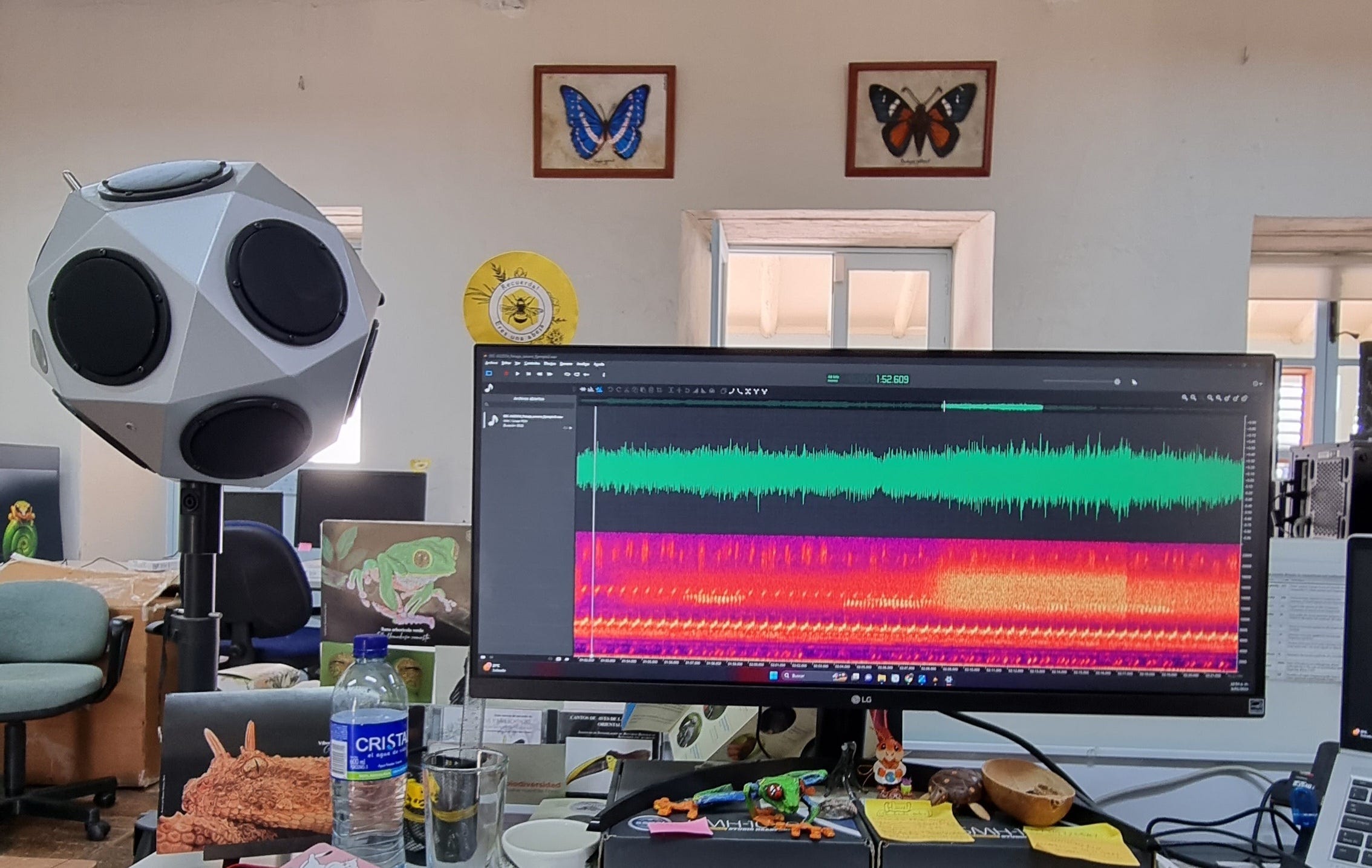
On a much larger scale, AI models are being developed at ecosystem level to monitor rainforest health in close to real-time, the largest study of which was taking place in Costa Rica, as reported by New Scientist. Earlier this year, I visited the Colección de Sonidos Ambientales, or Environmental Sound Archive at the Humboldt Institute in Colombia, whose collection is being used to train AI models at various scales, one if which - called Project Guacamaya - is concerned with the use of bioacoustics in monitoring deforestation in the Amazon. More on this next year.
For anyone interested in the use of bioacoustics for conservation, I really recommend this paper by Max Ritts and Karen Bakker, who ask important questions about “conservation acoustics” in the context of Big Tech and the implications of using sound as data in the service of economic or political agendas.
Just as Juan Cortés’ work looks at the impact of agriculture on soil soundscapes, so has new research found that invasive plant species change the nature of the soundscapes into which they are introduced. While this has been more widely studied in relation to changes in animal populations (we’re looking at you, bullfrog), the study of how plants alter the soundscape may offer a new dimension through which to study patterns of environmental change. I was also interested to read this strident - and perhaps controversial - paper questioning the veracity of acoustic communication in plants, suggesting that while plants do respond to acoustic stressors, there is currently no evidence that they can perceive the sounds they make.
I may be wrong, but it feels like this is part of a wider questioning of concepts such as the ‘wood wide web’ (popularised by writers like Peter Wohlleben, Richard Powers and Merlin Sheldrake), which have captured the public imagination, but whose stories might be outpacing the science. As this piece by Daniel Immerwahr argued in April, “it’s worth asking what makes us so eager to ascribe human qualities to the arboreal world. Might we be missing something important when we gaze into the wooden mirror and see only ourselves?”
That said, soundscape analysis has been succesfully applied to underwater plantlife, where it is now understood to be an effective tool for monitoring seagrass restoration. “A successful restoration action should lead to acoustic restoration and soundscape ecology could represent an important component of restoration monitoring,” the authors write, following up on research in 2021 that seagrass suffers damage from extreme noise, impacting its capacity to adequately store carbon.
While sound has played a significant role in coral reef monitoring and restoration in recent years (to the point where sound recordings are used to entice fish back to bleached reefs), there was a poetic discovery earlier this year that the sounds emanating from coral reefs respond to the cycle of the moon. As reported in phys.org, “as the moon rose, reflecting more light onto the sea, high-frequency pulses of sound increased while low-frequency sound pulses decreased. The reverse happened after the moon set.”
In other news from the world of animal linguistics, there were breakthroughs in decoding orangutan communication and the discovery of a sperm whale “alphabet”, but it was the pathos of this headline which I enjoyed the most: “Lonely dolphin in Baltic Sea found to be talking to himself.”
“The researchers noted that the dolphin continued talking when no humans were around, showing it was not trying to talk to them,” the article continues. “They suggest it is possible some of the voicings are related to emotional outbursts, similar to a human being laughing at something despite being alone. They also suggest it is possible the creature is simply lonely and talking to itself is a means of distraction.” We’ve all been there.
See you in 2025!
No posts
Comments
Nothing yet. Say the first thing.
Sign in to join the conversation.