
I bought Palantir at $7. Tempus is fundamentally the same trade, in biology: a data-and-AI moat the market keeps pricing like a lab.
Ten years ago Eric Lefkofsky asked a single question: could you use artificial intelligence to unlock precision medicine. To answer it you need two things, and almost nobody has both.
You need vast amounts of proprietary data to train the models.
And you need a distribution system to put what the models learn back into the hands of the physicians who treat patients.
Tempus has built both, and it spent a decade doing it whilst everyone watched the wrong number. The same playbook Palantir ran on government data, Tempus is running on the hospital
This is a Singularity Scaler. The thing it produces decouples from the thing it spends, and the gap widens as AI improves.
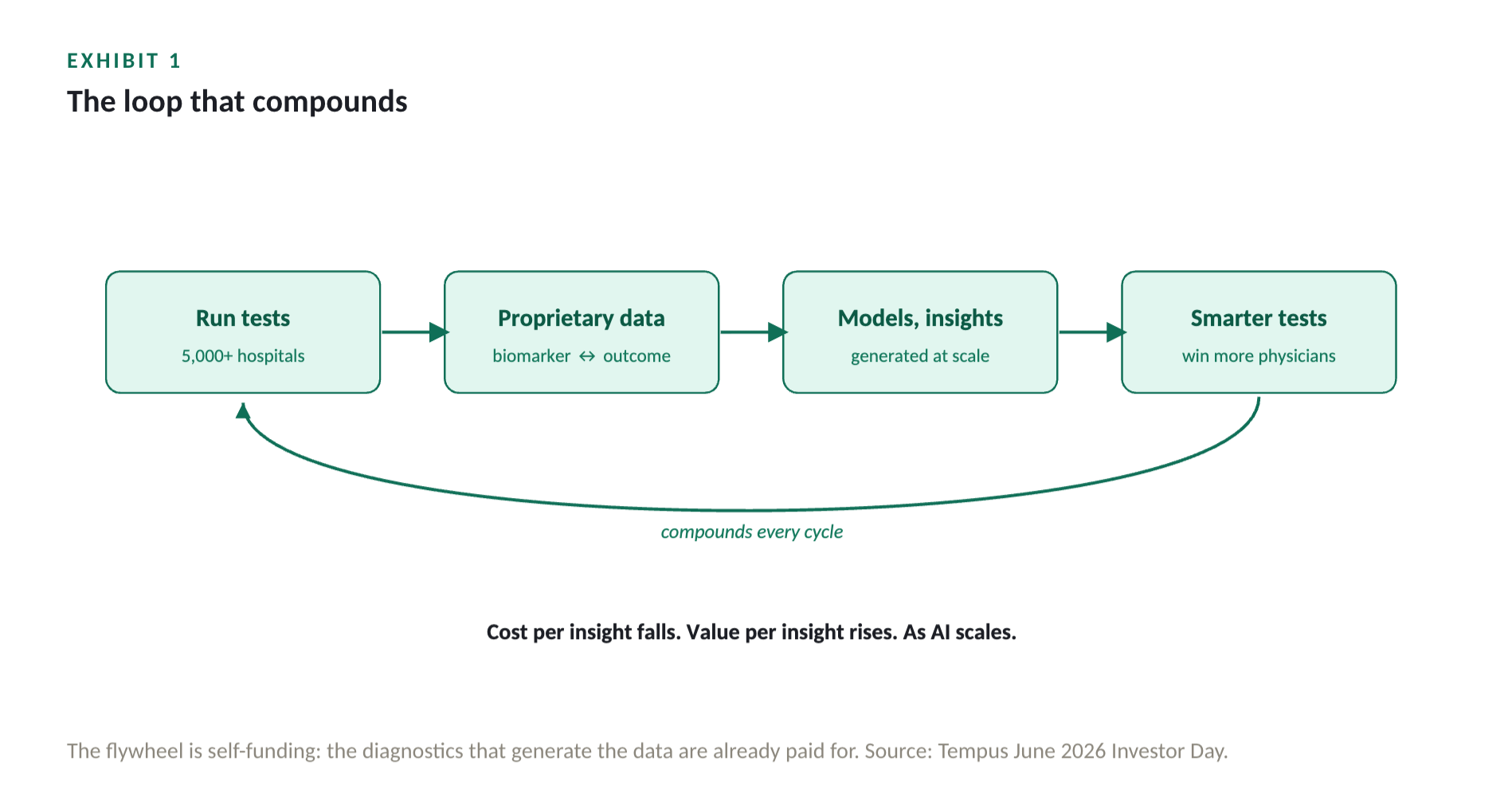
Tempus generates proprietary data correlating biomarkers to outcomes, and it generates that data as a free byproduct of clinical work it is already paid to do. Each test feeds the dataset. The dataset trains the models. The models make the tests smarter, which wins more physicians, which runs more tests, which feeds the dataset.
Run that loop for ten years across two thirds of American medicine and you do not get a diagnostics company. You get the substrate for an ambient, superhuman AI doctor that sits in the background of the clinic and improves the more the world's compute improves, at no additional cost to the loop.
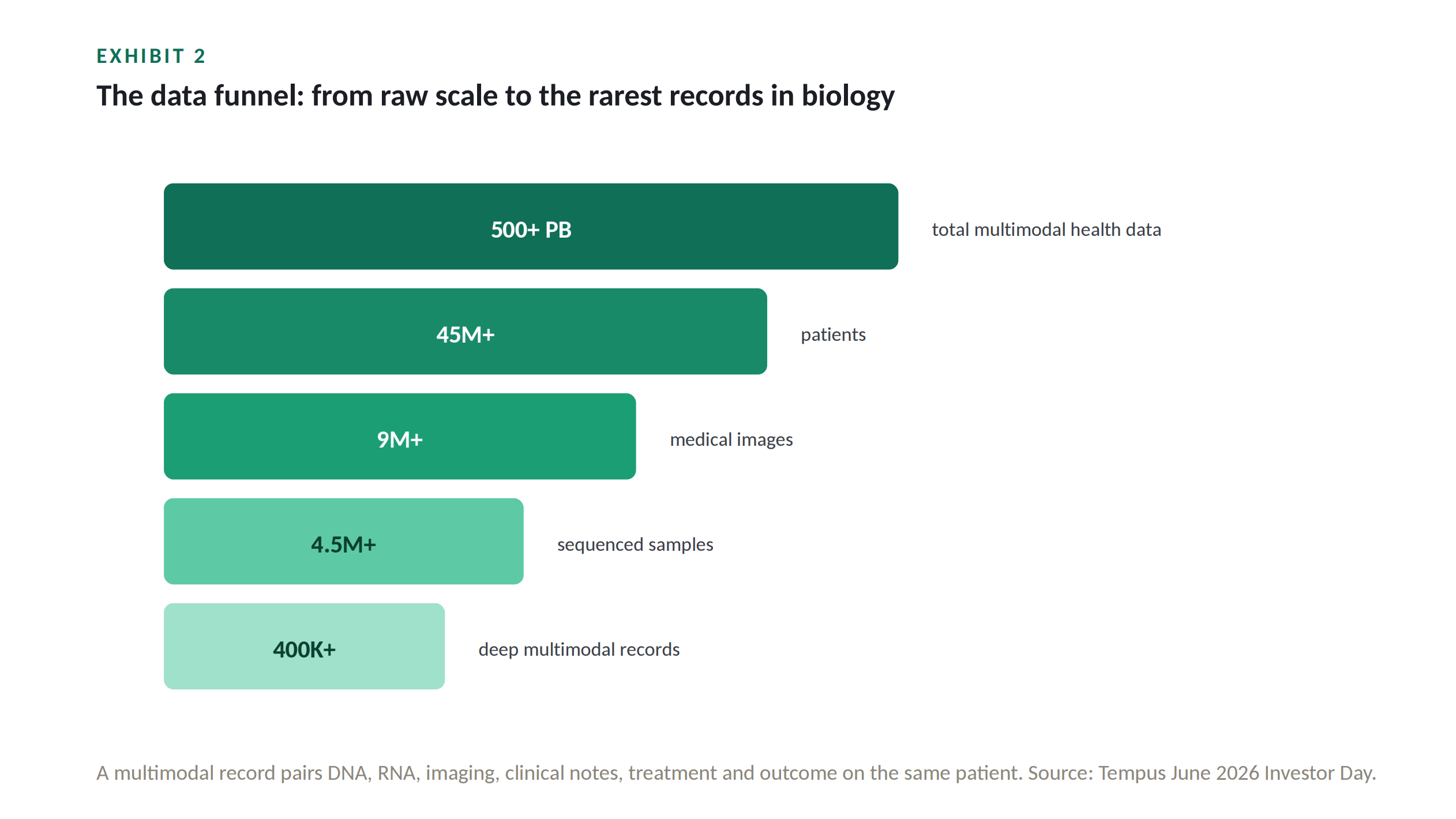
Start with the magnitude, because the magnitude is the whole argument. Tempus sits on over 500 petabytes of multimodal health data. Five years ago that number was 50. It has gone up tenfold whilst the cost of holding it collapsed, which is the shape you want. That data spans more than 45 million patients and contains over 9 million medical images, one of the largest digitised pathology and radiology sets known to exist anywhere.
Beneath it sit over 4.5 million sequenced samples, and at the very bottom of the funnel, over 400,000 deeply multimodal records: patients for whom Tempus holds DNA, RNA, clinical history, imaging, treatment, response and adverse-event data, all connected. That bottom layer is the rarest asset in biology. It is the totality of what you need to ask why a real patient lived or died, and answer it.
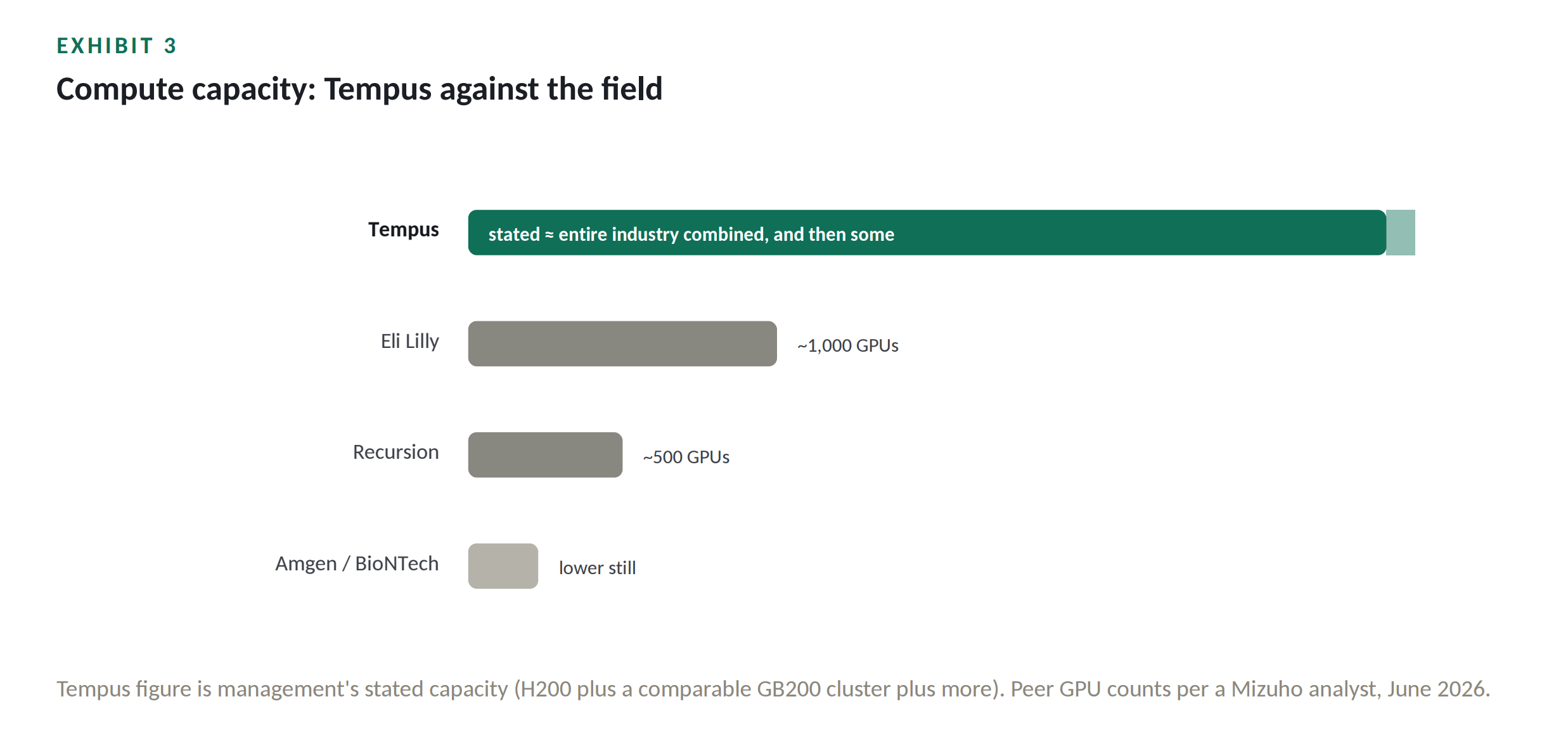
Then there is the compute. The foundation model alone sits on a cluster of 1,008 H200s, run for roughly 90 days at full capacity to pretrain. Behind it Tempus runs a roughly equal cluster of GB200s, each chip around four times the H200, plus more compute beyond the two foundation-model clusters. By management's own account, Tempus holds compute capacity comparable to the entire pharmaceutical industry combined. You do not have to take that on faith. An analyst on the call put the field in numbers: Eli Lilly around 1,000 GPUs in the lead, Recursion around 500, Amgen and BioNTech lower still.
As the data compounds, Tempus turns into a model that can generatively ingest any biomarker and tell you what it means for the patient in front of you. Not "this patient has EGFR," which is targeted medicine and which any sequencer can give you, but "this patient has EGFR, and based on millions of comparable trajectories, they sit in the quarter that barely responds, not the quarter that stays on the drug for five years." That second sentence is precision medicine, and it is worth orders of magnitude more, because it changes what the doctor does next.
That is where the operating leverage of the next decade comes from. A useful clinical insight like the immune profile score took a team of computational scientists the better part of three years to build and validate. The next phase replaces that team with the model.
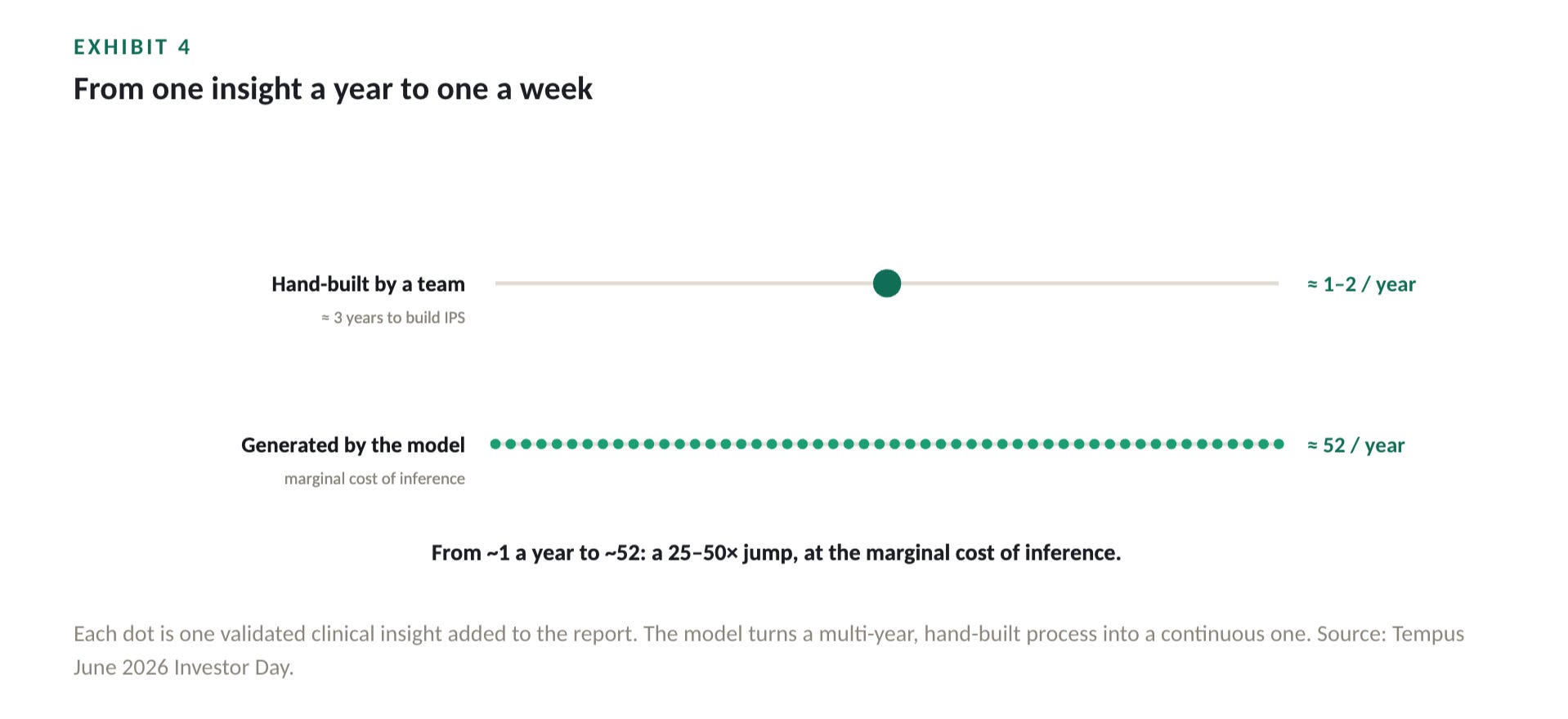
Instead of one new insight every six to twelve months, generate one a week. Each one generated, validated and dropped into the report at the marginal cost of inference. The leverage going forward is a function of the model's ability to spin up bespoke algorithms on the fly, in a way no competitor can match, because no competitor has the proprietary data that makes the algorithms work. And this is the move that turns a great company into a category: Tempus becomes the platform everyone else builds their own models on.
Increasingly, people don't just want our data, they also want models. Almost every conversation we have now is a blend of license some data and use our capabilities to build models, build those models on the Lens platform.
-Tempus co-founder and CEO, Erik Lefkofsky during 2026 Investor Day
Tempus has the deepest distribution in American medicine. It is connected to more than 5,000 institutions out of roughly 8,000 hospitals in the country, and reaches around two thirds of all academic medical centres. The vast majority of American oncologists order its tests, and there are only about 14,000 oncologists in the United States, of whom only half order comprehensive genomic profiling today. The room left to grow is inside a market Tempus already dominates.
The moat is mechanical, and it is the part investors consistently underprice. Proprietary data is a function of superior tests, and superior tests are a function of the pipes that connect Tempus to the institution: the BAAs, the legal agreements, the IT integrations, the EHR connections that let data flow out and insights flow back in.
Laying those pipes takes years. It is slow, unglamorous work, and it is exactly why a better-funded competitor cannot simply appear. What makes it a platform rather than a project is that Tempus has proven it can reuse the pipes. It earned its position in oncology first, then ran the same play into hereditary testing, rare disease, cardiology and radiology.
The tests themselves evolved the same way, by addition. Tempus started in solid tumour profiling with its xT assay, now FDA approved across its full DNA portfolio. It earned the right to move into liquid biopsy, the xF assays that read tumour DNA shed into the blood for patients without tissue. It added RNA, the xR assay, which reads a layer of biology DNA alone misses. It acquired Ambry to take the gold standard in hereditary testing, and folded in Paige to bring digital pathology models into the stack.
And it does not run these tests in isolation. It connects every test to every other test, and all of them to outcome data. So the platform a physician orders from does not stay the same. It gets smarter over time with every test. That is Ontology Velocity: the rate at which the system expands what it is able to know. The clearest way to see the value is to look at what the data surfaces that nothing else can.
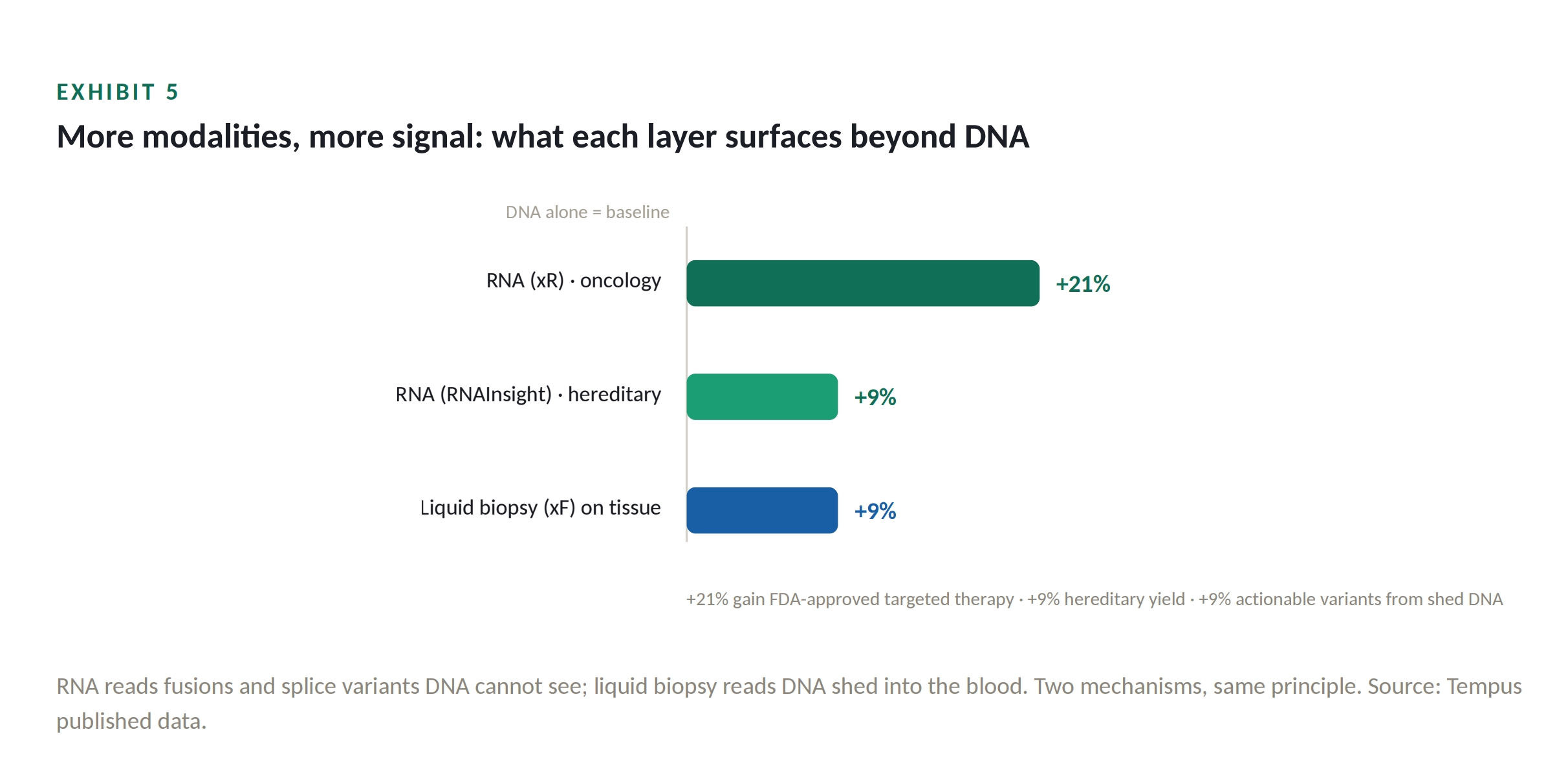
A DNA test alone is a single lens, and a single lens misses things by construction. Add RNA and you start seeing the fusions and splice variants that DNA cannot show you, the ones that turn a patient with “nothing to target” into a patient with an approved therapy. Add a liquid biopsy and you catch the tumour DNA shed into the blood that a tissue sample never detected.
Each modality is not redundant with the last. It is a new window onto the same patient, and what it surfaces is a patient who was previously invisible to treatment. The numbers below are not marginal improvements to a test. They are people who would otherwise have been told there was nothing more to do, now matched to a therapy, because Tempus read a layer that everyone else left on the table.
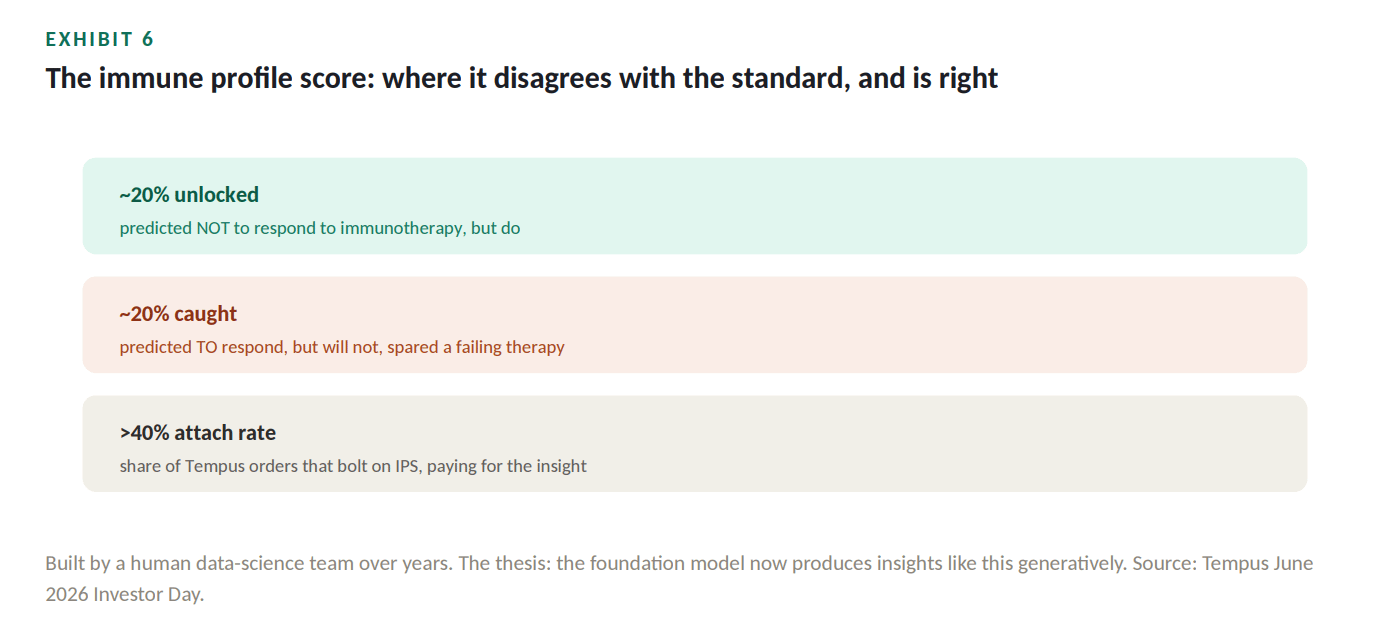
To illustrate further, consider IPS (immune profiling score): an algorith developed manually by the Tempus data science team. IPS predicts which patients will actually benefit from immunotherapy. The standard biomarkers, tumour mutational burden and PD-L1, are right often enough to use and wrong often enough to hurt people.
IPS goes underneath them. Now hold the most important fact about it in your head: IPS tooks years to build. The entire thesis of the next decade is that the foundation model produces insights like IPS generatively, at a cadence humans cannot match. IPS is not the achievement. It is the proof of concept for the machine that makes the next thousand.
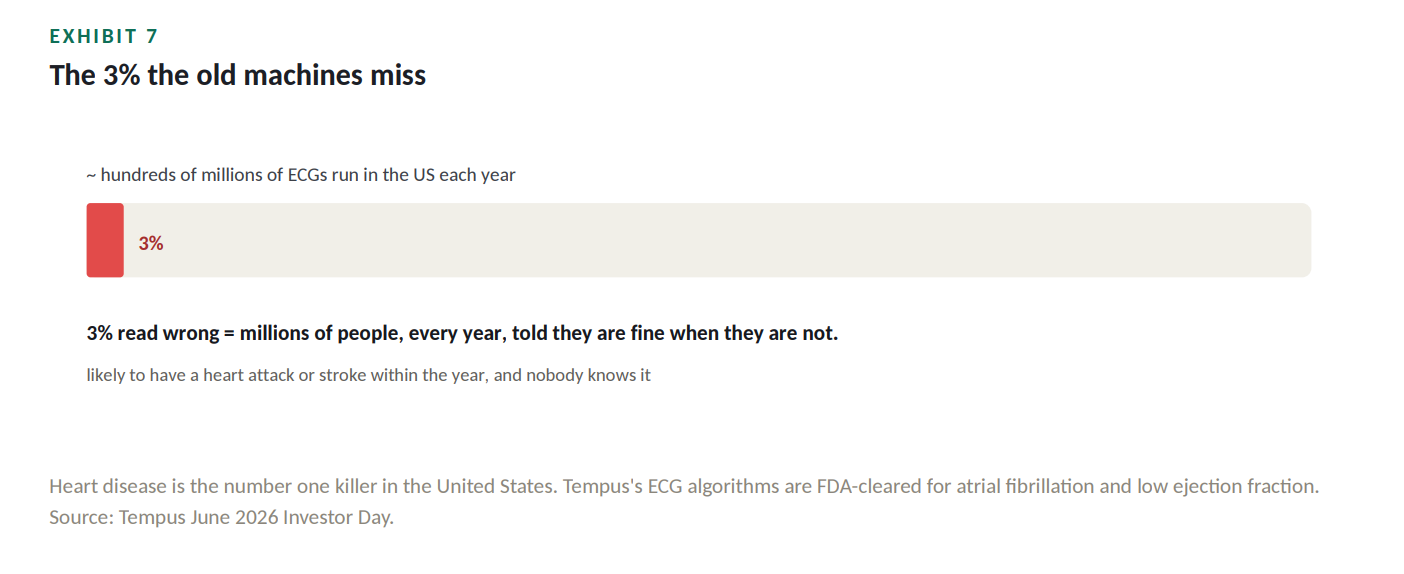
Heart disease is the number one killer in the country. One of the most common diagnostic insights in all of medicine is the ECG, run a few hundred million times a year. The read technology in most machines is thirty, forty, fifty years old, built before AI existed, and it is effectively wrong about 3% of the time. It tells people they are fine when they are not, when they are in fact likely to have a heart attack or stroke within the year.
Three percent of a few hundred million is millions of people, every year. Tempus trained on millions of ECGs connected to what actually happened, and built algorithms that catch what the old machines miss. Same system, different organ.
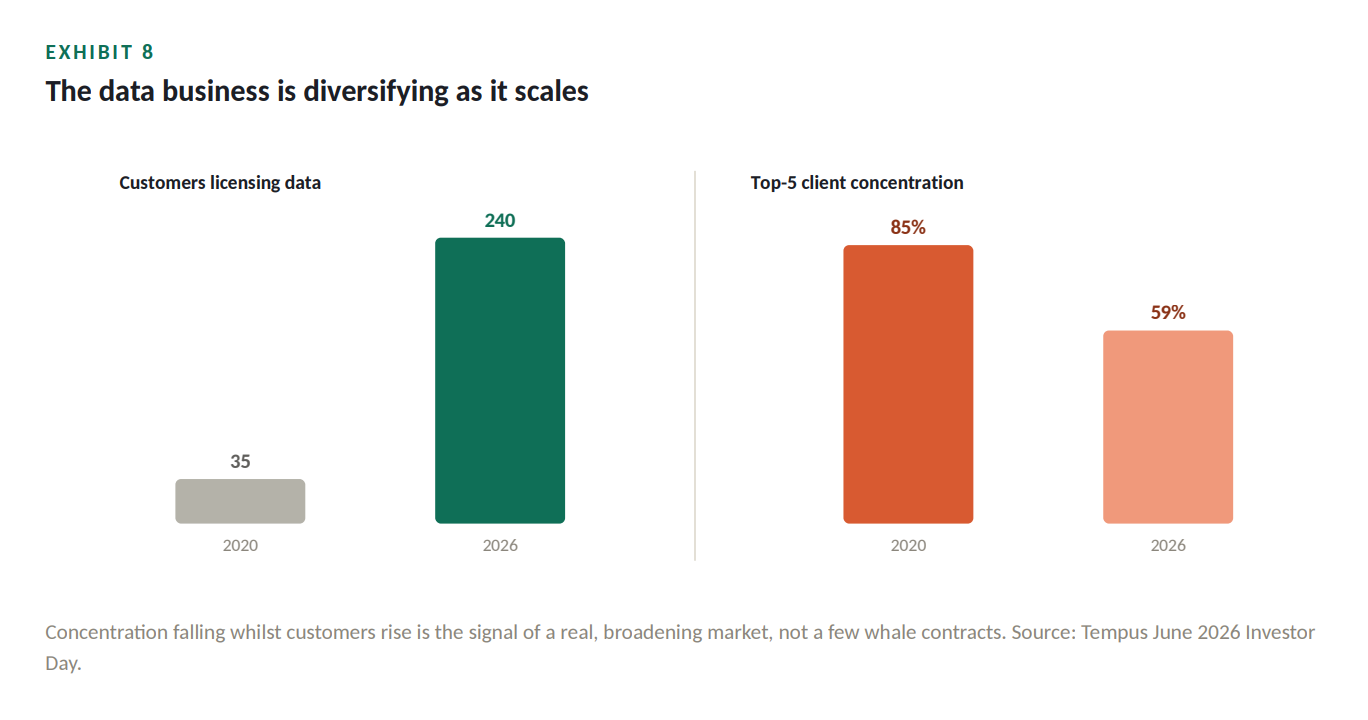
The cleanest proof that the data is valuable is that the most sophisticated buyers in the world keep paying more for it. Tempus has signed over 2 billion dollars in data licensing deals. It works with 19 of the 20 largest pharmaceutical companies in America, and over 250 biotechs. The customer base has gone from 35 companies in 2020 to around 240 today. And the concentration is collapsing in the healthiest possible direction: in 2020, 85% of the data business came from the top five clients; today that figure is 59% and falling.
Net revenue retention is 126%. A business that started as a handful of whale contracts is turning into a broad, diversified, compounding base.
The reason the money flows is that Tempus answers a question worth more than any other in drug development: will this drug work in this patient, and if not, why not. The legacy data vendors describe what happened, like playing back the news. Tempus addresses why a patient is not responding to standard of care. That why is the difference between a 1 billion dollar failed trial and a 10 billion dollar franchise.
A Phase III go or no-go decision carries 200 to 500 million dollars of risk. Against numbers like that, a 20 million dollar data licence that derisks the decision is not a cost, it is the cheapest insurance a pharma executive will ever buy. So they spend more, and the revenue line just goes up.
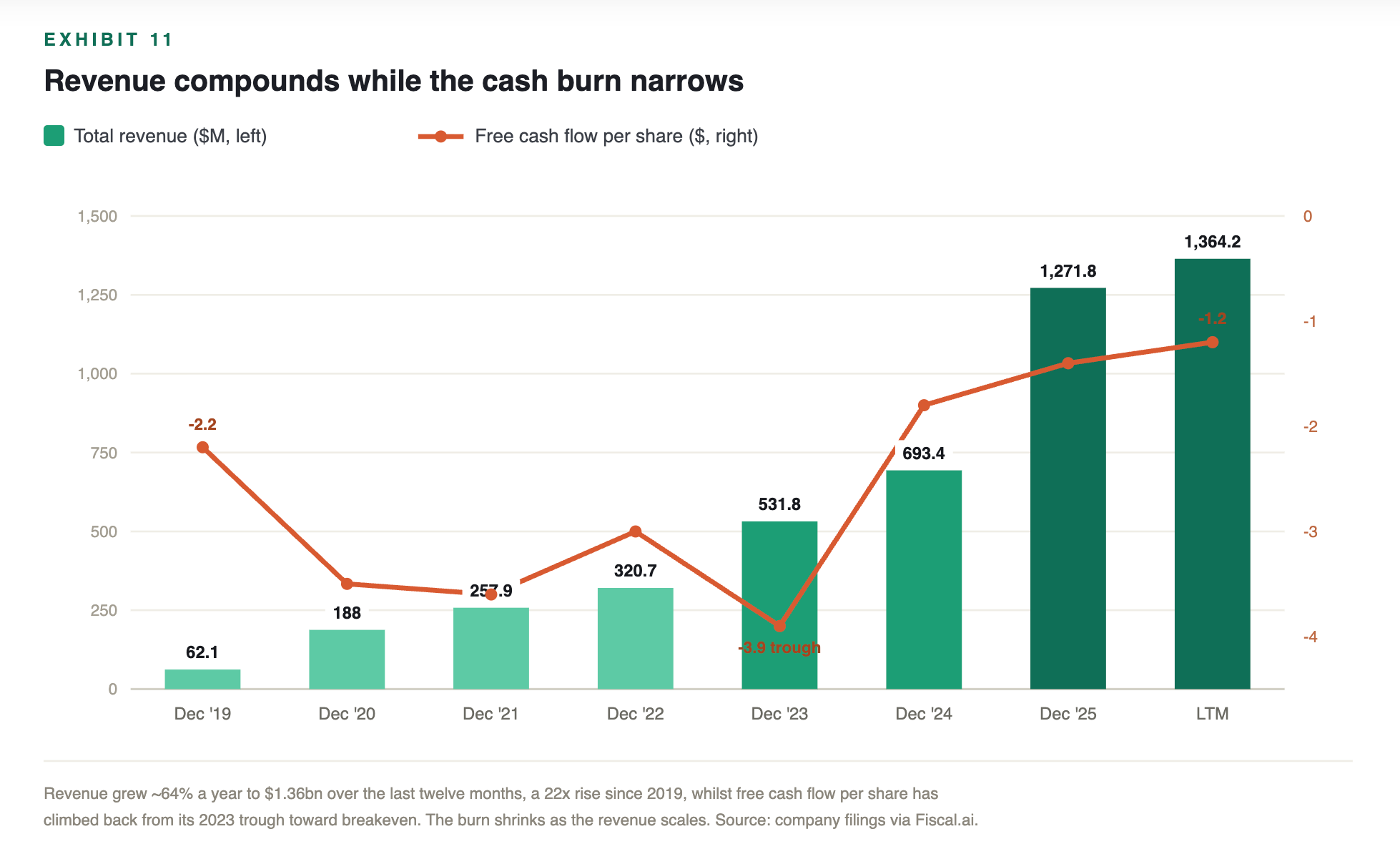
Tempus trades at roughly four times sales. For a company growing the top line around 25%, with a data business growing faster, generating real operating leverage and approaching positive free cash flow, that is not a valuation. It is a structural misunderstanding. Technology investors who think in AI do not understand diagnostics. Diagnostics investors steeped in next-generation sequencing do not understand data and AI. So the stock sits in the gap between two audiences, that I am proud to bridge.
The ecosystem is very hard to displace. It is wired into the plumbing of American healthcare in a way that took a decade and billions to build, and the rebuild cost for a competitor is the same decade nobody wants to spend. And it is even harder to beat Tempus at the layer above, the apps and algorithms, because generative AI has quietly changed what an app is worth. The value of an algorithm is now a function of the proprietary data it was trained on. Tempus owns the data. So the better the AI gets, the more valuable Tempus's apps become relative to everyone else's, automatically.
That is what gives me clear visibility into sustained operating leverage going forward: not a forecast, a structural property of the loop.
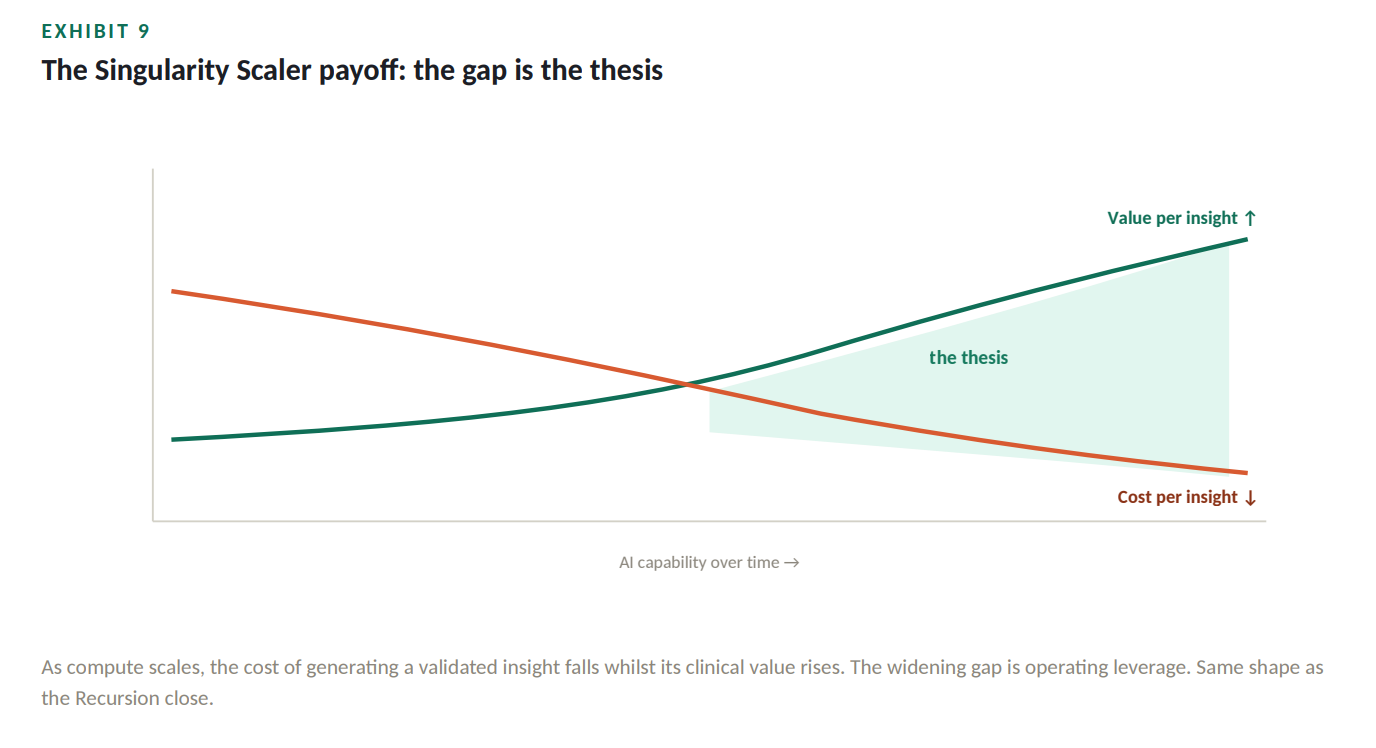
A price-to-sales of four, a moat that compounds rather than erodes, and a genuine Singularity Scaler shape make this one of the more compelling names in my bio/acc watchlist. I’m pending a deeper read on the reimbursement path for algorithmic diagnostics, which is cracking but not yet open.
Bio/acc is one thesis expressed at four layers of a single value chain. Biology is becoming code, each company owns proprietary data at a different layer of the stack, and each becomes a Singularity Scaler on the data it owns. Measure, build, deliver, distribute. Tempus is the delivery layer, and it is another instance of the market mispricing the thesis.
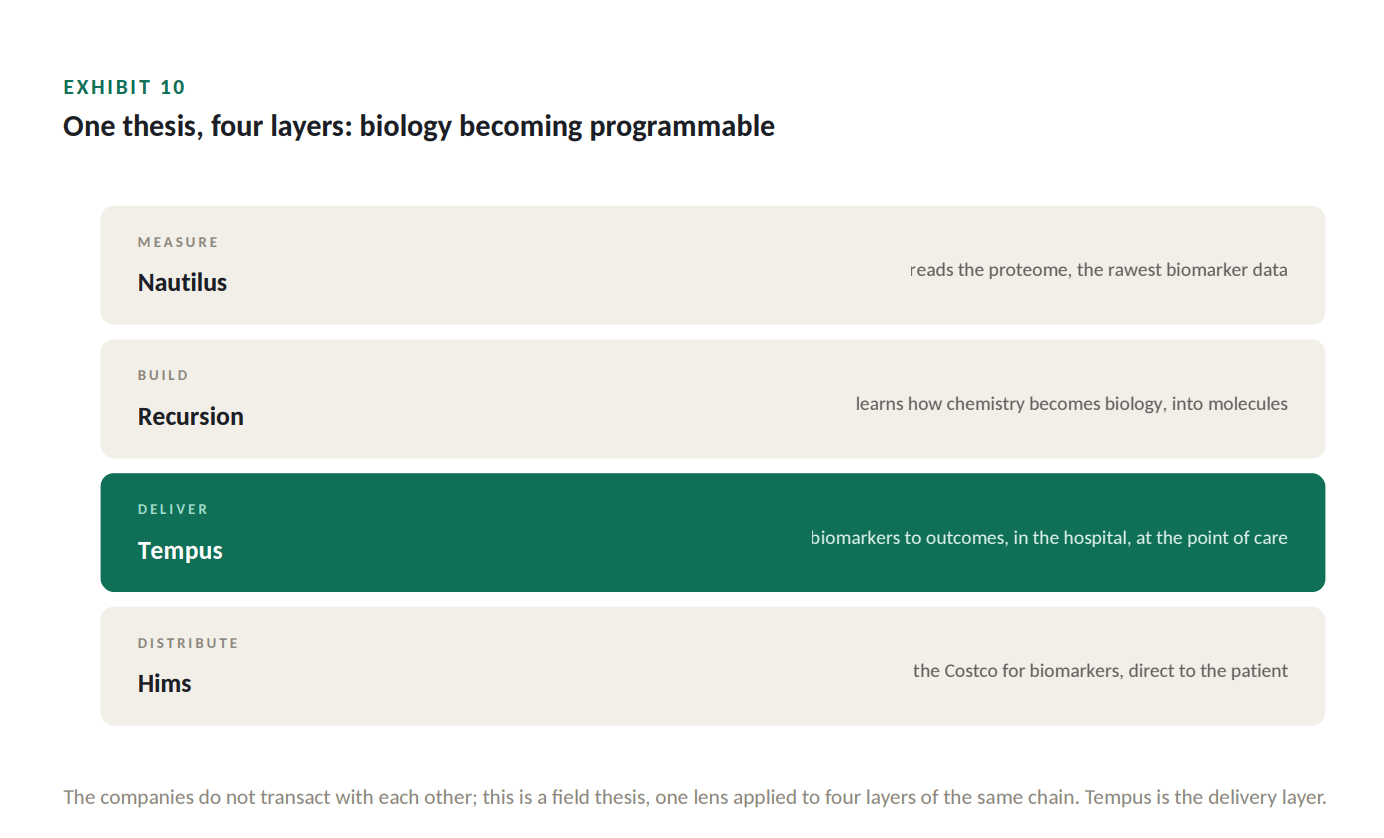
Tempus operates inside the traditional, insurance-reimbursed healthcare system, and the incentives there are not aligned with truly optimising health over a lifetime. That system is built to code, bill and reimburse discrete episodes of disease, not to keep a person well for forty years, and a company that lives on its rails inherits its reflexes. That puts Tempus, for now, at odds with the layer below it: Hims is built around the patient optimising their own health continuously, direct and outside the reimbursement maze, whereas Tempus is paid when the system acts.
Long term, it is possible that Tempus is precisely what reverts those incentives, because an AI that can tell you years in advance who will have the heart attack makes prevention the cheaper path, and the system eventually follows the cheaper path. But that is a destination, not the present. What is not in tension, and what holds regardless of how the incentive question resolves, is the data.
Because of its stronghold at the clinical level, the underlying model captures intelligence about real patients and real outcomes that no one operating outside the hospital can see. The incentives may be imperfect today but the data is valuable anyway. Unless D2C fundamentally disrupts hospital care, Tempus’ free cash flow per share is likely to rise fast in the coming five years.
Lefkofsky's roughly $1.7 billion stake, more than half his net worth, is genuine alignment, and he funds the long bets from the core rather than diluting. Dual-class voting does mean more rests on his judgement than on the board's, and Groupon is worth remembering for context: public near $13 billion, around $600 million today, with some $398 million paid to him in the rounds before that IPO. None of it disqualifying, just a reason to weigh the narration carefully.
⚡ If you enjoyed the post, please feel free to share with friends, drop a like and leave me a comment.
You can also reach me at:
Twitter: @alc2022
LinkedIn: antoniolinaresc
These are opinions only of the individual author. The contents of this piece do not contain investment and/or medical advice and the information provided is for educational purposes only and no discussions constitute an offer to sell or the solicitation of an offer to buy any securities of any company or any drug or medical treatment. All content is purely subjective and you should do your own due diligence.
Antonio Linares makes no representation, warranty or undertaking, express or implied, as to the accuracy, reliability, completeness or reasonableness of the information contained in the piece. Any assumptions, opinions and estimates expressed in the piece constitute judgments of the author as of the date thereof and are subject to change without notice. Any projections contained in the Information are based on a number of assumptions as to market conditions and there can be no guarantee that any projected outcomes will be achieved. Antonio Linares does not accept any liability for any direct, consequential or other loss arising from reliance on the contents of this presentation. Antonio Linares is not acting as your financial, legal, accounting, tax, medical or other adviser or in any fiduciary capacity.
No posts
Comments
Nothing yet. Say the first thing.
Sign in to join the conversation.