
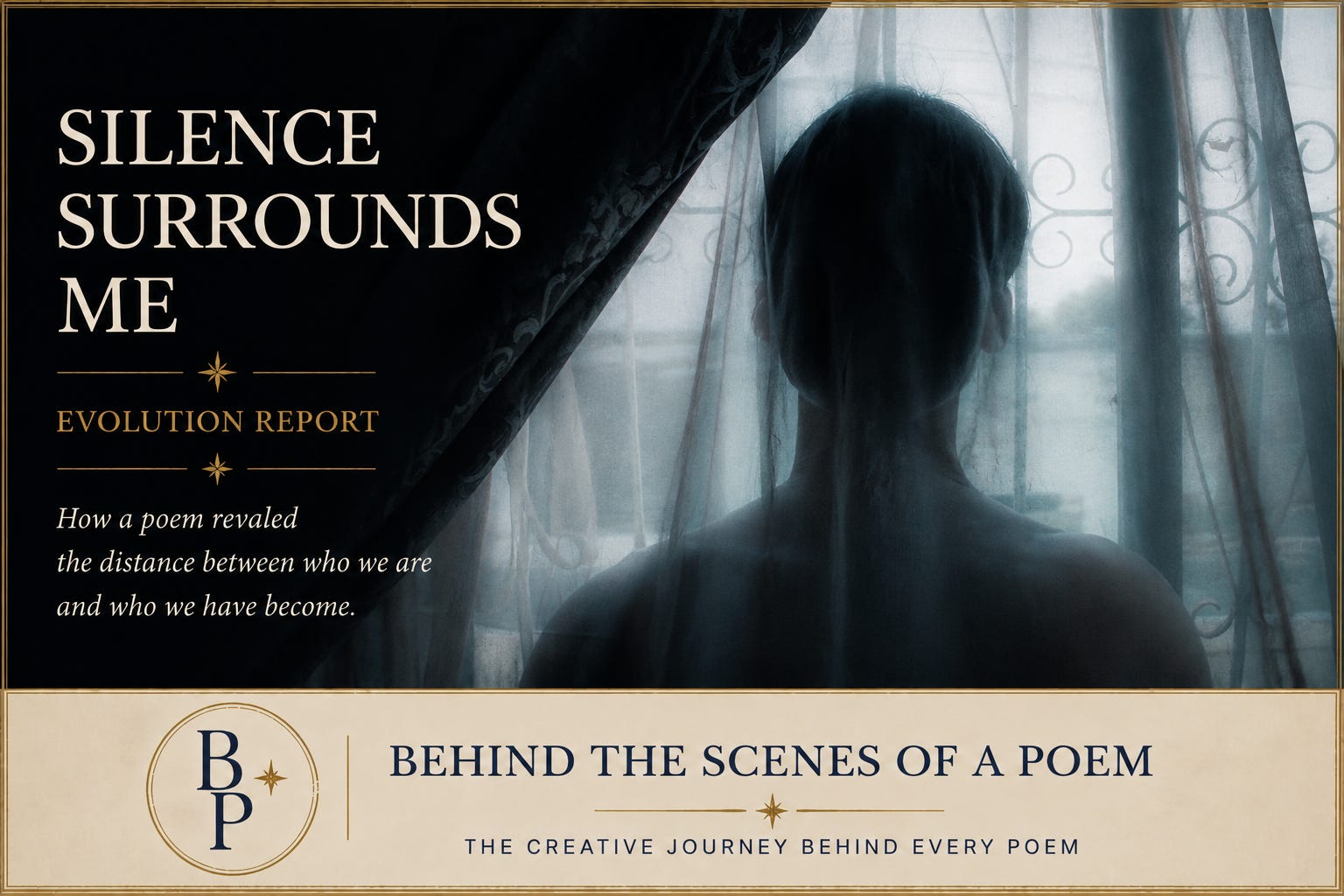
When I wrote Silence Surrounds Me, I thought the poem was about silence. Reading it again, I realized that silence was only the passage.
The real question was somewhere else.
There comes a moment in everyone’s life when silence stops being a simple interval between the things that come toward us in the light of day. It is no longer the pause between something you are thinking of doing and whatever comes next, which perhaps will be better, nor the breath that separates one thought from another without letting them push against each other.
It becomes something closer, something we had left alone, more insistent because it is alive, more revealing in what it has to say. A place inside us we had not expected, but that reaches us anyway, beyond our will. A place we did not choose, but that seems to choose us before we even realize it.
And it is precisely then that we understand this is not sadness speaking, nor solitude refusing company. It is something more intense, impossible to see with words, because it does not come from an emotion that has charmed you, but from a real realization telling us this: we have avoided for too long what was asking to be looked at.
With what eyes have we seen the world? We did it in good faith, without any doubt, the way we do when we live trying not to disturb anyone, not even ourselves, with a dull noise that says nothing. But silence is not a guest content to remain on the uneven road of our everyday lives.
When it arrives, it enters. And when it enters, it brings with it what we had left outside, what was truly ours without our really knowing it.
I did not write to describe silence. That would have been too simple, and perhaps useless as well; it is not for me to describe what belongs to the deepest part of us. I wrote to understand, to reach a question I no longer wanted to put off. A question that is not about silence, but about what silence placed before my eyes.
Because silence does not speak: it shows us the identity we try to hide. And what it shows is never what we expect to see in ourselves, perhaps out of modesty or shyness, in an attempt to soften something more serious.
We live inside what we call “normality,” as though it were a house built with the best intentions, though we were never really its architects, and this is precisely what unsettles me. We move through the rooms of our lives convinced that we are inside something that represents us, that we are being faithful to who we are.
But normality, when we do not question it, becomes a habit that dresses us without asking whether it fits. Perhaps the size was never really mine; perhaps the mirror no longer reflected my image.
And so, without realizing it, we wear identities that do not belong to us, perform gestures that do not resemble us, take on roles we never truly chose, simply to survive the act of getting by.
Yes, it is true, we do this sincerely, without pretension, without wanting to teach anyone anything. We do it because we believe that living means adapting.
And yet there is a wisdom that does not stand at a lectern, that does not demand to be heard. It is a wisdom that stays close to the human breath, that moves with us, that does not place itself above life but within it.
It is this wisdom that reminds us that an inner boundary exists, even when we leave it in shadow. And when that boundary opens, it does so in silence. Not to judge us, but to let us see what we left behind while becoming someone.
My premise was simple, and yet it contained everything:
What matters is not who we have become. What matters is what we left behind in order to become that person.
This sentence is not an endpoint. It is a starting point.
It is the recognition that, in trying to live, we can lose what truly belonged to us. We can forget parts of ourselves that were not fragile, only silent. We can lose what did not cry out loudly enough to be heard.
When silence arrives, it does not ask us to go back.
It asks us to look.
To recognize.
To stop lying to ourselves.
It asks us to see the distance between what we are and what we have forgotten we once were.
A distance that is not a wound, but a map.
A map that does not tell us where to go, but where we began.
And perhaps that is precisely where the truest part of us can be found.
What the Poem Already Knew
Only after reading Silence Surrounds Me again did I realize that this question had been there all along.
In the second part of the poem, I had written about the distance “between me and myself,” between what I really am and what I had forgotten. A little later, I wondered what had kept me from wearing “the clothes of my own self.”
But it is in the final part that I can now see more clearly where this reflection would eventually begin:
what we leave of ourselves behind
to belong to life
I had not fully realized it yet.
Even the Author’s Note ended with a question I had written without knowing how long it would stay with me:
And perhaps the most difficult one is not who we have become, but what we left behind in becoming so.
Reading it now, I can see something I had only sensed then.
The poem had already asked the question.
I simply needed more time to understand what it was asking of me.
Author’s Note
When I first wrote Silence Surrounds Me, I thought I was writing about silence. Only later did I understand that silence had simply given me a place from which to look at something else.
The poem had already begun asking a question I was not yet ready to recognize: not simply who we become as we move through life, but what we may leave behind in order to become that person.
Returning to the poem made me notice how much of that question was already there—in the distance between me and myself, in the clothes that no longer seemed to belong to me, and in the feeling that something of us can be lost while we are simply trying to live.
I do not think silence asks us to recover the person we once were. Perhaps it asks something quieter of us: to notice what was truly ours, what remained behind without making enough noise to be remembered.
Maybe that is why I now think of that distance not as a wound, but as a map.
Not a map that tells us where to go.
A map that reminds us where we began.
— Antonio Castellaneta
A Note to Readers
Beginning with this publication, all new posts will remain open to subscribers.
Subscription is completely free.
If you already follow The Light That Remembers on Substack, subscribing means something simple: new poems and writings can reach you directly, without depending on what appears in your feed.
Nothing is being placed behind a paywall. These writings will remain accessible to everyone who chooses to subscribe.
Following allows us to meet here.
Subscribing allows the next piece to find you.
A gift is fulfilled when it continues.
If these words have reached you, and you would like to help them reach others, you are welcome to support this work through a voluntary donation.
Thanks for reading The Light That Remembers! This post is public so feel free to share it.
Artwork inspired by the poem and created through generative tools.
No posts
Comments
Nothing yet. Say the first thing.
Sign in to join the conversation.