
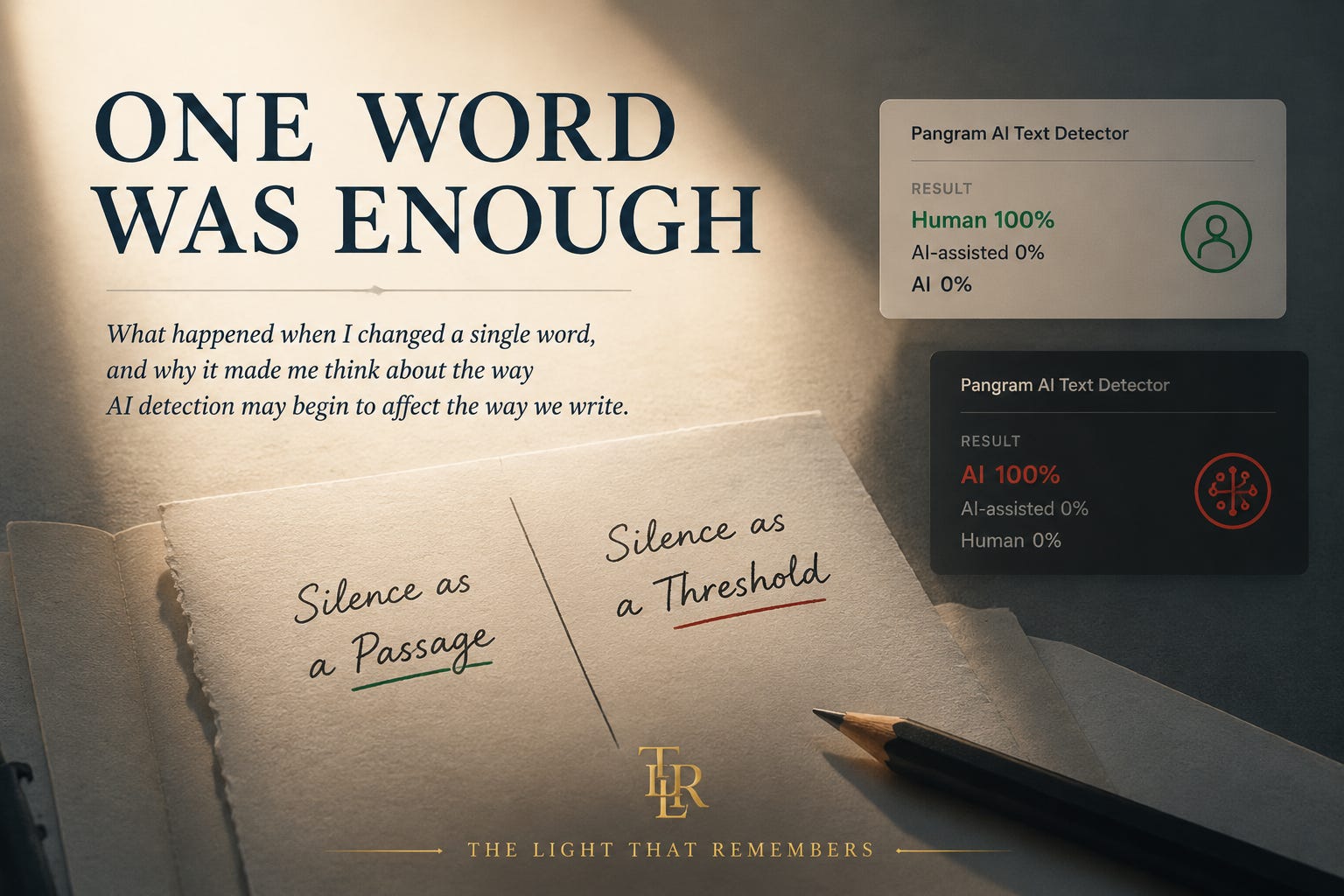
I am not an expert in artificial intelligence. I write, and like many people who publish their work online, I became curious about the systems that claim to recognize whether a text was written by a person or generated by AI.
My doubt did not begin because I wanted to prove that one of these systems was wrong. It happened almost by accident, while I was working on a short text of mine.
I had written it myself, following the same process I normally use: thinking about a sentence, returning to it, changing something when it no longer sounded right, and sometimes leaving an imperfection because removing it would also remove something that belonged to me.
At a certain point I decided to run it through Pangram.
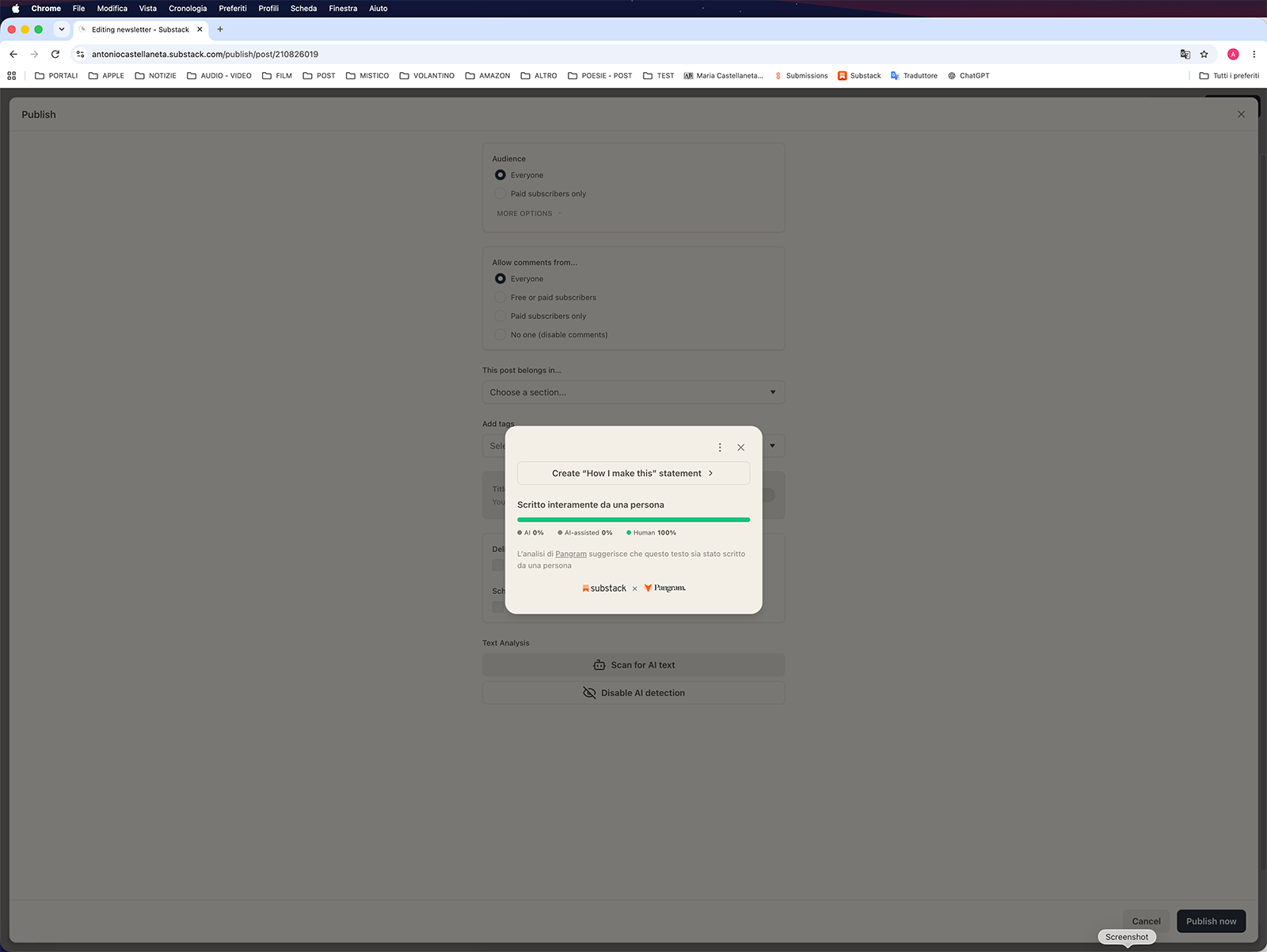
The result was clear:
Human 100% — AI-assisted 0% — AI 0%.
There was nothing surprising about it. I had written the text, and the result simply confirmed something I already knew.
Then I changed one word.
Not a paragraph. Not a sentence. Not the structure of the text.
One word in the title.
And the result changed completely.
This is the point where I stopped taking the result for granted and started wondering what I was actually looking at.
Since most of the people who read my work are English-speaking, I reproduced the same test in English. I kept the text exactly the same in both versions.
I am including both texts in full. I think this matters because anyone reading this can copy them and try the same test instead of simply taking my word for it.
This was the first version.
Silence as a Passage
There is a moment, in everyone’s life, when silence stops being a silent place and you realize that reality is different in the light of day.
You take a pause between one thought you are meditating on and the other that is knocking at the door of your heart. And do not believe that it is the better one, nor hope that one thought can remain separate from the other without them arguing with each other.
It becomes something closer, something we had left alone, more insistent because it is alive. The more you think about it, the more you believe it has something to tell you.
It is a place within us that we had not foreseen, but that reaches us anyway, beyond our will.
A place that we did not choose, but that chooses us without asking permission, and it is a gesture that comes from within.
Pangram result: Human 100% — AI-assisted 0% — AI 0%.
Then I changed the title.
Only this:
Passage → Threshold
Nothing in the body of the text was touched.
This was the second version.
Silence as a Threshold
There is a moment, in everyone’s life, when silence stops being a silent place and you realize that reality is different in the light of day.
You take a pause between one thought you are meditating on and the other that is knocking at the door of your heart. And do not believe that it is the better one, nor hope that one thought can remain separate from the other without them arguing with each other.
It becomes something closer, something we had left alone, more insistent because it is alive. The more you think about it, the more you believe it has something to tell you.
It is a place within us that we had not foreseen, but that reaches us anyway, beyond our will.
A place that we did not choose, but that chooses us without asking permission, and it is a gesture that comes from within.
I looked at those two results for a while.
The text had the same author.
The same thought.
The same sentences.
The same punctuation.
The same imperfections.
One word in the title had changed.
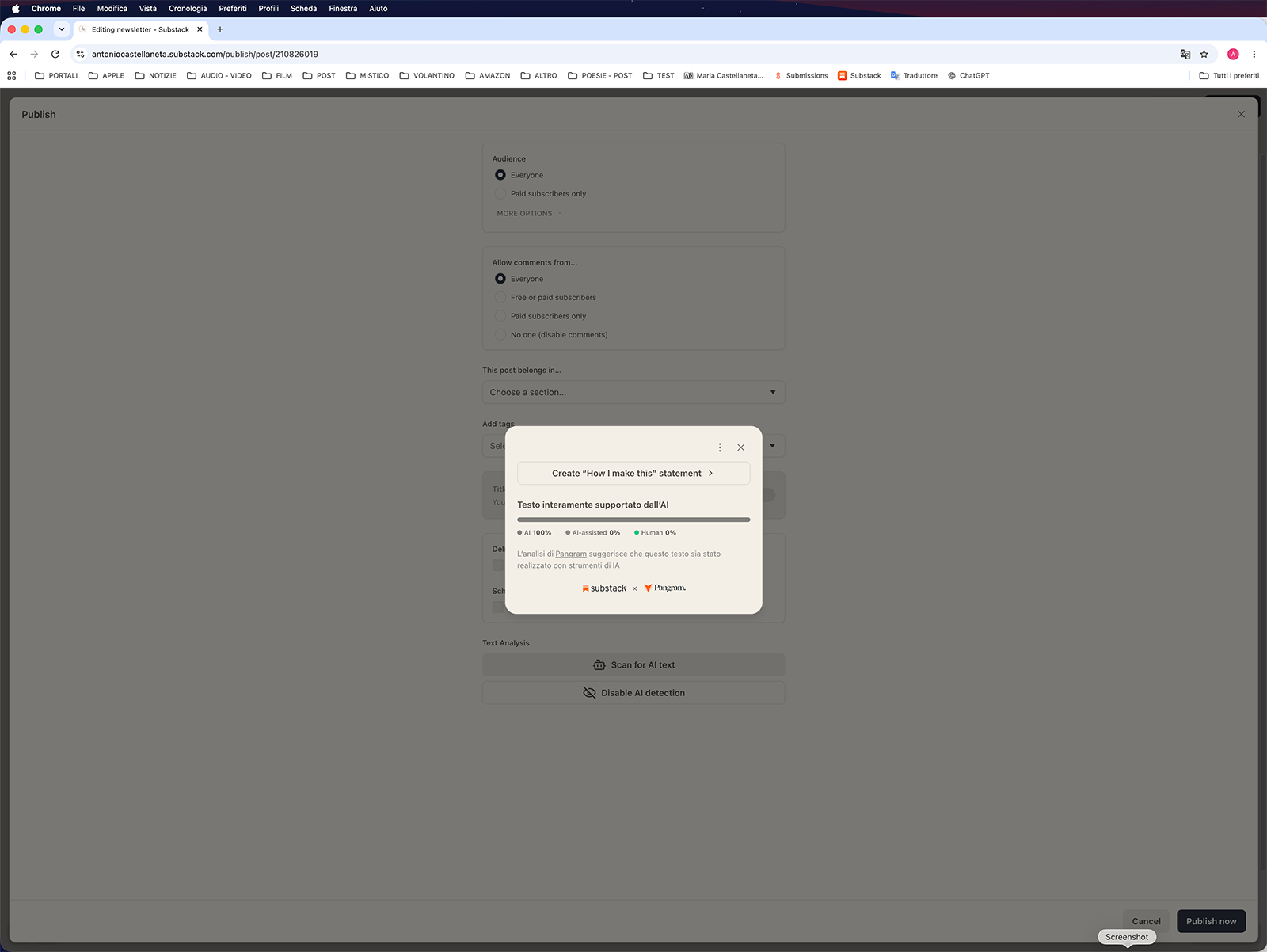
Yet according to what I was seeing on the screen, the first text was completely human and the second completely artificial.
I am leaving both versions here deliberately.
Copy the first one exactly as it is and test it. Then copy the second one and do the same. Do not correct the English, do not change the punctuation, and do not add or remove anything.
I cannot promise that everyone will always receive exactly the same percentages I received. These systems may change over time, and I think it would be wrong not to say that.
But try it.
Because my concern does not come only from whether the result can be reproduced forever. It comes from what happened when I saw those two judgments beside two texts whose history I knew.
I knew I had written them.
The detector did not know that.
And this made me wonder how much authority we are beginning to give to a percentage when we use it to judge the person behind a text.
Imagine that someone takes something you have written and runs it through one of these systems.
The result says:
AI 100%.
They take a screenshot and post it on social media.
“This writer uses AI.”
Someone shares it. Someone else repeats it.
How many people will ask to see the previous version?
How many will know how the text was written?
How many will wonder whether another word might have produced another result?
Probably many will see the number.
And a number like 100% does not look like doubt.
It looks like certainty.
That is where the problem became more personal for me.
Because there is the judgment of other people, but there is also what the fear of that judgment can begin to do to us.
The accusation does not even have to happen.
Knowing that it could happen may be enough.
The next time you write something, perhaps you test it before publishing.
The detector says AI.
You change a sentence.
You test it again.
Still AI.
You replace a word.
You break a sentence.
You remove something that sounded natural to you.
You leave something slightly awkward because perhaps that will help.
Then you test it again.
Human.
And you feel relieved.
But why should you feel relieved?
You knew you were human before the test.
This is the part I find difficult to ignore.
At some point you may stop asking:
Is this the sentence I wanted to write?
and begin asking:
Will they believe that I wrote it?
Those are two completely different ways of standing in front of a page.
I know my writing is imperfect.
Sometimes I repeat myself. Sometimes a sentence takes a direction I had not planned. Sometimes I keep a word even when another one might be more elegant, simply because the first one feels closer to what I wanted to say.
Those imperfections belong to me.
But deliberately introducing other imperfections because I am afraid that a machine might otherwise consider my writing artificial would not make the text more human.
It would only make me more afraid of writing naturally.
And that is a strange place to arrive.
A human being changing his own voice in order to convince a machine that he is human.
I do not want to learn how to sound human to a detector.
I already am.
This small experience did not make me an expert in artificial intelligence, and I am not presenting it as a scientific study.
It gave me a doubt.
And perhaps that doubt is enough.
I no longer feel comfortable treating a percentage by itself as proof of who wrote something, especially when that percentage can be turned into a screenshot, an accusation and, within minutes, a public judgment.
But there is something that concerns me even more than the accusation.
A false judgment can change what other people think about us.
The fear of that judgment can change the way we think about ourselves.
And if we begin changing our sentences, our rhythm, our words or even our imperfections because we are afraid that a machine may not recognize us as human, then something has already happened before anyone has accused us of anything.
The detector has entered the room where we write.
It is no longer waiting at the end of the page.
We have brought its judgment to the beginning.
There is a difference between being judged after we have written something and writing with that judgment already inside our head.
The first can affect our reputation.
The second can affect our voice.
And between the two, I am beginning to think that the second may be the one we should fear most.
— Antonio Castellaneta
The Light That Remembers is a reader-supported publication. To receive new posts and support my work, consider becoming a free or paid subscriber.
Thanks for reading The Light That Remembers! This post is public so feel free to share it.
Artwork inspired by the poem and created through generative tools.
Comments
Nothing yet. Say the first thing.
Sign in to join the conversation.