
I’ve been wanting to write about Sean Baker’s “Anora” for a year. I’ve been thinking about “Anora” so much in fact, that I now have Anora paralysis, which is to say that I am so tired of thinking about the issues that it brings up for me, about what it means for a (cis, white, straight? male) director who is not directly connected to the sex industry, to build a 4-Oscar career on the backs of the sex worker community while things have only become worse and harder for sex working people. Sean Baker’s career would not exist without sex workers.
What should Sean Baker do about this glaring reality now that he has his pick of deals in Hollywood?
What should sex workers ask of him? Why has this widely normalized Hollywood rapaciousness not been discussed more openly? Sex workers are currently at risk for being arrested for giving one another rides, for walking in front of a strip club, for doing consensual sex work. Today and every day, sex workers are kicked off of Instagram, denied access to Venmo, which means potentially being denied housing, and losing custody rights. Arrest can mean a kind of social death.
I’ve been thinking about what sex workers should expect of ALL directors and ALL actors in 2026 (Yes, Mikey! it’s so very cool that you have sincerely, publicly dedicated “Anora” to sex workers! And I know, I know. Sean Baker is Just. So. Nice.)
Still. The fact remains that so many directors use sex workers life stories to tell the best stories, while excluding sex workers from meaningful, lasting roles in writing rooms, and directing opportunities. Why don’t more sex workers direct their own films? Because they do not have the resources. And it’s not for lack of tenacity and talent. Making films is an expensive endeavor. I know, I’ve made one.
It’s amazing how little gains have been made in this area: the massive amount of sexism, whorephobia, and misogyny in Hollywood—the blatant gatekeeping! Oh, how it is seen and felt. The substantial movie deals are not going to remarkably accomplished women making films about stripper labor rights, for instance. The big money is going to Sam Levinson for the popular TV series, “Euphoria” where sex workers have openly expressed distress about the demoralizing depictions of sex work.
Netflix, we need to talk.
Which brings me to this: If “Anora” is the updated, Gen Z coded “Pretty Woman” (it is), then “One Battle After Another” is “Born in Flames” 2.0. Hear me out.
Paul Thomas Anderson’s 2025 triumph, “One Battle After Another” is an action-packed, deliciously sinister film that is so contemporary, it is old school. It’s also a weirdly familiar film, but not in the way that you’re thinking. It was actually filmed in my hometown of Eureka, California as well as in my actual high school. The excellent stoner dad played by Leonardo DiCaprio acts and dresses like every dude over 45 I’ve ever known growing up in Humboldt County. It’s downright unsettling, and brilliantly done. But we’ll come back to that later.
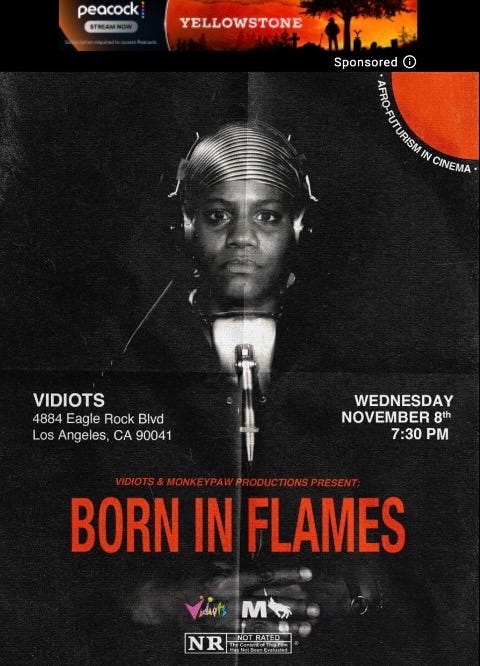
Here I want to tell you about the fact that “One Battle After Another” is no Vineland by Thomas Pynchon. It is an updated, fast-paced, Sean Penn-ified version of Lizzie Borden’s “Born in Flames” a very revolution-drenched film that has maintained its arthouse notoriety for 43 years. “Born in Flames” directed by Lizzie Borden shows Black lesbian feminist resistance to authoritarianism with nuance, complexity and lots of bicycles. Like many artists, Lizzie Borden mines her own life for much of her material. “Working Girls” (1986), her follow-up feature film to “Born in Flames” (1983) centers the point of view of of a lesbian sex worker who toils in a brothel. Lizzie has spoken openly about her own experiences in New York as a struggling filmmaker who made ends meet working in a brothel in the ‘80s.
One way or another, “One Battle After Another” is inadvertently borrowing from a sex worker director and mirroring her work and her film’s themes. Notably, “One Battle After Another” grossed $213 million worldwide. I don’t have to tell you that “Born in Flames” didn’t come anywhere near that at the box office, although its lasting power is undeniable.
I am troubled by the psychosis of Hollywood’s insatiable thievery, and I fear that it will get worse if we don’t demand change.
After all, both films also share a desire for change. “Born in Flames” and “One Battle After Another” both challenge us as a culture to look at how to upend abusive structural power and what that could possibly look like: Hot. Both films ask us if we will remember our own codes of resistance when the time comes, will we be willing and able to call upon them?
And most important, both films ask of us to not simply build power, but to shift it— alchemize it and use it to nurture our courage. We will need it when it is time to take direct and collective action, even when, especially when it hurts the most to do so.
Comments
Nothing yet. Say the first thing.
Sign in to join the conversation.