
There have been three crowned King Charles’ who have sat on the Throne of England. King Charles I of England (1600-1649) the son of King James I. He ascended to the throne in 1625 until his beheading. He named his heir apparent after himself. King Charles II (1630-1685) sat as crowned monarch from 1600 until his suspicious death. Both Charles I and Charles II were traitors to England. Their allegiance was to Rome from where they were impowered to believe they had the divine right to reign.
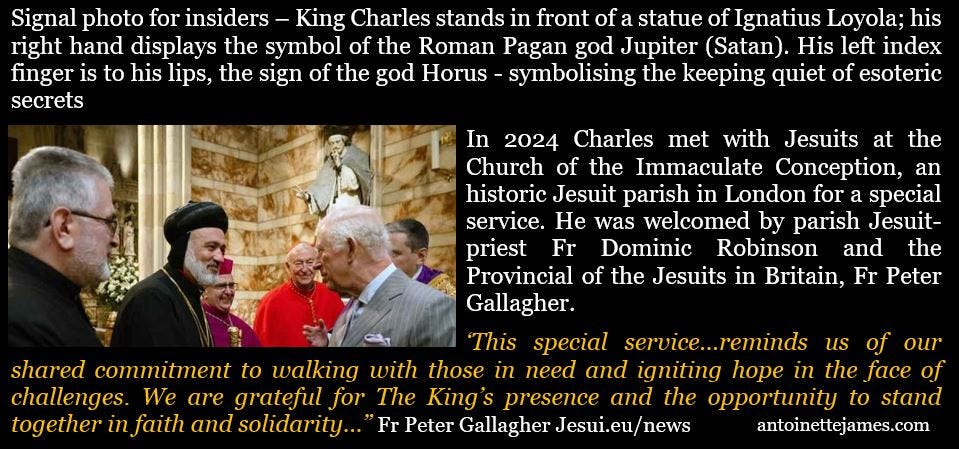
Fast forward 337 years, to 2022 when Charles III was crowned King of England. Perhaps it can be argued the long wait for the third Charles was because his predecessors were of political, social and religious odds to the nation. But with the skilful reediting of history in the early 1900s by House of Rockefeller, and the dumbing down of education much of the Charles-treachery has been sanitised, making for a Charles-comeback.
Male royal names of good repute throughout English history are thin on the ground; that said, was the name Charles the best one Elizabeth II could think of for the next-in-line? Essentially the choice comes down to eight over used names - George, William, Charles, Henry, Edward, James, Albert, and Arthur.
There have been two James, four Williams, six Georges, eight Henrys, and a whopping eleven Edwards. Arthurs all died before their coronation, making the name jinxed. As for Alberts, both of them chose regnal names - King Edward VII was born Albert in 1841, and King George VI also born Albert in 1895, but known as Bertie by his family. Albert was too Germanic for a WWII king. The regnal option follows papal protocols of a chosen name to mark the philosophy of the reign.
More than likely, Elizabeth had constraints when naming her first-born son. Henry would not have been her advisors’ choice, for he departed from papal Rome. Certainly James, would have been totally off the table, as it was James I who commissioned the King James Bible, the most hated book of the papacy. So that reduced the list, (removing Arthur) to five – George, Edward, William, Albert, and Charles.
Elizabeth’s father and grandfather were Georges, so she may have thought it time for a change, leaving four names in the hat. Albert probably was too close to the bone. Her grandfather King George V disassociated himself from his German (Holy Roman Emperor) roots in 1917, during WWI, dropping Saxe-Coburg and Gotha to rebrand to the more Protestant English name of Windsor. That left three names.
Edward was the name that wasn’t even mentioned by the Queen Mother, for it was Edward who abdicating the throne thrusting her husband Albert to become George VI. Elizabeth II would not have distressed her mother. That left two names to choose between.
And it is here that Jesuitical history starts to repeat…
The British throne is steeped in tradition and that extends to names. In the modern area the heir is given a swath of spare names, partly in honour of prior kings, partly to honour parental lineages and partly to counter any unforeseen events making a regnal name more appropriate.
A pattern of a “King Charles” ascending before a “King William” is emerging. Elizabeth’s first born is named Charles, and Charles first born is named William repeating the 17th century dialectical swing. Charles’ reign openly champions for Rome, so in line with dialectic principles, he will be followed by a William, a king positioned as controlled opposition, to champion for Protestant Christianity - while in fact both are in subjection to Rome.
This pattern is a counter Reformation engagement of a silent war against Rome’s most hated country - Protestant Britain. Rome sent Bishop Augustine to displace an established Christian Church on the Isle in 597; King Henry VIII, albeit for selfish reasons, brought her out from Rome during the Protestant Reformation started in earnest in Scotland by John Knox, and in Germany by Martin Luther.
During the 15th and 16th centuries…The imperial title became hereditary in the Habsburg family and, by a calculated policy of dynastic marriages, they enlarged their borders. After centuries of decline, the last vestiges of the Roman Empire in the East finally fell to the Ottoman…In the West, the greatest of all the Habsburgs, the Emperor Charles V, built a global empire stretching from Vienna to Peru (through the acquisition of the Spanish dominions) and pursued tirelessly the ideal of a unified [Roman Catholic] Christian Empire. He achieved the world’s first truly great modern empire, only to be thwarted by the Italian Renaissance spirit with its questioning and criticism of time-honoured institutions, including the [Catholic] Church. This great awakening of learning and knowledge spread northwards to the German universities, and reached an insignificant monk and educator named Martin Luther. His disgust with the corruption in the Roman Church and Papal abuse of power led to the Protestant Reformation, which spread like wildfire over the Continent. Despite the Emperor’s efforts to declare war on the protesters, the old order had been demolished and hopes of religious unity destroyed, along with the meaning of the office of Holy Roman Emperor. He was now the head of just one party — the Catholics. Charles had been crowned Holy Roman Emperor by Pope Clement VII in 1530, the last time the office was bestowed by a Pope.’ Britain and the emerging holy European empire, 1997, Adrian Hilton, page 28
The Protestant Reformation extinguished Papal Rome’s grip on the known world, and the modern era began with the burgeoning of the sciences, arts, and middle-class. England’s Christians were very vocal about the advances of Rome; but underestimated the reach of the Vatican private military, the Jesuit Order.
‘After the Reformation and the adoption of the 39 Articles of the Church of England, the Church and State laid their foundations upon the authority of the Bible and a Protestant monarchy. However, the present Queen [QEII], in 1996, appointed an influential Roman Catholic as her chaplain, and attended Vespers in Westminster Cathedral to celebrate the centenary of the building as Britain’s Roman Catholic centre. Further, [the then] Prince Charles, the Heir to the Throne, is professing an allegiance not to biblical Christianity but to all faiths. The Coronation Oath is clearly being ignored and undermined through these changes, in a prelude to the removal of the Act of Settlement of 1701, which does not permit a Roman Catholic, or a monarch married to a Roman Catholic, to accede to the throne. If this happened, for the first time since the Glorious Revolution of 1688 [William III sat on the throne], Rome would be provided with a vassal monarch with sovereignty over ‘Mary’s dowry’. This would inevitably lead to the ascendancy of Roman traditions over the authority of Scripture which lies at the heart of Protestantism and the institution of the Monarchy.’ Britain and the Emerging Holy European Empire, 1997, Adrian Hilton, page 53
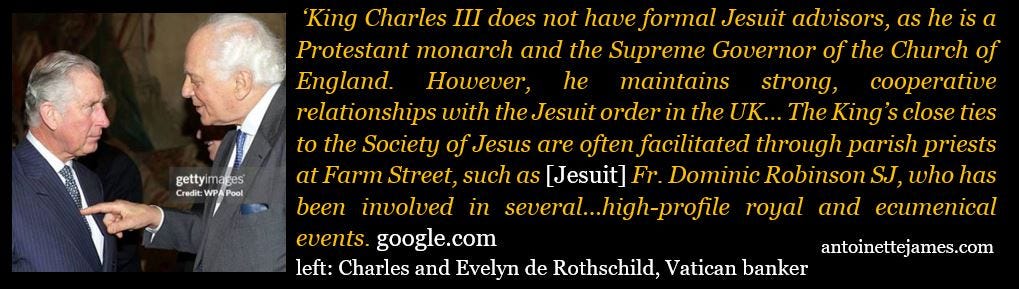
The Jesuit Order, which plan 100 years in advance, knew at the birth of Elizabeth II’s son in 1948, that it was time for a covert Catholic monarch reset – as popes take on a regnal that denotes their core thrust, so naming the baby boy Charles was an esoteric symbol to insiders that the time to strike at the heart of the nation was nigh. A time was growing close for a new Holy Roman Emperor, in England, to reign over a one world religion was within their grasp. At the same time the Jesuits were busy working in the United Nations draughting Agenda 21 – a return to universal papal rule. But neither the Holy Roman Emperor nor Agenda 21 were realised.
Like the two Charles before, Charles III in waiting was for all intents and purposes removed from his mother and mentored and shaped by men steeped in Ancient Mystery beliefs (for fuller dialogue read Prince Charles Speaks at COP28 Dec 14, 2023, antoinettejamescom.substack.com)
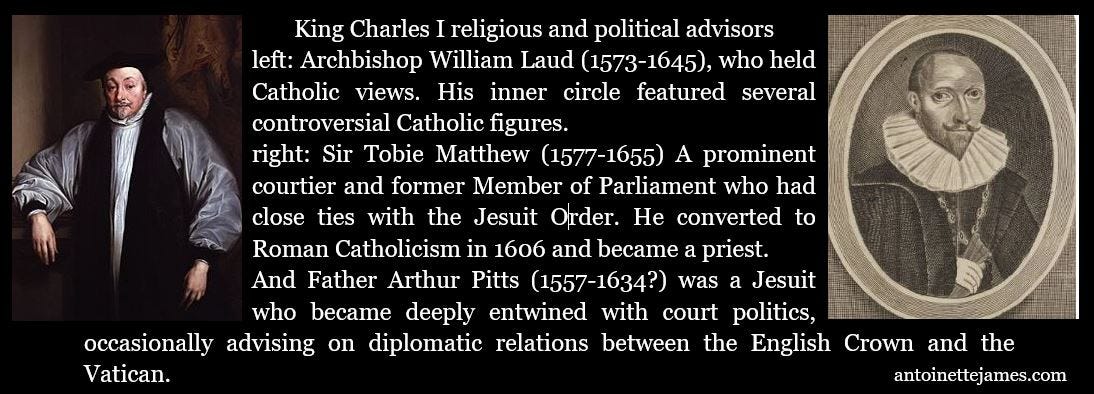
The first King Charles in history was the French Roman Catholic Charles le Magne, translated into English as Charles the Great. In attempt to remove the papal connection he is known as Charlemagne. He was the first Holy Roman Emperor, a title given by the pope to his faithful European kings during the bloody Dark Ages that spanned over a millennium (800–1806). Charlemagne was a tyrannical brutish champion for papal Rome, naming Europe after the esoteric papal goddess Europa. Other kings named Charles were the known by the Germanic variation of Carl/Carlo/Karl and in Spain, Carlos.
In AD 800, Charlemagne (Charles the Great), a zealous Roman Catholic, was crowned Imperator Romanerum (Emperor of the Romans) by Pope Leo Ill. He became Western Europe’s ‘Christian’ Caesar — a Roman emperor born of a Germanic race. The West once again had an emperor, and his coronation was to become the central event of the Middle Ages. He was proclaimed Rex Pater Europae (King Father of Europe) and espoused the ideal of a unified Christian Empire — albeit christianised at swordpoint — in close alliance with the Pope. The fact that Charlemagne received his crown from the Pope was seen by the populace as equal to a divine bestowal. It confirmed the perception that the imperial crown was a papal gift, and that the kingdoms of this earth belonged to the Bishop of Rome; they were his to give, and his to take away. It was the lesser person being blessed by the greater.’ The principality and power of Europe : Britain and the emerging holy European empire, 1997, Adrian Hilton, page 26
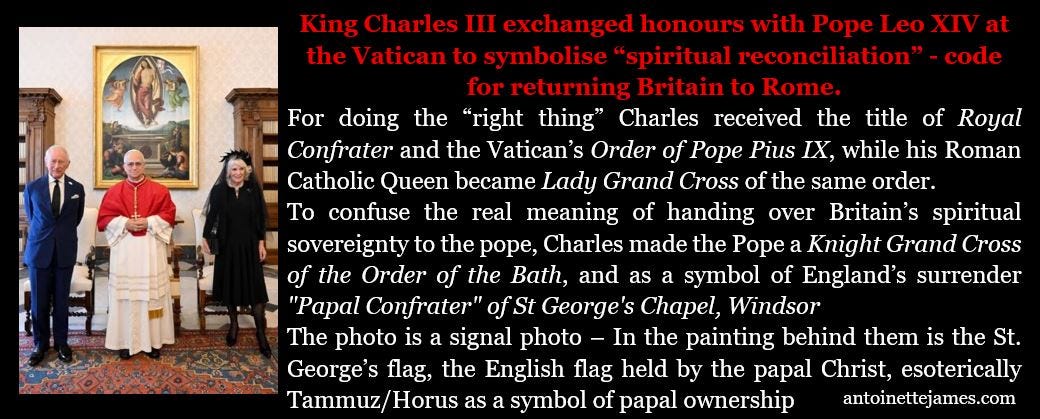
In the silent (papal counter reformation) war against Protestant Britain, Pope Paul III commissioned the Jesuit order in 1540. From that moment the manipulation, grooming, and the positioning of Catholic Consorts has been used as a weapon to destroy Henry VIII Protestant legacy. And none have done it better than the three Charles. Charles III, a law unto himself, has done as his predecessors. He has opposed Queen Elizabeth and the lied to the people, by saying Camilla would not be Queen. What a triumph for his handlers to once again have a Charles and his Roman Catholic Queen sitting on the English throne, after 337 years.
‘And when Henry VIII wished to give the legal grounds for English independence from Rome, he said: “This realm of England is an empire.” By that be meant that political authority in England was absolute, and could not be subordinate to any concurrent authority, be it that of pope or of emperor.’ Britain and the Emerging Holy European Empire, 1997, Adrian Hilton, page 17
King Charles I, believed he had the divine right to rule, and this unchallenged authority was exercised through his staunch commitment to the already Roman infiltrated Church of England, rather than a commitment to Christianity.
Charles was groomed by his father’s favourite, the homosexual George Villiers, who quickly became the 1st Duke of Buckingham. Villiers conveniently filled the confidant-void left when Charles older brother, Henry died. Villiers first took him to visit the Spanish infanta, to gain her hand in marriage in exchange for a promise to grant concessions to English Catholics. This did not go well in Protestant England, that was still feeling the whiplash of the papal inquisition under the Jesuit Order. Charles changed course and Villiers removed his focus from Spain, thereby fomenting a war between the two countries. He turned Charles’ eyes to Marie Medici’s daughter, Henrietta Maria of France. She too was Roman Catholic and very unpopular in Protestant Britain, where the Church of England refused to crown her queen.
‘The Jesuits were the advisers and confessors of the ill-starred monarch, Charles I of England, and through their advice oppressed the people and subsequently lost his head…the Jesuits…betrayed and deserted Charles in order that the kingdom might be disintegrated by civil war and render the Jesuit conquest sure.’ Gury’s Doctrines of the Jesuits, 1924, page 569
The English parliament demanded Charles to enforce the anti-Catholic laws. They wanted the immediate dismissal of Buckingham and pleaded with the king to return to parliament for dialogue. Instead, Charles dismissed parliament and increased taxes. Buckingham was murdered and Charles moved the country closer to civil war, just like Charles III is attempting to do today.
Charles I was isolated from the people and parliament, to be surrounded by Roman Catholic advisors as Charles II and III. Only his Catholic Henriette Maria was allowed to sit with him, and she very quickly took power, flaunting her loathing of Protestantism in court. This had the desired effect, causing courtiers to convert to Romanism to curie favour and thereby a Catholic lobby was built.
In 1637 Queen Henrietta Maria facilitated a papal representative at Whitehall, and the people realised that unchecked, Charles was to reintroduce popery. Charles ignored the rising concerns of his subjects as Charles II and III, and continued his course. Parliament forces fought Charles’ Catholic forces as the country moved into civil war.
Charles I was taken into custody and charged on, plotting to overthrow the rights and Liberties of his people maliciously levying war against them, negotiating with foreign powers to invade England, and renewing the conflict after his defeat. Therefore he was copiable for - all the treasons murders repines burnings spoils desolations damages and mischiefs to this nation. Charles I was beheaded in 1649 and the country became a Republic for eleven years.
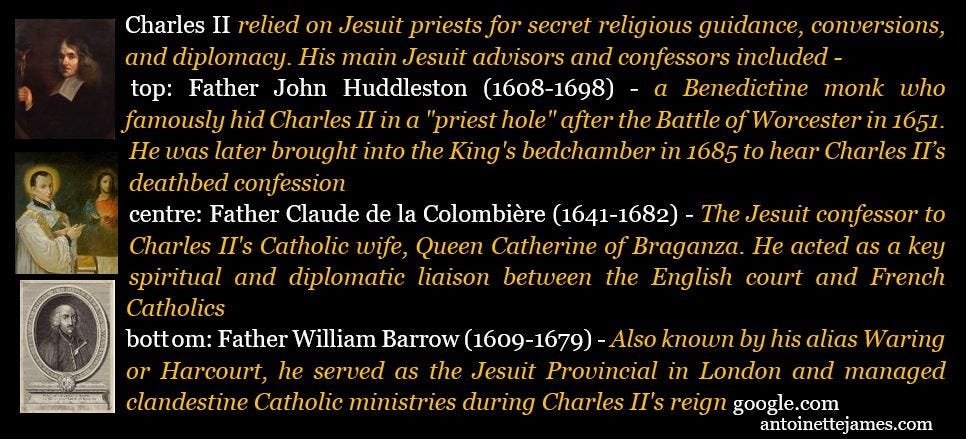
King Charles II of England came to the throne after Oliver Cromwell’s death when there seemed increasing instability in the country without a head. Charles I was an unwitting useful idiot for Rome, but his son Charles II, was fully complicit. He was a secret Roman Catholic sympathizer for much of his reign and formally converted to Roman Catholicism on his deathbed in 1685.
In 1660 Charles II sat on the throne, wasting no time to revive esoteric Roman Catholic worship of goddess Priapus, by reconstituting the pagan Roman May Day festivities to England; including putting up Maypoles at every crossway and village green. He believed like his father in the divine right of kings, he introduced Jesuit Drama back to London, he was a prolific philanderer (14 confirmed mistresses), siring many illegitimate children while married to his Portuguese Roman Catholic wife, Catherine of Braganza; who bore no children – surely the hand of God. He was known as the Merry Monarch.
It was Charles who sanctioned the establishment of the Jesuit organisation of the Royal Society of London under the guise of Improving Natural Knowledge. But in reality, it was a closed shop of gnostic thinkers who popularized the Theory of Evolution to destroy credibility in the King James Bible.
Charles II quietly oversaw the Jesuit arson of the 666 fires of London, so the papacy could affect a covert landgrab of private property that spread throughout the West. It was he who gave the square mile piece of land to the papacy called The City of London, inside greater London, but no longer owned by England.
‘Canon 2036: A Cestui Que Vie Trust, also known later as a “Fide Commissary Trust” and later again as a “Foreign Situs Trust” and also known as a form of “Secret Trust” is a [papal] fictional concept being a Temporary Testamentary Trust, first created during the reign of Henry VIII of England through the Cestui Que Vie Act of 1540 and updated by Charles II through the Cestui Que Vie Act of 1666 wherein an Estate may be effected for the Benefit of one or more Persons presumed lost or abandoned at “sea” and therefore assumed/presumed “dead” after seven years. Additional presumptions by which such a Trust may be formed were added in later statutes to include bankrupts, minors, incompetents, mortgages and private companies.’ Cestui Que Vie, Christopher Bruce and Ingham Hardy, 2017
Charles was hands on with the rebuilding of London, commissioning the architect Christopher Wren to build a new cathedral on the site of the burnt Protestant Christian St Paul’s. The new Cathedral was a miniature lookalike of St Peter’s in Vatican City complete with Ancient Mystery sun dome and many Luciferian pagan symbols.
In 1670 Charles agreed to the secret Treaty of Dover with King Louis XIV of France. He agreed to formalise his conversion to Roman Catholicism, on the terms that it be kept secret from his subjects. But his subjects found out forcing him to annul the Treaty.
Like all elites, since the creation of the Jesuit Order, Charles too needed to be compliant to their wishes – on pain of death. In 1678 Titus Oates, a Catholic priest with ties to the Jesuits, and Israel Tonge, a Protestant who was believed to have been mentally unstable, revealed a conspiracy to assassinate king. Whether it was true or not, it resulted in further religious agitation and polarisation of the nation and probably a reminder to him to obey. However, five years later, in 1680 another assassination plot was discovered and dealt with. Then, in 1685 in what looks like a play by play copy of the poisoning, sudden illness and medical torture of President George Washington, Charles took sick and died. He openly confessed his Roman Catholicism; Catholic Priest Huddleston arrived to give the last rites; and King Charles II of England was farewelled in a very quiet Roman Catholic funeral shunning public scrutiny.
Surrounded by a great opposition, Roman Catholic James, next in line, was rejected. The throne was offered to James’ Protestant daughter Mary and her Jesuit controlled husband, William of Orange. In the 21st century England has a William heir apparent, who seems to be more street savvy than his Romish father and more willing to hold the nation together under the Protestant Christian banner…time will tell.
The world watches on as Charles III, goes through a hard end of life scenario like the others. His life reads the same as well - Groomed and under Jesuitical control, married to a Roman Catholic, whom he had an ongoing affair with during his marriage to his first wife. He too seems just as distant from the people he reigns over as Charles I and II. Charles III legacy will not be one of freedom but bringing the nation to a new civil war. Charles I should be a warning to him, as he has resigned from his command as Defender of the protestant Christian Faith, and all the inalienable rights that are inherent in it. Such neglect and blindness saw Charles I head cut off, because when one is the head of any organisation, one has the power to stop the tyranny, yet he allows it.
‘Unlike other European nations with monarchies, the British throne is not merely a symbol of popularity or an ingredient of constitutional ceremony with minor political functions, but the maintaining legal foundation of biblical Christianity on these shores. It is not therefore appropriate to compare defence of the British throne with other European monarchies. The Danes, the Dutch, the Belgians and the Spanish do not have constitutions which prevent the ascendancy of a Roman Catholic monarch, leading to submission to Rome. The prospect of the removal of the Act of Settlement from the Statute Books, a change which the Queen and other senior members of the Royal Family are reported to favour, would be the crowning glory of the Anglo-Roman Catholic International Commission. The signs are already evident. On the significance of Prince Charles’ bedside rosary, a gift from the Pope…’ The principality and power of Europe: Britain and the emerging holy European empire, 1997, Adrian Hilton, page 55
The Sunday Telegraph reported in horror the news that Charles does the rosary each night, How changed is our country, even 30 years ago, the news that the future Supreme Governor of the Church of England practised [praying the rosary] what would have been considered a popish superstition would have provoked outrage. A century before it might have provoked revolution. The news about a mistress would have attracted far less attention.
Charles’ bias towards Islam is blatant for the world to see. His only response to accusations, and questions is silence, protected by his Jesuit adjutors in the palace like the Charles’ before. It was significant symbolism when he invited Muslims to end Ramadan at Windsor castle, Queen Elizabeth’s beloved home. This was a sign that a monarch as defender of the Protestant Christian Faith, is history. Charles, defender of the Papacy is now the new normal.
Charles III has been given the nod by the papacy as the temporal king of the one world order under the pope. This is why he is not a in the least worried about what will come of the nation of Britain or its people.
Charles will have been told of his status and told he will be hedged about if he stays the course. The papal Syllabus of Errors of 1864 published by Pius IX says that Kings and princes are subject to the Roman Catholic Church, with no autonomy. Error 54 states, Kings and princes are not only exempt from the jurisdiction of the Church but are superior to the Church in deciding questions of jurisdiction. Charles will have been informed that to think he is above the church is an anathema to the papacy, to be head of the Church of England is an error!
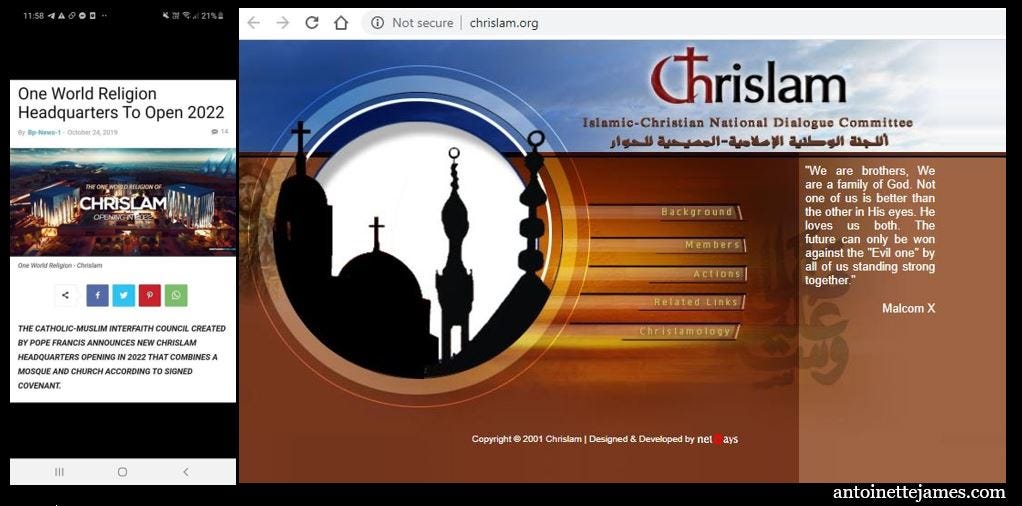
His open fascination with Islam has been carefully managed. It is a designed dialectic squeeze to cause enough chaos to usher in a one world religion. It will not come in suddenly, first the agitation, then blending of Christianity and Islam into the papal created Chrislam. This will be followed by a drift into the ancient esoteric heart of both Romanism and Islam – Mithraism, taking the world back to the glory days of Pagan Rome – a full circle and a full stop!
In the days of Charles I and Charles II the Christians stood up. Rockefeller history vilifies them as Puritan fanatics, and Christians scared of their own shadows. However, it does not matter what others think, it only matters what one thinks about one’s own response in a created crisis to bring down Christian civilization. It is time to be heard.
Please share this article with people you know who like this type of exposé
Comments
Nothing yet. Say the first thing.
Sign in to join the conversation.