
A fortnight ago, with Alekos in the chair beside us, we waded — perhaps unwisely — into the perennial parlour game of Who is Satoshi?, took aim at the New York Times’ breathless attempt to crown Adam Back, and concluded, as one must, that the case did not cut the mustard. The code was wrong. The fingerprints didn’t match. The man does not, by all credible accounts, even use Windows. Case closed; coffees finished; on with the show.
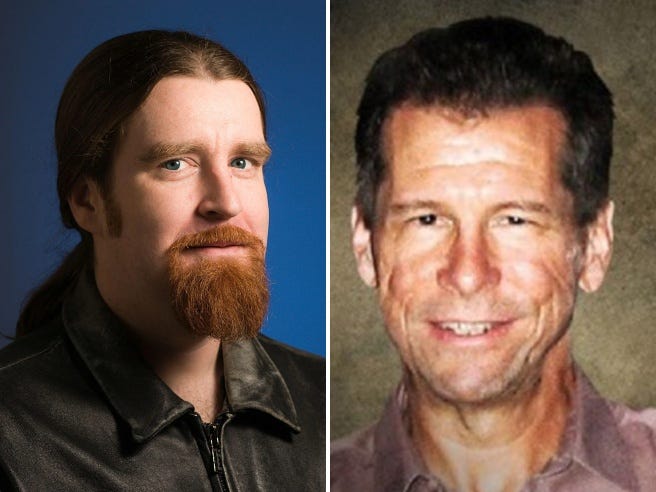
And then, as if the universe were simply waiting for us to commit a take to tape, along comes another documentary — Finding Satoshi — pointing not at one man but at two: Hal Finney and Len Sassaman. Reader, your weary correspondents owe you an update.
Here is what’s compelling, and I’ll spare you the breathless reconstruction. Sassaman was a cryptographer of genuine pedigree — PhD candidate in Belgium under David Chaum (the actual godfather of digital cash, 1983 vintage), flatmate of Bram Cohen, PGP veteran, cypherpunk to his marrow. In the months immediately preceding Bitcoin’s release, Sassaman was publicly noodling on a solution to the Byzantine Generals Problem — the very problem Bitcoin proceeded to solve. He had a documented affection for Japanese-sounding pseudonyms. He wrote, despite being American, in conspicuously British English (bloody this, flatmate that). And he was almost certainly one of seventy people on Earth in possession of a particular Belgian time-stamping paper that — wouldn’t you know it — appears in the Bitcoin white paper’s citations and was, so far as anyone can tell, never published online.
Hal we know already. First node operator after Satoshi. First recipient of a Bitcoin transaction. A coder for whom programming languages were apparently a second mother tongue, capable of pivoting to C++ in an afternoon. And — a detail that lodged in my brain like a splinter — he lived two or three blocks from one Dorian Satoshi Nakamoto, that infamously and wrongly-fingered gentleman of Temple City, California. If you were a paranoiac of cryptographic temperament reaching for a plausible alias from your local phone book, well. Quite.
Two months after Satoshi’s farewell post, Sassaman — debilitated by chronic back pain — took his own life. Hal, locked in by ALS, died in 2014 and was cryopreserved (so, technically, the jury remains out, and one rather hopes for a future thaw and a smirking I told you so).
Is this proof? Of course not. There is no smoking gun in this game and there never will be — the only true proof would be the movement of Satoshi’s coins, and those coins, mercifully, are not moving. But as a theory it has the virtue of fit: an academic who writes elegant prose; an engineer who writes elegant code; two friends, two skill sets, one impossible problem cracked between them.
What we find most stirring is not the whodunnit but the why. Whoever Satoshi was — singular or plural, alive or frozen — they gave the thing away. They let the keys lie. Hundreds of millions, then, billions now, abandoned for the sake of the project’s integrity. Try to name another act of comparable restraint in the last fifty years of technology. I’ll wait.
We may never know. Frankly, we shouldn’t want to.
Listen to the podcast on Fountain, or wherever you get your podcasts, and if you’re building on Bitcoin, applications for Antidote Cohort 2 are now open at antidotebtc.com.
Comments
Nothing yet. Say the first thing.
Sign in to join the conversation.