
(summary in a meme)
Whereabouts of your once inseparable school friends.
Old clothes hidden behind the pile of your latest wardrobe collection.
The garbage you disposed of yesterday.
All of the above have one thing in common - you forgot about them as they disappeared from your sight.
With tech hype cycles getting shorter, rather, looking more like just trends, our limited attention is being encroached upon much faster by multiple products, accelerating our forgetfulness. This forgetfulness has intensified our thoughtlessness. And there is a faction out there which makes the most of this deadly combination we offer for free. Global waste traders.
They sell the refuse of one country to another.
It is a real life game of passing the parcel, only the parcel is garbage (literally). All the plastic you use and throw and electronics you no longer fancy, there is a good chance it does not end up in a landfill of your country (if you live in a developed nation) but in the landfills of another nation, most probably, a developing one. Yes, we’re talking ship containers filled with filthy used plastic bottles, soiled wrappers & bags, scraps of discarded metal and dumps of toxic waste serenading the seas on their one-way trans-Atlantic cruise. As per Statista, Germany was the largest exporter of plastic waste in 2022 as it said “Bon voyage!” to 0.7 million tonnes of plastic trash. Next in line were Netherlands and Japan respectively. Refer chart below.
Stock trading. Commodity trading. Cattle trading. All understood ✅
But waste trading. Are you serious?!
The amount of solid waste that the world generates is huge. More than 2 billion tonnes was generated in 2020 alone. I wrote about it in Overconsumption is eating the world where we also discovered that the wealthiest nations generate more than 33% of world’s waste because
Higher income → more money to dispose → overconsumption → more waste
Since the amount of this waste is so high, it gets difficult for countries to manage it all by themselves. While they drown in consumerism, they don’t have enough capacity to treat this waste. Consequently, transporting this waste to countries willing to search for metaphorical gold in this waste turns out to be much easier than dealing with it at home. Most Asian nations like Indonesia, Malaysia, Vietnam and Turkey are generally at the receiving end of this waste in the hope of turning economic profits from imported scraps through recycling. As global trade got liberalized in the 1990s, waste trade became rampant soon after. However, over time this symbiotic relationship surfaced social costs that breached some tolerance levels.
While some waste goes for actual recycling, some goes on the pretext of recycling and the remaining goes for disposal in a manner the recipient deems fit. As you can probably already perceive where this is going, a lot is broken in this process. While the importer looks forward to waste that is segregated and only a certain grade that can be put to use, the waste they receive is often untreated and contaminated with hazardous refuse (incl. a lot of stuff that’s illegal). This makes things tedious for the importer who is left with no option but to burn or dispose of waste in landfills given that’s the cheapest, and oftentimes the only, option available to them. If you recall, importers are developing nations with fragile infrastructures to treat waste. As you can imagine, more trash sits atop the country’s own trash pile and some of it turns into waft of hazardous gases leaving inhabitants with a poor quality of living environment. China used to be the largest importer of world’s garbage until it decided against being the world’s dumping ground by enforcing a ban on such imports in 2018. This change made Thailand, Malaysia and Indonesia the next Asian dumping frontiers where the excess, untreated waste is seen floating by the shore in coastal areas and eventually degrading life.

A recent report by the Yale School of the Environment states that Indonesia too is seriously cracking down on non-recyclable waste imports. Interestingly, in 2019, 187 countries collectively agreed to curb these waste mismanagement practices by ensuring that stray waste would reach a country only if the recipient country consented to it1. However, actions by the Global North show otherwise. Read more about it here.
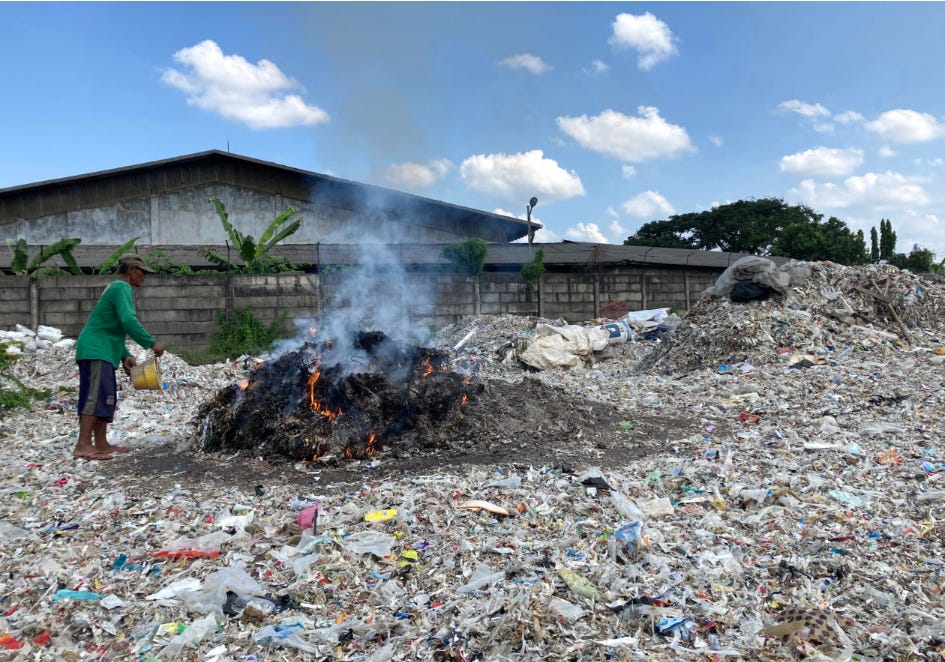
Through a different lens, the practice of the Global North dumping their garbage in the Global South is seen as a form of oppression, widely known as Climate or Green Colonialism. While this subject entails multiple contexts and is pretty layered, it broadly refers to the wealthy nations’ act of transferring social, economic and ecological burden of climate change action to the poorer nations. The displacement of indigenous people to build carbon-removal projects in developing nations, which are funded by the developed lot is another example of such colonization.
This brings us back to my previous piece Overconsumption is eating the world where I addressed this for you. As end consumers, your contribution can go a long way. The less you consume, the less you refuse. This automatically reduces the top of the funnel for waste which translates into less burden on countries to pass the buck. Your contribution is actually that simple; it’s only a matter of re-calibrating and putting more thought into how much you ACTUALLY need to consume to lead a comfortable life. Resharing my mental model from the previous piece here to help you think.

Happy thinking!
Suggested additional reads / videos:
What's wrong with plastic waste exports?
Rich Countries Are Illegally Exporting Plastic Trash To Poor Countries
Why leading climate scientists have finally acknowledged its link with climate change
The unbearable heaviness of climate coloniality
Thank you for reading Anticlimatic. Share this post with your friends.
Comments
Nothing yet. Say the first thing.
Sign in to join the conversation.