
Please hit the Like button ♥️ at the end if you like this post so that I can know if what I am writing is worth your time.
(summary of this post in one meme)

Our brains use ‘shortcuts’ (a.k.a heuristics) to make daily life decisions or to do anything quickly. These shortcuts are a culmination of all the knowledge fed into our brains over our lifetimes. If the brain were a Large Language Model (LLM), trained over an individual’s lifetime of data inflow, the heuristics would be ChatGPT using which the individual acts.
Our lives are encroached by an eternal stream of information - some useful, mostly noise. It is the house of noise where misconceptions reside, putting our ‘shortcuts’ at risk. Risky shortcuts = risky decisions.
Let’s hedge some risk by uncovering the most common environment related misbeliefs.
❌Planting more trees is always good
✔️Planting the right trees in the right place at the right time is imperative for it to be of any benefit
Planting trees is generally considered the lowest hanging fruit for doing something ‘good’ for the environment. Sapling plantation drives are the easiest route to earning brownie points from nature - the KPI being number of trees planted. But the reality is that there are a number of complex factors that have to be considered to determine where, when, and what kind of tree planting is warranted1. In one of the cases documented by Mongabay, the choice of a wrong tree wreaked socio-economic havoc for the country. South Africa undertook plantation of non-native acacia trees which led to a dip in water availability as the plants spread uncontrollably far and wide. They essentially became an invasive plant type on which the government now annually spends millions of dollars simply for clearing them out! An important case study in emphasizing that it’s not just the act of planting that matters, it’s the nurturing that commands greater accountability.
❌Using a disposable paper cup is sustainable
✔️Using a reusable cup is sustainable
Anything that is disposable eventually ends up in waste, mostly in landfills, an outcome that is definitely not sustainable. Paper cups commonly spotted at water stations, coffee shops, hotels & restaurants, have a thin plastic lining on the inside which prevents the cup from leaking / becoming soggy. It is difficult to separate this plastic from the paper, hence, minimizing even the possibility of recycling. These cups then rot in landfills for multiple decades. Not to forget, even the paper used to make these cups comes from millions of trees that were cut down.

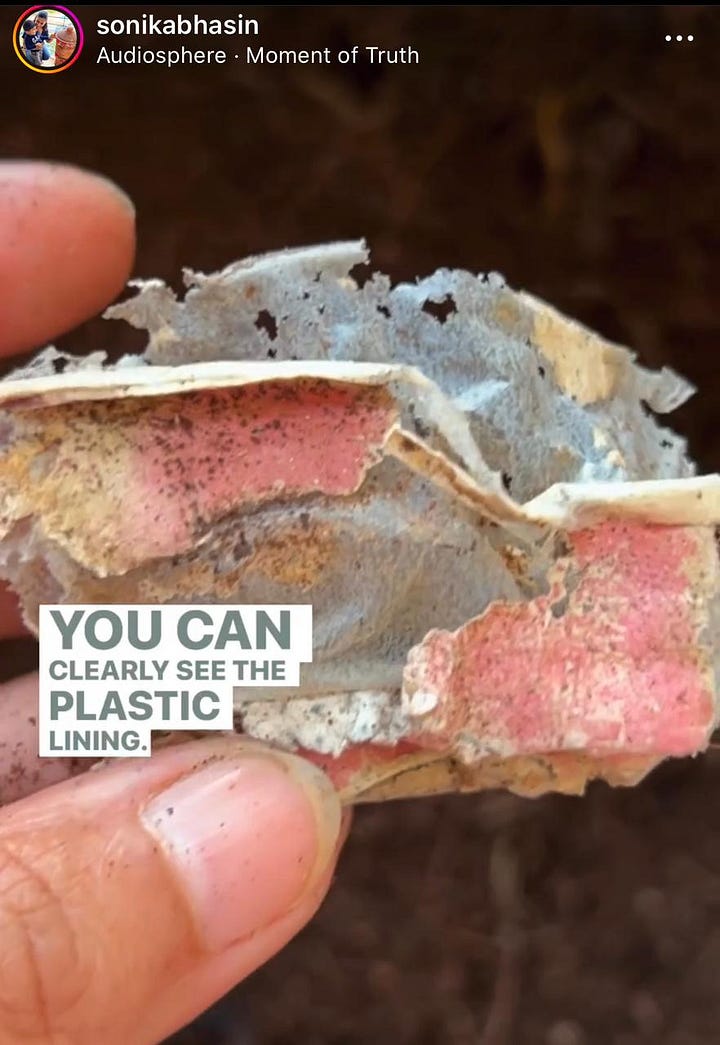
Screengrab of a video posted by a regular composter who tried to compost 2 different types of paper cups Watch the video here.
An IIT Kharagpur study also establishes that if you hold a hot liquid in such a cup for ~15 mins, the plastic lining breaks down to become a part of each sip. You’re not just having your beverage but also consuming invisible microplastic.
What is genuinely sustainable is infinitely reusable cutlery - anything that doesn’t have to make its way to the bin after a few uses. So the next time you plan to buy a beverage on the go, take your mug along. It is much easier than it sounds.
❌ Emissions = air pollution
✔️Emissions are a subset of air pollution
Emissions are that of gases only. These may be visible (smoke) or invisible. In the previous posts, we’ve been talking about greenhouse gas emissions like carbon dioxide, methane and nitrous oxide.
Air pollution refers to any contamination of the air we breathe, be it by solids, liquids or gases, which could potentially cause health hazards. Dust, mold, soot, pollen, and certain gaseous emissions are some examples of contributors of air pollution. The combination of solid particles and liquid droplets, which may or may not be visible, is known as particulate matter (PM). These could be so fine in size, that their inhalation might give them a free stag entry to not only your lungs but also your bloodstream. These stags are highly likely to flirt with your healthcare bills. Read more about PM here.
Still trying to visualize the size? Take a strand of your hair and look at its diameter. Now, divide it by 30 times. That’s how microscopic we’re talking. The image below should help you further.
Trivia: Air Quality Index (AQI) in India is based on the measurement of 12 pollutants including sulphur dioxide, nitrogen dioxide, PM2.5, PM10, ozone, carbon monoxide and lead. Interestingly, the AQI measurement you read for your city may not be representative of your immediate surroundings since the reported AQI is only an average of the data collected by different sensors in the city (how many? well distributed?, no idea!). If you live in an industrial area or an area with heavy road traffic, your real AQI may actually be higher.
❌ Someone else will take care of the planet
✔️Climate change affects all of us; we’re all vested in its well being
Is there any other belief you’d like me to review? Let me know in the comments.
Additional read: https://india.mongabay.com/2022/10/inhaling-particulate-matter-is-increasing-the-prevalence-of-anaemia-among-women-of-reproductive-age/
Thank you for reading Anticlimatic. This post should be shared with your friends.
Comments
Nothing yet. Say the first thing.
Sign in to join the conversation.