
My resume lists startups created, built, and sold and decades in the Executive Seat at iconic companies like GE, Reuters, and Honeywell, but I’m here to tell you that success hides a lie. I wasn’t just climbing the ladder; I was fighting the system that demanded I betray my own identity. This is the struggle I call The Executive Paradox: the brutal trap that nearly burned me out before the age of 30.
Today, as the CEO of StratifyPro, I carry a three-decade track record: building, scaling, and selling three startup companies, serving as an Officer and Executive at giants like GE, Honeywell, and Reuters, and as CIO and CTO at Sterling, DXC Technology, and other great companies. While that resume suggests a clean, straightforward ascent to success, the truth is, it was a hard-fought battle, especially during the critical first ten years.
Like many, my journey began in the trenches, and those first ten years were critical. They were the crucible where I forged the hands-on competence that made me a great engineer who quickly transitioned into management in my mid 20’s because of my innate skill for solving problems quickly with innovation. My technical abilities were undeniable.
However, this early success exposed me to the flawed standard manager’s playbook. I listened to all the well-meaning, but ultimately ineffective, advice: “Work harder,” “Manage your time better,” and “Just be more disciplined.” The most damaging advice, however, was the pressure to try to become someone I wasn’t simply to “fit in better.” My natural style was (and still is) direct, a bit New York, down-to-earth, high integrity, and a coach. I wasn’t the typical stereotype engineer, and certainly not the polished style they wanted in the C-Suite. Following that conventional wisdom meant putting on a disguise every day, which was stressful and led straight to burnout. I was the quintessential high-performer who got results, but maintaining that persona while being far from the stereotypical polished executive was truly exhausting.
But all that competence, built on a foundation of flawed advice, led to a brutal trap I now call The Executive Paradox.
Not bragging, but I was the best-performing VP, the guy who fixed everything, and probably the last person they wanted to promote to the C-Suite. Why? Because the business was addicted to my hands-on output. My value was tied to the constant, tactical grind; the endless, First-Order execution that was consuming my life. They literally couldn’t afford to lose my hands on the operational wheel. Beyond that operational addiction, they didn’t like my New York “Bronx” accent, which I spent years trying to hide.
Personally, I was burning out at 30 years old. The constant, relentless effort of maintaining that professional disguise was the true source of my exhaustion. It was draining me dry, leaving me running on fumes and wrestling with a profound sense of who I really was. I felt like I was constantly performing a role, not living my purpose.
The conflict came to a head when I was up for a major promotion. I was told, frankly, that I needed to “polish my edges.” My manager suggested I temper my direct, New York style, lose the accent, and “speak company language” to be palatable to the executive committee. They even sent me to an anthropologist; a direct, brutal attempt to change my core personality, which, shamefully, I willingly attended.
It was a profound moment of truth: They were demanding I surrender the authentic, high-integrity, coaching leader I was, all for a generic corporate script focused on appearance and corporate conformity. This just wasn’t me. I chose to fight.
I began resisting the pressure to conform, letting my authentic style show, but the system retaliated: I was laid off. This brutal outcome was the necessary catalyst, exposing the root problem with clarity. The system’s chief demand was conformity, not performance; it preferred losing a top asset to tolerating authenticity that didn’t fit its mold. Crucially, I realized I had made my own fatal error: I thought I could simply be myself while still allowing my value to remain locked into First-Order execution; tackling only day-to-day tasks without delivering strategic or long-term business value.
So I took action. The old managerial playbook was permanently discarded. I realized that relying on conventional wisdom (to simply work harder and be more disciplined) was a constant, exhausting fight against my nature when the goal was conformity, leading only to burnout and stress. The A-ha moment was recognizing the fundamental truth: Passion is more effective than self-discipline. Passion is fun and regenerative; self-discipline is exhausting and leads to burnout.
This passion is only unlocked when you embrace your true self. To leverage it strategically, I had to formally understand and commit to my Leadership DNA: the innate core strengths that fuel me and, most critically, the strategic blind spots I needed to navigate. This self-knowledge became the blueprint. I understood that to move beyond being the high-performer they were addicted to, I had to leverage this DNA to solve the system’s deeper need: the critical problem-solving that only strategic foresight could deliver.
This was the fundamental shift; from exhausting operational output to strategic value. I had to Master the Self before I could master the C-Suite. This self-mastery was the critical first step: it unlocked the capacity to strategically master the business and my relationships, creating an indispensable executive authority that even the system’s desire for conformity could not penetrate.
The problem wasn’t my unique style; it was the flawed operating system that kept my value tied to the tactical grind. The only way out was to become the leader who could prove the business scales faster when they focus on Judgment and Foresight Only.
That crucible: the decade of grind, the near-burnout, the layoff, and the fight for my identity, is why I created and refined the Executive Trilogy Blueprint.
I never set out to mentor people or write books. But as I implemented this system to save my own career, colleagues started asking how I did it. They saw the results, they wanted the escape plan, and I realized I had to share the blueprint. So, I kept refining it, the demand grew, and what started as a personal survival manual became a formal Executive APEX program and the foundation for these books.
The system worked. I secured my executive seat while still in my 30s, and I’ve used this blueprint to coach and mentor hundreds of colleagues to break their own paradoxes and achieve the executive seat as well.
The secret? Consistency. It’s not a magic pill. I was, and continue to be, constantly using this system, always aware of my blind spots and able to navigate them while consistently capitalizing on my innate strengths. I never sacrificed my executive identity; I simply refined and improved it as I learned. I remained absolutely aligned to my core identity, lifestyle, and goals, regardless of the advice I received or what the company demanded; and I even left companies to stay loyal to this process. That is why it worked and why I stand here today with the success I’ve had and continue to have.
Here is the crucial insight for you: even now, major corporations will always try to enforce conformity because they think it works. It doesn’t. Your strategic authenticity is what will differentiate you and allow you to stand out from others who are still trying to fit the mold.
This is the definitive escape plan for every high-potential leader struggling to make the leap. It’s built on a foundation of human truth and accelerated by strategic architecture. It is the roadmap that allowed me to redefine my value and secure my executive seat.
🧠 I realized I had to Master the Self. This was the escape from the burnout caused by the ‘disguise.’ I stopped fighting myself and instead focused on aligning my identity, lifestyle, and goals to resolve my internal exhaustion, or Recoverable Human Capacity (RHC) depletion. This step was non-negotiable; it forced me to figure out my Leadership DNA and turn my natural, direct style into my greatest strategic strength. What they told me to disguise became the engine to my success.
🎯 I had to Master the Business. To break the addiction the C-Suite had for my First-Order execution, I made the transition to the Second-Order Mindset. This meant I stopped just optimizing existing products and processes, and instead started looking for the missing elements and innovative designs that would fundamentally improve the business. This permanently shifted my value to strategic foresight and system design. This is where I built the mechanism, later refined into the AI Delegation System, that proved the business scaled faster when I focused on Judgment and Foresight Only.
🤝 I had to Master My Relationships. Instead of adopting the ‘company language and persona’ they demanded, I leveraged my authentic, high-integrity, coaching nature to build strategic alliances and trust. This systemic shift allowed me to move my focus from managing tasks to leveraging people and teams for internal and public influence.
🚀 I had to Master the Influence. The final, crucial step was translating this newly defined strategic value into undeniable authority. This was about ensuring my unique contributions were not a hidden secret but were seen and acknowledged by the C-Suite, the Board, and externally on my own terms.
For years, this system remained my personal secret weapon: a blueprint I used to coach and mentor hundreds of colleagues in my inner circle for free, watching them break their own Executive Paradoxes. The consistent demand, the clear results, and the sheer number of leaders I saw struggling with the same obsolete playbook made one thing clear: the survival manual had to become a formal movement. I felt the lessons I forged in fire needed to be available to every high-potential leader. That realization is why I formalized the Executive APEX Program and condensed the entire framework into this definitive trilogy set of books.
It’s time for a mandatory upgrade to your leadership operating system. Stop being the Silent Expert and start being the Undeniable Architect.
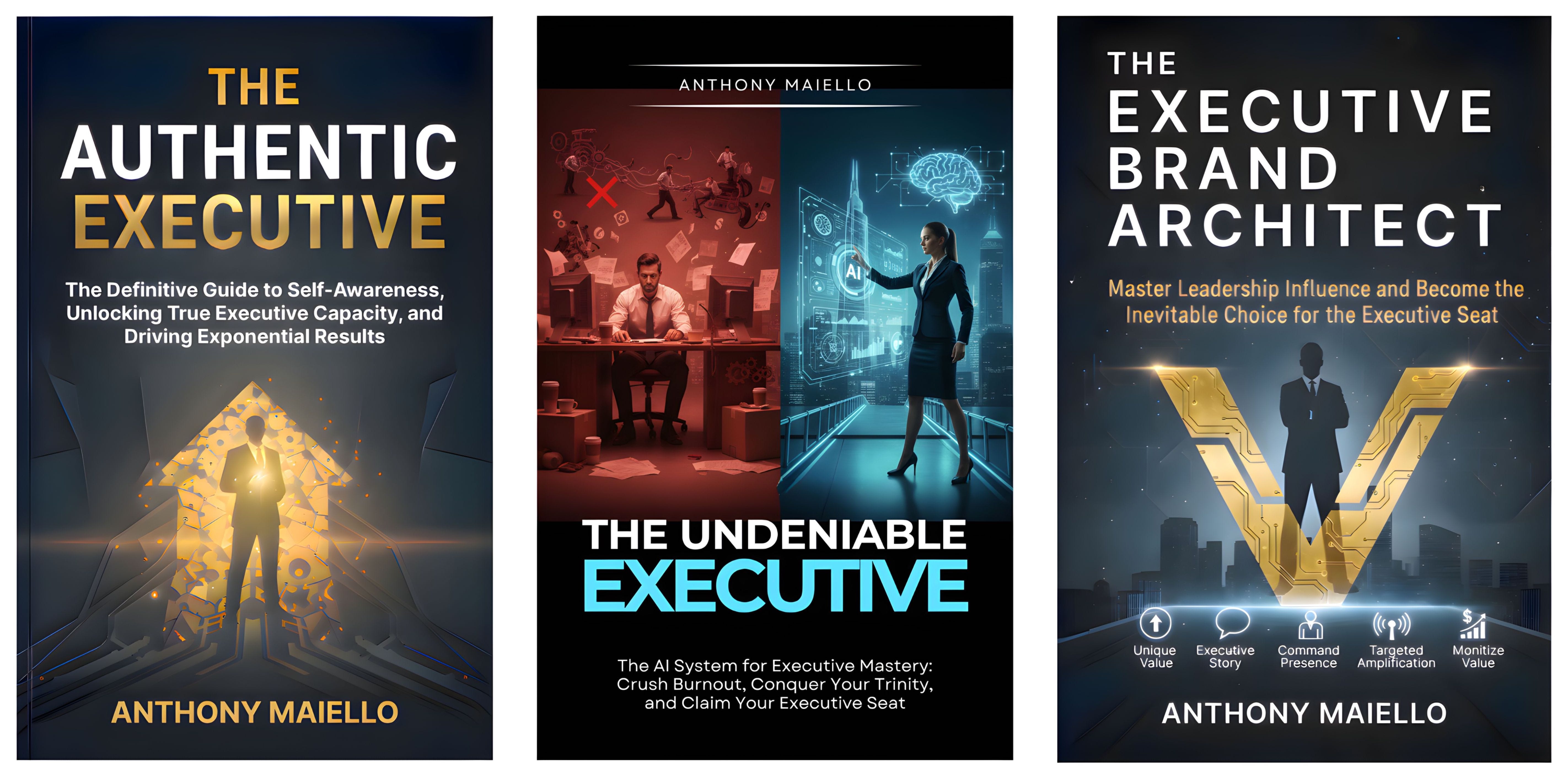
The solution is the Executive Trilogy framework, a complete system in three books for shifting your value from personal output (which AI is rapidly commoditizing) to strategic architecture.
The complete system is captured in the following three essential books:
📘 The Authentic Executive (Focus: Self-Mastery & RHC Security)
📙 The Undeniable Executive (Focus: Strategic Mastery & Second-Order Shift)
📕 The Executive Brand Architect (Focus: Influence Mastery & Undeniable Authority)
🚀 Secure Your Executive Seat
If you are a director, VP, or high-potential leader struggling to make the final leap, you need to read this now.
If you are an existing executive looking to get unstuck in your day to day routine and worried AI may be taking your job, you need to read this now.
📥 Download the Trilogy: All three books of the “Your Executive Seat at the Table Trilogy” are available for Amazon. Secure your copies now and begin your journey immediately.
🎓 Join the APEX Program: To go deeper and implement this entire framework with full support, learn more about the complete Executive APEX Program here: https://www.stratifypro.com/ignite-my-career
Click the link to download your FREE copies now!
No posts
Comments
Nothing yet. Say the first thing.
Sign in to join the conversation.