
Text within this block will maintain its original spacing when published
Wrestling the Waves at Brenu Akyinim
Copper sun or scarlet sea…
— Countee Cullen, “Heritage”
…“complexities which still will be complexities as long as the world lasts”
—Marianne Moore, “An Octopus”
Africa is the entirety of the world. Such a sea is a deep
Whole that cleaves and shatters in all directions,
Then pulls together again: mystery, guile, exaltation, despair.
Who can know the bottom of it? The bush is spare at Brenu Akyinim,
A blight eating up the palms, but one pretty grove, with painted trunks lean
Toward the sea, like sirens in love.  Nearby a traveler palm
Preens, flares its leaves for all to see into the green marbleizing,
Marbled sea and seaweed and black daggers of rock. The waves
Are tubes, painting scallops on the Atlantic. At the foot of the dunes,
The sand is soft, deep and crunches like snow; Is this the cradle from which Europe
Crawled, the ladle from which Asia was poured— and, the Americas, petulant urchins,
Silly at their mother’s breasts? Is Africa the cauldron into which the world falls?
Clay shards litter where Eufago, an ancient and golden city once
Sat, where now the sea digs up its three-skulled graves.  And yet it was
From Africa the Australopithecine crept, bending upright, squeaking out
The first human songs—taek-taek—and trekking in slow trails across the earth.
Rich and fat, black and white, black and blue from the rough housing ride
Of the recent centuries, I must take to this sea, to bath in the rough waters,
To wrestle with what Africa means to me.  An Octopus
Of water.  Deceptively reserved in its swelling and capacity for ruin,
It lies in grandeur and in mass beneath a sea of shifting peaks,
Each a Fugiyama, and each trough a Death Valley, a rolling mollusk
Muscularity, dancing.  An unimagined delicacy, chopped live and served
While its fingers writhe upon a plate of oil-drizzled greens, and yet,
Terror when it rises, roils, rolls, spits up the sea, a ginormous octopus—
Not a squid from a sci-fi movie I saw as a kid—rising up, slick and tattooed,
Killing prey with the concentric crushing rigor of the python
And skittering toward the shore, Anase fashion, on the tips of its arms.
How can I stand strong against this thing, this sea thing, that has taken blue wings—
Skates, angel fish, spotted ray—leathery, and powerfully flapping against the gritty sea,
Crunking the waves into coils and curls and ratcheting around my body and wrenching me,
Abrading skin and abreacting time, while the tentacles pull me toward its clicking beak?
I’ve been told of bodies found, weeks later, skinned, hanged from the rocks at Cape Coast.
Do I fear being stoned as an imposter?  I have lived in hotels but now I live
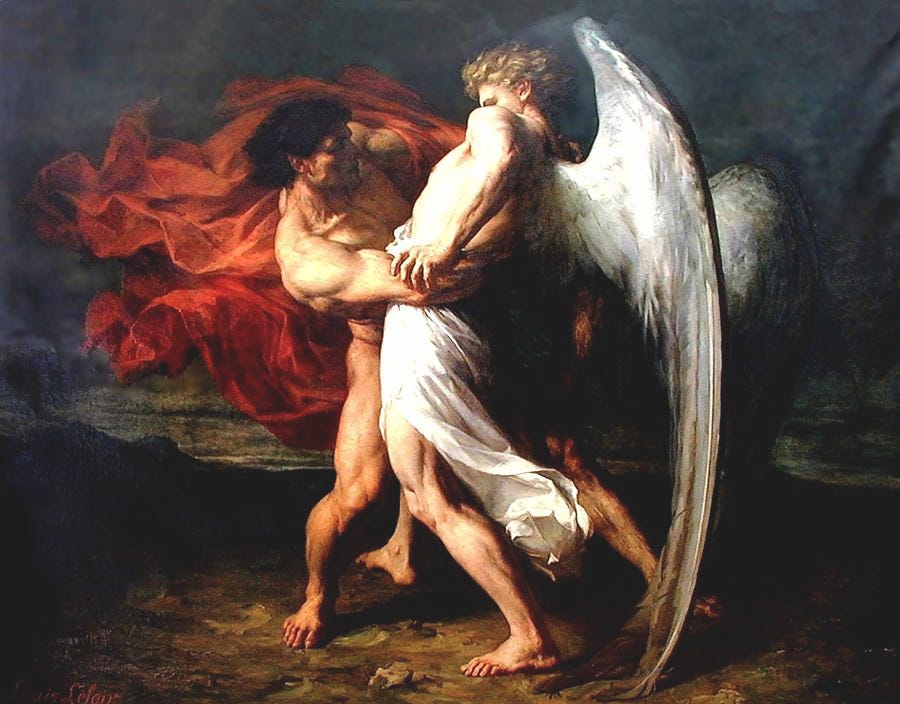
In camps.  I can do the hard things: Jacob returning to harried Esau, fearing
Only the brother’s resentment of my whit of Adam’s power, my wit and survival
Of slavery.  But before the beak, I must pass the eye, the rectilinear eye, a negative
Modern of cephalopodic void.  Three hearts beat in its body, and yet my one,
Bursting, strains them to a standstill: what is the blessing in this Africa—black,
Poor, and black with disease?  What is my new name, then? Kwame—Bo-wame—
Saturday born, or the slave name—what difference does it make?  Every move
I take is a prayer and a tussle.  In the gloam of this wave, I meet the rectifying glare,
Calm in animal intent—molecular, not muscular—inspiring qualm from its cold,
Void of all except instinct survival—gather all resolve before this sea dissolves!
Limping from the break, a hollow in the hollow of my thigh, the voice haunts
From that bleak eye: These problems are posed by God for men to solve.
Brenu Akyinim: (Locals pronounce it “bre-noo ah-chim”) a beach spot near Elmina, Ghana. Three-skulled graves: the practice of burial with heads supporting the coffin. Eufago: A Ghanaian town known in antiquity for its gold trade. Anase: A trickster deity that takes the form of a spider. Kwame: An Akan day name. Bo-Wame: A reference to the song “The Name Game by Shirley Ellis.
First published in African American Review. Volume 43.1 Spring 2009, pp. 2-3.
Image: “Jacob Wrestling with the Angel” by Alexander Louis Leloir
Let the Children use it. Let all the Children Boogie!
Comments
Nothing yet. Say the first thing.
Sign in to join the conversation.