
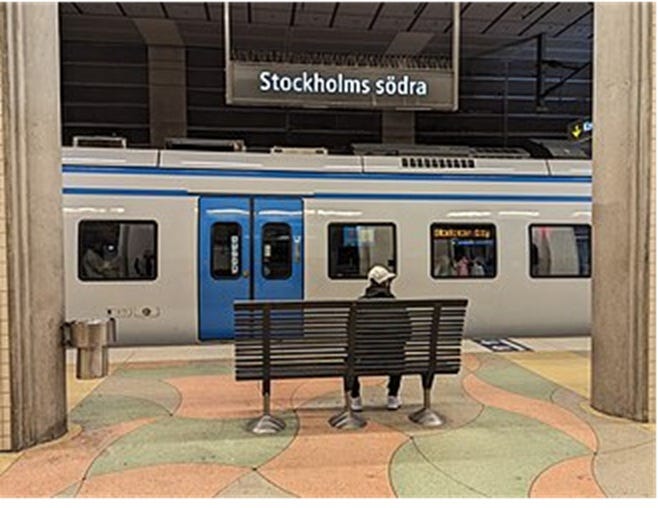
On the platform to Västerhaninge, I find a bench and sit, arms folded with elbows on my thighs and my head bent toward my lap. I am not in pain. My energy has drained away. Chemotherapy does that, you know. It also distorts time so that what seems a minute is five, five minutes become twenty. In a minute or two I begin to take notice of my surroundings. The floor of the platform is a pattern of colorful tiles in irregular shapes, like shards of glass in a broken pane. Someone, probably a child, has dropped a paper cup and a lump of ice cream lays spilled near the track. Only a few people are waiting. Most are standing and looking across the tracks to the other side of the platform. The platform is a long gallery of concrete and white tiled columns under florescent lights. The far end is blocked by a wind break, a glassed-in room with benches. The arrival board flashes indicating that the train to Västerhaninge is coming. I pull myself to the edge of the bench but do not stand. The other travelers are alert, moving toward the edge of the platform. There is a blur of white and blue and screeching and the train is stopping in front of me. I tell myself to stand, and my legs press my feet toward the floor. The doors open and people hurriedly leave the train while others board. He will hate me. He will walk slowly down the platform toward me, a tall man, with a round blurred face and a shock of blonde hair. “My son?” I will say. He will reply, but I won’t understand his words, only the contempt in his voice.
A woman steps in the ice cream. She looks at me, accusingly, then annoyed, and turns and walks away. Watching her walking away, her shoulders slumped and tight, and her shoe tracking the ice cream behind her, makes me dizzy. I look the other way. The doors on the train shut and with a whine the train leaves, the cars moving faster and faster, until the last one zips by with a rush of cold air. But he was kind on the telephone. I remember his voice. It was resonant at first, but pitched when he understood who I was. I stand and walk to the edge of the platform. The train is out of sight. I look at my watch. Then I see a clock jutting from a column. There is another clock on a strut protruding from the arched ceiling. They are numberless, timeless, clocks, blunt black marks on white faces. The hands are blunt unmoving spokes.
It was an hour before I needed to go to the Pendeltåg. Snow still held to the feet of the tombstones in Maria Magdalena’s churchyard. Though it had been cleared from the pebbled paths and melted from the branches of the gnarled linden trees, glaze-crusted patches of snow still lay in the graveyard. It was the vernal equinox and the hemisphere was tipping toward spring, tipping, but not yet enough to bring the churchyard back to life. Jet-legged, I felt that I too was wobbling between death and revival.
*
The façade of the church, with its pink baroque tower was bright, so bright in the sunlight, that I squinted. Winter still showed in the faces of the passersby. I watched a young woman, her head down and swaddled in a scarf, scurrying past the memorials, some recent, some dating back three hundred years. Her face was pale and glum with the svårmod, the black mood, that wore at people during the winter. The cause, I learned more than thirty years ago was the dark of winter, more than the cold. But now the scales, indeed, the earth, was tipping and the Stockholmers would soon unwrap and sprawl in the sun. In a few months, this very lawn, a cemetery, would host a bather or two.
I saw the memorial I’ve come to find. It was a stout stone column, just taller than a man, and enclosed by a wrought iron fence. It was the crest I remembered most because it topped the railing rather than attached to the face of the gate. It was a shield with an emblem of a tree taking up most of it, and beside the tree, a small rosette and an apple. On top of the shield, like the cap of a balustrade, sat a knight’s helmet, replete with a visor and a spike. Like the fence, it was all rust, but no rustier, it appeared to me, than it was some thirty years ago when I stood here with Lena pleading for me to stay.
It was January 1977, and I had, just that week gotten a much anticipated letter from my ailing father in Atlanta informing me of the amnesty offered by the new president. “It is unconditional,” his letter said. “There are no consequences, son, none whatsoever, for the desertion.” Though he called me a deserter, in fact I was only a dodger, having run before I was drafted for the Vietnam War. The distinction was miniscule for my father and even less so for Lena. I was holding onto the knight’s helmet, my numb fingers pushing down into the snow collected there. I spread out my feet, anchoring my stance. Lena’s embrace pinned my other arm between us. She wiped her face on my sleeve. Vad ska det bli av mig? What will become of me?”
I had known her for only two months, one of a dozen pretty Swedish girls I had dated over my five years of exile. You must understand, it was the 1970s and, even in provincial Stockholm, what we called the sexual liberation was in full swing. Like so many young Americans, I held to the stereotype of the easy Swedish girl, and my dark skin and Afro made me exotic and attractive to them. I had dated at least two other Lenas, and even then, with this one weeping on my shoulder, I was having difficulty remembering her last name. “You’ll manage just fine,” I said, looking beyond the graveyard, across busy Hornsgatan and into quiet Maria Trappgränd. The few pedestrians, heads down against the spit of fine grainy snow, hurried along. Lena tugged at my arm. She rambled in Swedish, growing more intense with each breath. “Can't you come with me to my father's? … I don't dare … I have to finish my education first … We don't have to get married … just stay … just come and talk to my father…”.
I shrugged. “What about my own pappa?” I only caught the gist of her Swedish, having never bothered to finish my language lessons at the folk school. “I don’t know what you want me to do.” Distractedly, I brushed the snow from the helmet. My hand was cold and I put it in my pocket. “What can I do? You don’t want an abortion, so what can I do?”
She pulled her arms away from me, folded them across her chest. Her lips trembled. Then her mouth became still, her lashes fluttered as if to shake off snowflakes and her eyes widened. “You can stay,” she said, struggling, it seemed, for each word. A look of surprise and recognition came to her face. She turned away from me for a moment, looking toward the street. When she turned back, she scowled. “Okay, then!”
“Lena,” I said, mustering reassurance, “it’ll be okay.”
“Ja! Okay. Ja.”
Suddenly, she spun unsteadily and strode away through the rows of tombstones. She slipped and caught her balance. I expected her to turn and come back to me, perhaps to plead again, perhaps to slap my face.
*
I looked at my wristwatch. The time was running by fast and it was time to go to the Pendeltåg. It was time to come face to face with my past. I am dying of prostate cancer. One doctor said I have six months to live; another said three. For weeks I was angry, and then resigned, but now I was grateful for the chance, given so rarely, to make recompense for the cavalier days of youth and the flagrant neglect of middle age.
I walked the path under the linden trees that led out onto Bellmansgatan. At the corner of Sankt Paulsgatan, I looked into the storefront of a curio shop. There were comic books, magazines and toys that would have been popular in the 1970s. It occurred to me that I should buy a toy—some kind of gift—but nothing in the window appealed to me strongly and I continued on to Swedenborgsgatan at Mariatorget. Though I had been given directions, it amazed me how well I remembered the streets and how familiar the area looked after my long absence. The buildings were restored and there was a modern veneer on everything, yet the lay of the streets and the shapes of the buildings with their five or six stories and their mansard or gambrel rooflines and their brick, stone or plaster façades had not changed. On the corner was Saint Paul’s Church, and in the center of the park is the statue of Thor fishing. Thor had hooked the Midgard Serpent and his sinewy arm raised his hammer to slay the monster. In the tale, Thor won, but in the course of the battle, the monster poisoned him and he, too, died.
I turned into Swedenborgsgatan and lingered for a moment at the storefront of a bakery. I wonder if småkakor, cookies, might be appropriate, but I knew that this boy was no longer a boy. His voice on the telephone, surprised, hesitant and yet courteous in its crisp English, was that of a man. I tried to imagine how he must look, but my mind is blank. Though I remembered that Lena had a round face and blonde hair, I did not remember other details. Sometimes, I was not sure which Lena, or which of those many young women, I was remembering. So, in my imagination, the man, my son, was vaguely round-faced, vaguely blond.
I saw a sign marked with a blue “T” and my stomach tightened. I pushed open the door and started down the stairs before I realized, I was in the T-banna station, the subway, not the Pendeltåg. The discovery brought a moment of relief, and then my hand trembled and I grasped the stair railing and took a deep breath. Outside, I continued past pubs and restaurants and a good number of shops marked “frisör,” hairdresser. “Drop In” one read. I had not noticed that Swedes were particularly well groomed. I wanted to laugh at my observation, but I could not even manage a chuckle, noting my own hairless head. Suddenly, I saw a sculpture consisting of four metal balls on a low pedestal, just as he had described, and then the sign marked “J” protruding from a building. Now, I was at the right station. Above a row of glass doors, above a sign naming the station, a clock was set in the frieze. I went through the door, and another door, and then down a short corridor lined with shops. I thought I should buy flowers, but that seemed a poor gift to bring after so many years of absence. He would be angry with me. He would not want a gift.
I stopped and held onto one of the lampposts which lined the corridor. I felt miserably tired. Perhaps this trip was too much to have attempted. One of the doctors was against it, but the other, more practical, asked what difference would it make—a week or two? Living eats up the body, and I have lived profligately and irresponsibly. From the outside, mine has been a fortunate life. My father’s construction business did well in the 1980s during Atlanta’s building boom. After he died, I sold the business at a good profit. After Mom died, I sold the house in Cascades and bought a small, but swank apartment in a high-rise in Buckhead. It was a good location, close to all the hangouts for Atlanta’s prosperous rap music and sports stars. Justin’s and Twist were the places to eat, and after dinner, a lap dance at the Gold Club or a private room at the Cheetah Club for sipping Remy and snorting cocaine. Delinquent as I was, I was careful about which women I brought home and I kept close tabs on my money.
Across the corridor was a tavern and I thought I should sit, have a rest and a drink. The time board said that the train to Västerhaninge would come in ten minutes, another one would come fifteen minutes after that. Determinedly, I pushed myself forward and through yet another door. It was too heavy for me to pull open, but fortunately, I slip through an adjacent door, opened by a departing passenger. I fumbled in my jacket pocket for my pass, went through the turnstile and down the stairs toward the track. There was a final door. “Drag,” it read. It was heavy. Drag. Slowly, I dragged it open and I was met by a cold breeze and the burnt smell of train brakes.
*
The woman who steps in the ice cream is vaguely plump, vaguely blonde. She is a middle-ish type—middle-aged, middle-class. I do not imagine she has done much in life or ever will. A muddle. Just a bland muddle. The bitch! My heart pounds and my head begins to throb dizzily, and I must look away from her.
I do not sit for fear of missing the next train. Trains come and go. People come and go. I see the Västerhaninge train coming, I sway a little bit in the shock of air it pushes down the track. The train stops and a door opens right in front of me. No one gets off. It is as if the train has come just for me. Hesitantly, I step aboard. The car is not crowded. I find an empty seat away from the other passengers and look out as the walls of the station whizz by and the train is out in the open. In a few moments we are on a bridge over water and I look out at another bridge, roads, the cityscape receding. I look down at my shoes and see that I’ve stepped in the ice cream.
We stop at an open-air station called Årstaberg. Three teenage boys get into the car. One is wearing short pants, and I wonder if he might not be cold. They sit behind me and are boisterous, chatting in Swedish with English interjections—“Whatsup?” “Not cool.” “Word!” I do not understand their Swedish until one blurts out “Fett och dålig!” They laugh. I imagine they are talking about a girl. At least I can say, as careless as I have been, I’ve never talked vulgarly of a woman. I have never lied to them, either. Even with this man’s mother—Lena—I never pretended to have been in love. I never made any promises. Yet, there is no reward for such small kindnesses when in the greater callings I have been an utter failure. I have loved my parents, as they, perhaps, loved me too much, and I have loved myself. Of Lena, of any other Lena, of any friend, of this man, my son, who in a matter of minutes I shall see for the first time, I have had nothing I could call love.
The scrolling signboard reads, “Nästa: Älvsjö” and soon we are at another station. A woman with a boy gets on. The boy is wearing a colorful knitted cap with earflaps. I think he looks cute, and then suddenly I am dizzy as the train pulls away and I lean my head against the window. The large building next to the station seems to dart away, then there are trees and houses flying by outside the window. I press my eyes with my thumbs and still my head spins. It’s just the medication, I think. But it is not. It is the teenagers behind me, laughing. It is the one, in particular, who throws around English phrases like a bully. He is about sixteen and reminds me of the letter I have in my coat pocket. I touch the pocket, but do not take out the letter. I know how it reads. It is only two paragraphs, written in practiced block letters. “Dear Pappa,” it begins. “Mamma has told me about you.”
*
It was the autumn of 1991. The Atlanta Braves had just won the World Series and the city was still in a hoopla about it. I hadn’t long come in from a celebratory party hosted by the least sports-minded people I know. I was sorting through a stack of mail, mostly advertisements, and the envelope, postmarked in Sweden, fell from the stack. It had been forwarded from my parent’s address. I didn’t recognize the return name and wondered who in Sweden still remembered me. It didn’t occur to me that it could be the boy, not until I read the salutation, “Dear Pappa. Mamma has told me about you.” I was drunk and the letter was making no sense to me. I put it down and had another drink. A few days later, I remembered the letter. Again, I stopped after the first line. What had the mother told him about me? What did she really know to tell him? I imagined unflattering things, and yet the letter, as I read more of it, was a veneration, speaking of what the boy had learned about Atlanta, the Civil Rights Movement, and the Vietnam War resistance. He wrote that his favorite band, REM, was from Georgia and so were the hip-hop musicians he mentioned—none of whom I recognized. He had been following the World Series and hoped that the Braves would win. “Please,” he asked, “is it possible to send me a Braves baseball hat? Is it possible that one day you will come back to Stockholm?”
Weeks go by and the letter laid on the table until the woman I was dating found it. “Your past is catching up to you!” She laughed. “And he wants a Braves cap. How cute.”
“He called it a ‘hat,’ not a ‘cap’,” I told her. “What does that mean? A batting helmet? One of those silly Indian headdresses? Where the hell would I get one of those?”
“Oh, you know what he means,” the woman chided. “Buy the poor boy a Braves cap.” We went shopping for it later that day, but the stores were sold out. There were plenty of caps for other teams. I chose a New York Yankees cap. “What difference will it make to a Swedish boy? Braves or Yankees? It’s American. What will he care?” When I packaged the cap, I wrote a short note. I made a promise that, in the moment of writing it, I intended to keep. When I mailed the package, I neglected to put on my return address.
*
I notice that the teenagers have left the train and I startle, thinking I might have missed my stop. The woman with the boy is gone, too. Six or seven passengers remain in the car. Outside, there are woods with patches of snow around the trees. The sign board reads “Jordbro”, and I am relieved that I have not missed my stop. As the train pulls away, my heart pounds. The next stop is Västerhaninge. I close my eyes and take a deep breath. I am resigned to what will happen. In my mind, I see Lena stumble in the graveyard. She ought to have come back. I wanted her to come back. But she straightened herself and kept walking away. I ought to have chased after her. But I watched until she reached the street, then I turned and went the other way. The train slows. I open my eyes.
Västerhaninge station is festive. The platform canopy is trimmed in orange and blue. I rise. Mechanically. The train stops. I fall forward and catch myself by a seatback. The doors open. The cold air wakens me and I step into the sunshine. I look in one direction and the other, up and down the platform. The train sits for a long time, it seems, before it pulls away. A man is looking in my direction. My knees are beginning to weaken; my feet are heavy. The man is waving hesitantly as he starts in my direction. I cannot move, not to walk, not to wave back. The man does not have blond hair; he does not have a round face. I steady myself on the back of a bench. The man looks like my father. He looks like me. My son. I fall heavily onto the bench. The man is rushing toward me, his face full of concern. I am weeping. I can no longer breathe I am weeping so hard. He is reaching out to me. Weeping, my tongue loosens, “My son, min son. Forgive me.”
The End
NOTE 1: This story was commissioned by X Publishing, based in Stockholm, Sweden and published in 2012 in a collective novel called Avstånden mellan (The Distances Between). The novel is comprised of linked stories by different authors. My story links with one by Kevin Frato, an American-Swede, a friend, and the author of the novel Numera Negerkung (Kabusa 2009). The stories follow characters as they ride Stockholm’s commuter train, Pendeltåg, from station to station. My character rides from south Stockholm to the suburb of Västerhaninge, thus it is called “Stockholms södra—Västerhaninge.” At first, I wanted name it ”Den förlorade fadern” or “The Lost Father,” a play on the Swedish name for the “Parable of the Prodigal Son,” which is “The Lost Son” (den förlorade sonen). I was thinking about restoring that title here, but changed my mind and only shortened the published title.
“Stockholms södra – Västerhaninge.” Avstånden mellan. Karin Mossed and Hanna Larsson, eds. Stockholm. X Publishing, March 2012. p. 137-47.
NOTE 2: The protagonist is imagined from the experiences of the more than 1,000 war resisters—deserters, dodgers, activists—who self-exiled in Sweden during the Vietnam War. I became interested in this history after reading Memphis, Nam, Sweden: The Story of a Black Deserter (Double Day, 171; Univ. Press of MS, 1997) and befriending the author, Terry Whitmore (1947-2007).
Comments
Nothing yet. Say the first thing.
Sign in to join the conversation.