
PART TWO
They watched the woman and her children, whom they determined to be German, play in the shallow end of the pool. The sun had crawled up, almost to zenith, and was casting mottled light through the trees. John thought that Cam might put in his ear plugs again, but he didn’t. They sipped their watery drinks, occasionally glancing away from the scenery, the playing children, at each other. The boy—the young man—smiled and yet was anxious, John thought. He didn’t want to pry. Give him time. He will talk about it if he wants to. After a while, John asked Cam if he wanted to swim.
“I want to,” Cam said hesitantly. “But I saw this video on YouTube of this guy who had a worm—it looked like a string of spaghetti—and the doctor was pulling it from his eye. He got it from swimming in Africa.”
John chuckled. “I doubt if there is guinea worm here. That’s more of a West African problem. And besides, the pool is chlorinated. Can’t you smell it?” Cam acknowledged that he could. “Here you might find trypanosomiasis caused by the tsetse fly bite and plasmodium from mosquito bites. Neither of which you should worry about as long as you are taking your atovaquone. You’ve been taking it every day, haven’t you.”
“Those pills? Yeah.”
“Then you have nothing to worry about.”
Cam seemed to consider. Then, he asked, “Dad, is Mom all right?”
The question surprised John, and yet he knew what Cam was
talking about. “I don’t know.”
“She’s been…well, mean. She was really mean to Margi-Mom. I thought they were friends.”
“They are.” He recalled when the women met. Majorie was a year behind them in college and Charlotte and he befriended her their sophomore year. She was from California, when they were from the South and they thought her to be odd, a little too much of a hippie. Everybody wore Afros in those days, but Majorie decorated her hair with flowers and feathers and wore peasant dresses and fringed vests. “She’s sweet,” Charlotte accessed, “but no one will take her seriously.” Majorie proved to be smart and contributed well to their study group. She graduated in three years, and so they all walked together. They went to different medical schools, but as fate would have it, they all came back to Atlanta to do their residencies, and their friendship picked up again.
“Things change,” John said. “I was married to your mother, and you were born. Then your mother and I divorced, and I married Majorie.”
“Yeah. I know that. It wasn’t like Majorie broke you guys up. And Mom and Majorie always seemed like…like sisters. But something has happened.”
John looked at the German children, a girl about ten and a boy five or so. They were advertising-perfect children, blond, tanned and happy. The mother, too, was picturesque. He remembered Cam at those ages. He, too, was an advertising child, he could have been a Gerber baby, when Gerber finally started to use black children in its advertising. It seemed only a short while ago that Cam was a child—in fact, now, he was less than a decade older than the girl, but a world apart.
“You’re a man,” John said.
Cam snorted, confidently.
“A young man, but a man, none the less. It’s change for you, but it is also change for Charlotte. For you it’s the beginning of something wonderful. College, professional school, a family. But for your mother—it will feel like a loss.”
“A loss? But she will always be my Mom.”
“I feel a little that way too. That I am losing something, something slipping away from me. But it’s just you growing up and being what you are supposed to be. We can’t keep you little forever. We have to let you go.”
Cam considered for a while. “Then why aren’t you being a bitch?’
“Who said I wasn’t?” John chuckled. “I guess because I have Majorie. I am not faced with loneliness.”
Cam considered again. Then he stood and stripped off his shirt. His torso was brown, lean, and the muscles were lined. “Let’s go for a swim.”
Several reasons flashed in John’s mind as to why he didn’t want to swim. His love handles were flappy, and his chest sagged. Besides, he was a poor swimmer, there being no pool for blacks when he was a child. That was one reason he insisted that Cam learn to swim and took him every weekend to the natatorium for lessons. Cam had swum for the neighborhood team.
“Oh, come on Dad,” Cam insisted. There was a bit of pleading in his voice and John couldn’t resist.
When John returned to the chalet, he found Majorie sitting stiffly in a chair beside the bed. Her eyes were red and swollen. He went to her. Got on his knees in front of the chair. “What happened?” he asked, trying to quiet his voice. Majorie told him. Calmly, he examined her face, pressing gently to feel the jaw bone. She winced, but did not cry out. He wetted a washcloth and pressed it to her jaw.
“I’ve put ice on it already.”
“What do you need? I’ve got some ibuprofen.”
“Yes. I’d like that. And a nap.”
He got the pills from his luggage and brought them with a bottle of water. Then he pulled back the bed covers, helped her out of her clothes and held her elbow as she got into the bed. He stood a moment looking down at her and then started out of the chalet.
“Don’t,” she said. “It’s been enough already.”
“I’m going to kill her,” he said and went out. He heard voices when he got to Charlotte’s chalet, which was two cabins down, Cam’s being between them. He heard Cam’s voice as he approached the door and went in without knocking. Cam paced back and forth, and Charlotte sat on the edge of the bed with her palms covering her face.
“How could you? How could you? How could you?” Cam asked, his voice heightened, but not yelling. Charlotte said nothing, but looked up when John came in. Her face was still wet from tears.
“I…I…I…” . She breathed deeply, started to rise to meet John, but then sat back. “She was so condescending!
“You didn’t have to hit her!” Cam retorted.
“Okay, Okay.” John said. He tried to bring calm to his voice. It had been a long time since he had seen Charlotte cry, and he couldn’t remember the circumstance. There were no tears at the divorce, in fact, there were smiles, hugs, a sense of relief. John took a seat and indicated to Cam that he should do the same. He realized that his clothes were still damp from swimming and that he stank of chlorine. They were quiet for a moment.
“I’ll go home,” Charlotte said. “I’ll apologize and then I’ll go home.”
“That’s probably the best solution,” John said.
Cam glared at Charlotte. “You’ve ruined everything, Mom. Everything.”
“I’m sorry baby. I just couldn’t help myself.” She gave him a pleading look. “I’ll make it up to you. I’ll give you that trip to Europe you wanted. I promise—”
“But what about Margi-Mom? How are you going to make it up to her?”
“I don’t know.”
“You can begin with an apology,” John said. “I’ll look into getting you a flight out of here.” He sighed, remorsefully, looked at Cam and then at Charlotte. “And when you get home, you need to talk to someone.”
“Talk to someone?”
“Counseling.”
“I know what you mean. For what? I’m not crazy.”
“I didn’t say you were. But—”
“She needs counseling more than I do. Even in college she was—was—greedy. Oh, she has that demure little way about her, so cool and carefree—but she will take everything if you let her.:
“She’s taken nothing from you.”
“She’s taken everything from me.” Charlotte raised herself from the bed as if to go to Cam, but sat back. “But I won’t let her take my baby”
“Mom!”
“She can have you.” Charlotte pointed to John. “But I’ll not let that bitch take my boy.”
Cam stood, seeming to stretch taller than usual. “I’m not a boy.” He left the chalet, leaving the door ajar. Outside, a housekeeper looked in from the path, but kept walking.
Charlotte waited for them at breakfast. She rehearsed in her head what her apology would sound like. She would be contrite, and she would be careful not to make any conditions—not to say, if I hurt your feelings, or if I hurt you. She had hurt Majorie, and, in the moment, she had meant to. She did regret it now. She wished she had had more self-control, but something else told her she wasn’t all to blame. Majorie needs to take some responsibility, too. After all, it takes two to tangle.
When she saw them enter the dining pavilion, she took a gulp of coffee and stood. John led the way to the table. John hadn’t been able to get an earlier flight for her. They had four days left before their scheduled flight. She had offered to go ahead to Arusha and wait there, but they were unable to arrange transport. It’s not like there are Ubers in the Serengeti, John said. So, Charlotte would be with them when they transferred to Ngorongoro.
Charlotte nodded to John as he approached and walked around the table, reaching out with both hands, not to hug, but to take Majorie’s hands. Majorie remained still. I think she might be a little afraid of me, Charlotte thought. She smiled, a little forced. “I can see that you are angry with me, and you have every right to be. I was awful to you. I really was. Majorie, I hope you can forgive me. I am so very, very sorry.”
Majorie looked at John for a long moment, until a large white man excused himself and squeezed by her. Then she looked back at Charlotte, her face blank and blanched.
“Okay, Charlotte,” she said, her voice gravelly. “Okay. Let’s just get through this for now.”
Not very gracious, Charlotte thought. But it was okay. They would drop it for now. They all sat. “Where is Cam? Is he having breakfast?”
No one had seen him.
The drive to Ngorongoro was two hours of bumpy, dusty road, until they got onto stretches of paved road and began the climb into the Ngorongoro highlands. The landscape became forested and the vegetation green and lush. The air, too, was heavier. For most of the ride, no one spoke. They had taken a break at the Olduvai Gorge Memorial, a box of a museum and two large concrete primate skulls on a stone plinth. John had taken a picture. He had wanted to travel the two miles to the archaeological site. He and Charlotte had gone there twenty years earlier. It was a honeymoon trip. She was pregnant soon after the trip, and he wanted to think that their loving making in Africa had gotten her so. “We made a baby in Africa!” he once told her. She reminded him that the timing was off by six months. But still it was a lovely thought.
Majorie surveyed the small museum with him, waiting until Charlotte came out of the ladies’ room, though the restrooms were large, and the site was not crowded. When Majorie went to the restroom, John left Charlotte to examine the museum. He saw that Cam hadn’t left his seat in the car. He sat with his head against the window, earbuds in. “Don’t you want to stretch your legs.”
Cam shook his head.
“The museum is interesting.”
“What’s in there?”
“Well…maybe not that interesting. Mostly about the terrain where the fossils were found.” Lemu and the women returned.
They stopped again at the Ngorongoro Overlook. The crater was a grassy bowl, ringed by blue ridges with a bull’s eye of a lake in the center. “It’s really a caldera,” Charlotte announced. She stood beside John and Majorie. John could feel Marjorie stiffen, but she turned a pleasant smile toward Charlotte, acknowledging her observation. Cam, too, got out to look, but was the first to go back to the car.
Soon they arrived at the town of Karatu. The main road was busy with safari cars, vespas, tuk-tuks and various styles of European cars. Heavy trucks, too. People went busily along the sides of the open drains on tamped down mud trails. Shops made of stucco-covered blocks or wood and tin sheets, open to the air, showed a variety of wares—shoes, dresses, furniture, automobile parts. Everything had a worn dusty look, especially the people, many in brightly patterned kangas or kanzus and often tattered sweaters or coats. John had a pang in his stomach. How did he see these people? His people? No. He had learned long ago that he was not African. African- American is not African. Had circumstances been different—had his ancestors not gone through centuries of chattel and Jim Crow, he might be one of them. But African or American was not what caused the pang. It was poverty. They were poor, poor, black and poor. So much like his rural grandparents who never had running water or a furnace in their home. Many Africans were wealthy, he knew, but the people of Karatu were not among them. At least there are dogs, he thought, when he saw a rib-thin animal, tail wagging, greet a boy. When he lived in Ghana, he had seen no dogs.
They turned away from the main road and drove on a graveled road that winded up and up through coffee trees. After a while all that they could see were the round shrubs dotting the hilly terrain. At the top of the hill, they arrived at the Manor.
“I am called Ibrahim,” a tall, stout man with an infectious smile said. “I am your butler.”
“Ooh, a butler!” Charlotte said. She glanced at John with a look to say she was impressed. “You didn’t say, it would be so fancy.”
“It was Majorie’s idea. A couple of nights at a really nice place.”
Outside the reception building, were a dozen or so whitewashed Dutch style chalets, set around a green lawn. The compound had been founded by Afrikaners who traveled to the region to look after their plantations. From the chalet, John looked out on a horse pasture and beyond more coffee trees sloping down to a forest. “It’s quite elegant,” Majorie said. There was a living room with a fireplace, a bedroom with a patio and a large bathroom with a deep, footed tub. Someone had lit the fireplace for them.
“A bit closed off, after the Serengeti. No vistas.”
Majorie snorted, “Can’t have everything.”
“But why can’t we?” John asked. “We work hard.” He made gin and tonics and gave one to Majorie.
She sat on the divan and pushed off her shoes with her toes. “I really need a shower.”
“A long ride.”
“Made longer by your bitch of an ex-wife.”
John sighed. “What did she do now?”
Majorie gave him a look that suggested a wink. “She breathed.”
“Will you ever forgive her?”
Majorie took a deep draft from the cocktail. “I don’t know. I doubt it. I don’t think she’s capable of apologizing—”
“I thought she had.”
“She didn’t mean it. And it’s not just that she slapped me. It’s also…well…she’s changed somehow. It’s been going on for months, really. Long before we started the trip. She’s angry at me about something.”
John sat beside her, put his drink on the table and put his arms around her. “I think she’s afraid.”
“Of?”
“Of what comes next for her.”
Majorie snuggled against him. She yawned. “We’re all afraid of that. What comes next? It could be something wonderful, or it could be something awful. We don’t have a lot of control over it. But that’s when you stand together—I mean, something is always going to happen—besides, if you mean with Cam—” She pulled away from him, sitting up straight. “That’s normal. He’s supposed to grow up.”
On the way into the crater, through switch back after switch back, Lemu told them the story of an inexperienced guide who found the narrow road blocked by an elephant as he was driving into the crater. Unsure of what to do, he began to reverse up the crater road, but he went too quickly through a switch back and the car slid, and tumbled down the cliff. The guide and his clients were killed.
“I hope you are a better driver,” Charlotte said with a nervous laugh.
Lemu laughed too. He explained that when encountering an elephant, or any large animal the thing to do is to turn off the engine. Wait patiently. The animal will find a way around you.
Even before they were fully on the flat of the crater floor, they ran into a gigantic herd of wildebeests and zebras. Thousands of animals. They drove into the midst of the herd, which was on both sides of the road. Cam and his mother stood under the roof to take pictures. The animals were close enough to touch. Cam began to laugh.
“Listen to them. They sound like…like ducks or geese.” They were surrounded by a chorus of grunts and adenoidal croaks. The car drove slowly, and the angular, muscular animals trotted out of its way. A calf zig-zagged along in front of the car for several moments before departing the road.
Just look at them! They look so…so…so… primitive, like a cow and horse got smush together, Charlotte thought. Then she said it and laughed at herself.
Because Cam had overslept, they had started late to the crater and soon were stopping for lunch at the Ngoitokitok picnic ground. The area was no more than a concrete bathhouse and areas cleared of tall grasses with logs for tables. Several cars were parked around, some with portable tables and chairs. They stood, while Lemu opened lunch cans and laid out sandwiches, crisps and kalmatis, which were locally made glazed fried doughballs.
John finished a cup of coffee and looked out at a half-submerged hippos and Egyptian geese in a pond, a little distance downhill from them. He was thinking that the hippos were awfully close, but other diners had camped even closer. Them before us, he thought. Cam came behind.
“Excited?”
“Kinda,” Cam said. “I feel better today. This is our last safari day, and I really want it to be iconic?”
“Africa isn’t so bad?”
“I’ve gotten used to it.” Cam snorted. “Nah, not all that bad—Look!”
John turned. A herd of zebras was approaching, grazing and moving over a low rise toward them.
“They look like ponies,” Cam said. “Remember Tony the Pony?”
John remembered the pony rides. He walked beside the pony as the handler guided it around the park and Cam, wearing a cowboy hat, sat on its back. The rides started when Cam was barely a toddler and lasted until he was pushing puberty. “Believe me, they aren’t as tame as Tony the Pony.”
“Anyway, I want to pet them.”
Suddenly a marabu stork who had been slinking around the periphery of their camp, suddenly ran in and snatched a kalmati from Charlotte’s fingers. Charlotte screamed and retreated toward John, before realizing the bird had run the other way. Then she ventured to laugh. John saw that Majorie was glancing at them, an ugly but satisfied look on her face.
In the car again, they drove to the edge of Lake Magadi, a mirror-like shimmer in the middle of the grassy plain. As they approached, they saw a skim of pink, and Charlotte shouted “Flamingos!” I didn’t know flamingos lived in Africa!” They parked along the side of the road not far from the shore and watched the birds striding on their reedy legs, flapping their black trimmed wings, and dipping their beaks into the water. A family of buffalo grazed on the other side of the road. Lemu pointed out a young buffalo who had wandered a distance from the herd.
“That one, there, is dead!” he announced.
“What? Where?” Charlotte said.
Lemu did not answer but moved the car slowly along the road, making a slight turn toward the lake. When he stopped, he turned off the engine. The buffalo was in sight, now wandering away from the car and his family. Lemu pointed to a knoll just in the direction where the young buffalo wandered.
“Do you see them? The lions?”
“Where? I don’t see anything?” Charlotte had her field glasses to her eyes.
“Way cool.” Cam leaned past his mother. He pointed out the two lionesses, crouched in the tawny grasses beside the sand knoll.
Through the binoculars, Majorie watched a lioness’ muscles flexing in her taught haunches. A kill. A kill is about to happen. Her heart rate sped up and she felt her own muscles tighten. She watched the buffalo, grazing, unaware of the danger just in front of him. Oh, stop! part of her said. Go back home. But another part of her wanted to see, wanted to see the lionesses in action. It is so rare to witness a kill in the wild. She wanted to see claws shred open the buffalo’s hide and to see blood spray out. Lazily, it seemed to her, the lionesses began their chase, one a body’s length ahead of the other. Their sinewy torsos went long as they gained speed, limbs stretched out and paws spread wide. Their tails extended in graceful arcs.
“He is a young bull,” Lemu said.
The buffalo ran, his back legs coming under the front, in an awkward gallop. He couldn’t gain enough speed, and the lead lioness dug her front claws into his rump and pulled him to a halt. The second lioness circled to the buffalo’s front. The bull strained, turning one way and then the other to face the second lioness. It kicked, but the first lioness held her position on his rump. She dug one hind claw on the rear of the bull’s thigh and pushed herself up. Now on its back, she sank her fangs into the buffalo’s spine. Majorie, looking through the field glasses, saw the buffalo’s shiny back and the cat’s muzzle redden. The second lioness charged the bull from the front, but the bull put its horns down and she turned her charge.
“She will try to bite it in the throat, to cut off its breath.”
The buffalo bucked and the first lioness was thrown from its back. Majorie’s heart skipped. It might get away. Afterall that, it might get away. She was aware that Charlotte was talking, whether to herself or someone else didn’t matter. She didn’t care about Charlotte. She wanted to see the lions eat.
The buffalo galloped toward the lake and splashed a few feet into the water. The flamingoes thundered, and a pink cloud rose, chaotically, then organized into a stream before it resettled at a distance. The lionesses hesitated at the water’s edge.
“They are not very hungry,” Lemu said. “Or they would go into the water.”
The buffalo stood knee deep in the lake. It raised its head and brayed mournfully. At a distance its herd stood in a cluster, facing it, stiffened into statuary poses.
“Poor, poor, thing,” Charlotte said. “And the others won’t help him. That’s nature, I guess. That’s the way nature works, but at least they didn’t kill him.” Then a flash of brown, a hyena, splashed into the water towards the bull. Then another, and another until a dozen attacked the bull, biting at its legs, its tail, its belly.
Majorie’s knees weakened. She thought she might have to sit down but the excitement was too great. Field glasses at her eyes, she enjoyed seeing the box headed hyenas tear at the buffalo. Flaps of hide fell away from the marbled muscle of its rump. A pink intestine unraveled from its belly and the hyenas gobbled the entrails. The bull brayed. Stepped dizzily one way and then the other, until it went over on its side and the hyenas, churning the water, swarmed it.
“Oh my god,” Majorie said. She sat with a flop. Her body suddenly released of tension, and she closed her eyes.
“Well, that was something!” John said to Cam. Cam took the iPhone from his widened eyes. He ventured a crooked smile that came with a sharp exhale. “Awesome!”
The herd was wandering away. The lionesses were no longer insight. Charlotte turned to Cam. “Let that be a lesson. If he had stayed close to his family, nothing would have happened to him.”
“I don’t think that’s a lesson, Mom.”
“You don’t think?”
Lemu started the car and slowly moved back into middle of the road. Then he stopped abruptly, sliding in the dried mud.
“What is it?” Charlotte asked. “What the matter?”
John noticed that the hyenas all seemed to raise their heads in unison, each looking in a different direction. They seemed cartoonish, except for the bloody flesh some of them held in their mouths. Then one ran to the shore, at an angle to the car. Then another. Another ran in the opposite direction. One ran straight away from them into the deeper waters of the lake.
He was about to ask what had spooked them, when John turned to the side of the car opposite the lake. Already Cam was looking. A lion walked toward them. He was large and lacked the tawny gold of the lionesses, for a burnt sienna. His mane was tattered, and he favored his front right paw. He held his head down, and moved deliberately, but with direction within a few feet of the front of the car.
“He’s as big as a cow,” Charlotte said. She sat down and pulled her arms behind the backrest of Lemu’s seat. “Sit down,” she said in a sharp whisper to Cam. Cam ignored her. “Sit down, I said.”
“I’m good,” Cam said, not looking at this mother.
“Well, there is Mufasa,” John said.
The lion was so close that Majorie saw gnats swarming in the corners of his eye. Silently, he passed and continued to the water’s edge where he hesitated. Tentatively, he touched the water with a paw, shook it and then waded into the lake. The water came up just above his knee and he continued, head still lowered toward the bull. The bull kicked weakly with the unsubmerged rear leg. How was it still alive? The lion sniffed at the bull, then turned and traced its way back through the water, leaving a path of small eddies. Again, it passed the car, this time to the rear.
John snapped photographs, as did Cam. Charlotte remained seated. Marjorie saw the lionesses return and hesitantly enter the water. They buried their faces in the buffalo’s flank and tore away strips of muscle. Majorie looked through the field glasses as the cats, sisters, she thought, raised their open mouths, muzzles bloody and greasy, to the sun and swallowed big chunks of meat. She imagined it was pleasure she saw on their faces. A lionesses’ tea party.
The old lion sat just a few yards from the car. He took the posture of a disinterested sphinx, staring, it seemed, at the blue ridges of the crater wall. Cam leaned out of the window, his shoulders and arms stretching out with iPhone. He had his earbuds in, “Big Foot,” a song by Nicki Minaj playing.
Lyin' on your dead mama, on-on your dead mama
Lyin' on your dead mama, lyin' on your dead mama
He heard his mother telling him to get back in the seat. In fact, he was thinking how he could get closer—a close-up of the face of the lion, maybe it would open its mouth, and he could see the canines. He slipped forward more, now his belly button rested against the bottom of the window opening. His mother said again, her voice exercising authority, for him to sit. She laid a heavy emphasis on “sit,” over articulating the “t.” He slipped forward out of the window, just an inch more. He wanted the picture. He knew what he was doing. And besides, she couldn’t tell him what to do.
Lyin' on your, lyin', lyin', lyin' on your dead mama (brr, ooh)
The lion turned in his direction, a full face in the camera’s view. Cam pressed and pressed the shutter. The lion posed. Cam pressed and pressed the shutter. He felt a hand on the back of his leg. It startled him. The iPhone slipped and he stretched to catch it. He was slipping forward out of the car. His hand braced against the ground. The iPhone lay in the sand. His fingers crawled for it, and he slipped more from the car, his knees braced against the top of the door panel, one palm against the ground, the fingers of the other hand coaxing the phone to him.
'Cause she was lyin' on your dead mama (ooh), on-on your dead mama (ah-ah-ah-ah)
Lyin' on your dead mama, on-on your dead mama
His mother screamed and he saw the lion rise up, the muscles in its shoulders bunching. Suddenly, everything moved. He felt himself being jerked by the waist band, urgently. At the same time, the groan of the engine, the car jerked forward, and a flash of brown, which he only realized minutes later, was the lion’s paw swiped the air near his face.
His belly was full. Tight. He had eaten a young zebra that morning and slept until he heard the buffalo and went to investigate. When he saw the hyenas chase away the lionesses, he knew he wouldn’t let them have the kill. He went to the buffalo, marked it and left it for the females. Now he watched the human snaking itself out of the car. Why was it snaking its way out of the car? It always meant trouble when humans were outside of their cars. He was curious, yet he didn’t want to investigate. Sleep was settling into his muscles and his lids were falling. Still the thing came out of the car. Its palms were on the ground. It was like a young baboon picking at a spiny acacia pod. The sleep in his muscles rapidly evaporated, replaced by tension. He had a notion to pounce. He wasn’t hungry. Yet the tension built, his muscles wrenching, and wrenching until he would have to release them.
“I hope you left a good tip for Lemu,” Majorie said. Her gin and tonic was finished. She wanted another drink, something stronger she thought. “Do they have any whiskey—I’d like a scotch, I think.”
“Oh, very generously,” John said.
“He deserves every dollar.”
“He was happy.” John got up to make drinks for them. When he turned, Charlotte had joined Majorie at the table. The two were stiff, but talking. When John approached, both gave him sharp looks that told him not to interrupt. He went into the lobby. Cam was standing at the large window at the end of the room and John could see a plane on the tarmac. Cam looked up as he approached. He looked at the two drinks that his father carried and smiled crookedly. John offered him one. Cam shook his head and pointed to his own watery drink, sitting on a table.
“Dad, do you think Mom and Majori-Mom will be okay?”
“I don’t know. Things happen. You do the best you can with it.” He sighed. “There is a rhythm to life, and it isn’t always smooth, but you manage.” He wanted to hug his son, to hug him like he did when he was three, or five, or ten. But he turned to the window and to passengers disembarking to the tarmac. “It’s a beautiful plane, isn’t it?”
The plane was an airbus A330, an elegant machine that looked more organic than it did mechanical, with its swept back cockpit and graceful, stout fuselage slimming back to its trim tail. The airport lights played highlights on its azure top, and its white underbelly put John in mind of an orca. The engines gave it heft, and the tires anchored and balanced it. Such a mountainous thing, yet soon it would be as light as air, and carry them home.
THE END
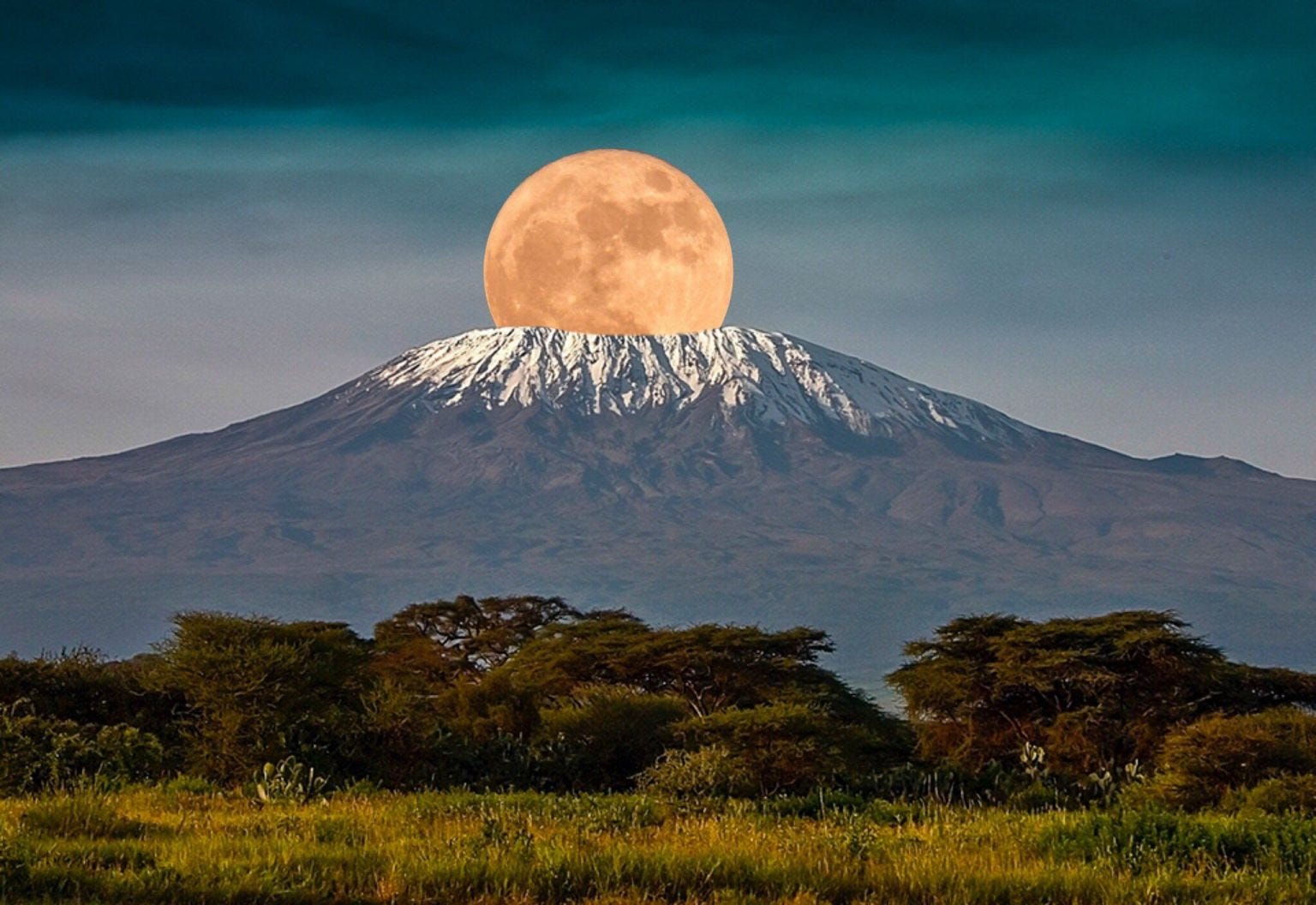
NOTE: This is a new story, written this year. It finds its debut publication here. It was inspired by a recent trip to Tanzania and getting a glimpse of Kilimanjaro at a distance.
The title references the Ernest Hemingway story, “The Snows of Kilimanjaro,” a story I hadn’t read for over 40 years. In re-reading it, I found the masterpiece didn’t live up to my expectations. Nor did the 1952 film version written by Casey Robinson and acted by Gregory Peck and Susan Hayward.
I mimic a lot of the Hemingway style in the story, especially entering the lion’s point-of-view as in “The Short Happy Life of Francis Macomber,” but having lost “Snows” as a model, I felt freed from the story of a dying man kvetching about his regrets, and made my story about a family in transition to a new phase of life.
The image was culled from the internet. Lyrics are from “Big Foot” by Nicki Minaj.

Comments
Nothing yet. Say the first thing.
Sign in to join the conversation.