
Imagine earning so much by your verse, you end up moving to the French Riviera! That’s what Robert Service did, leading a life that seems all but unimaginable now — born of Scotch parents in England, moving to Vancouver at age 21 after he’d been working in the Bank of Scotland for some years, intending not to become a banker there, but a cowboy. And then it was down to California and Mexico and back up to Vancouver Island, working as a clerk in a store, then in a bank — over to Kamloops and on up to Whitehorse, in the Yukon, where he took up writing what he agreed to call “verses” rather than “poetry,” vigorous and immediately appealing, using the accentual meter of popular ballads, with lines of seven beats, but really a line of four and a line of three, welded in one, often rhyming internally AAB, as in this great couplet from the silly song “A Capital Ship”:
And the cook was Dutch, and behaved as such, for the diet he gave the crew
Was a couple of tons of hot-cross buns served up with sugar and glue!
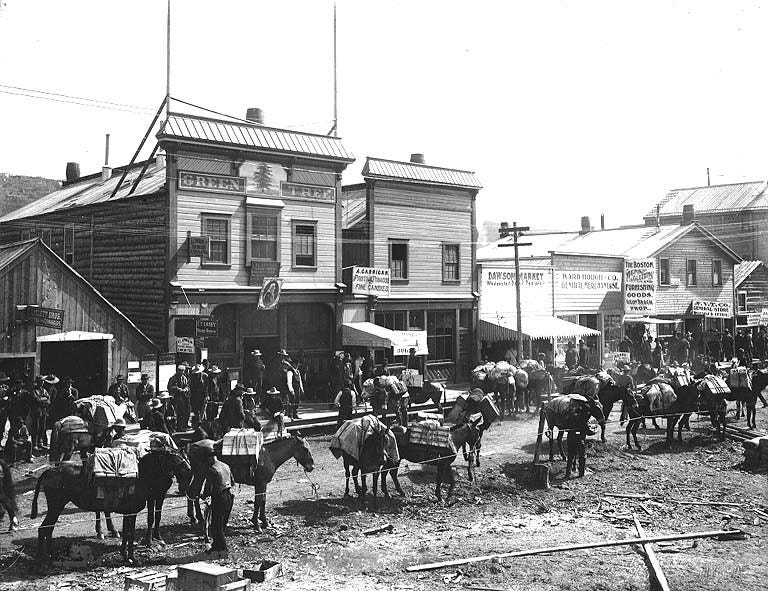
Anyway, Robert Service had no pretentiousness about him, and he was, like the far more serious and troubled Jack London, an inveterate listener to other people’s stories. So even before he had ever set foot in Dawson, the hot spot of the gold rush, he had written verses about that wild land and that fever. It was in Whitehorse where he wrote the poem we’re featuring today, “The Shooting of Dan McGrew.” He finally did make it to Dawson in 1908. Dawson had passed its peak of population in the first heat of the gold rush — 17,000 people in 1898, making it by far the northernmost town of any appreciable population in North America, but when the rush subsided, so did the town, though its glory hung about for a couple of decades anyway. Apparently, since the price of gold has spiked upward, it’s become profitable again to go a-prospecting in the area of Dawson, and that is what some people are now doing.
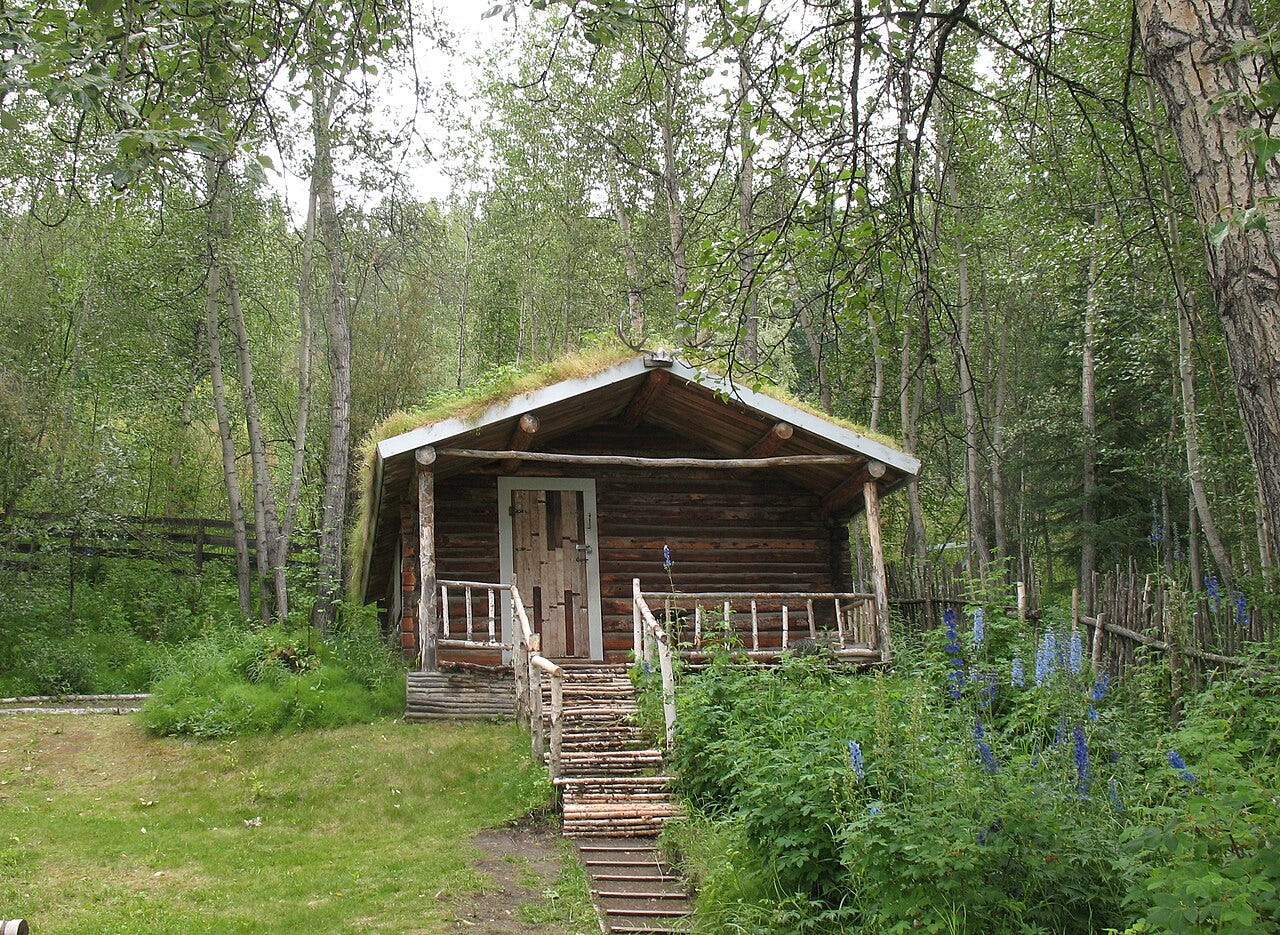
But imagine that the volume of poetry in which “The Shooting of Dan McGrew” appears earned for Service the equivalent of today’s $3,500,000 — and the boys at the publishing house were reading the poems aloud as they came off the linotype machine. And that was just that single book. People have compared Service to Rudyard Kipling, and that seems right to me, though I think Kipling had the more serious moral purpose. There ought to be a place for popular verses well-turned and strong, and if there’s a boy anywhere in the world who wouldn’t warm up to this story of a slick customer, a gloomy and single-minded prospector out for vengeance, and a bad and beautiful woman, I haven’t met him.
Two notes on the text: a “spread misère” is an oddball and daring bid in various card games. The bidder bets that he will take no tricks at all — that’s the misère or pitiable part of it. The “spread” means that he lays all his cards face up. So that’s what Dan McGrew is playing, and I think that Service is up to something there. And a “poke” is a pouch: what you shouldn’t buy a pig in. In the Klondike, that poke might have gold dust in it.
Text within this block will maintain its original spacing when published
A bunch of the boys were whooping it up in the Malamute saloon;
The kid that handles the music-box was hitting a jag-time tune;
Back of the bar, in a solo game, sat Dangerous Dan McGrew,
And watching his luck was his light-o'-love, the lady that's known as Lou.
When out of the night, which was fifty below, and into the din and the glare,
There stumbled a miner fresh from the creeks, dog-dirty, and loaded for bear.
He looked like a man with a foot in the grave and scarcely the strength of a
     louse,
Yet he tilted a poke of dust on the bar, and he called for drinks for the house.
There was none could place the stranger's face, though we searched ourselves
     for a clue;
But we drank his health, and the last to drink was Dangerous Dan McGrew.
There's men that somehow just grip your eyes, and hold them hard like a spell;
And such was he, and he looked to me like a man who had lived in hell;
With a face most hair, and the dreary stare of a dog whose day is done,
As he watered the green stuff in his glass, and the drops fell one by one.
Then I got to figgering who he was, and wondering what he'd do,
And I turned my head — and there watching him was the lady that's known as
     Lou.
His eyes went rubbering round the room, and he seemed in a kind of daze,
Till at last that old piano fell in the way of his wandering gaze.
The rag-time kid was having a drink; there was no one else on the stool,
So the stranger stumbles across the room, and flops down there like a fool.
In a buckskin shirt that was glazed with dirt he sat, and I saw him sway;
Then he clutched the keys with his talon hands — my God! but that man could
     play.
Were you ever out in the Great Alone, when the moon was awful clear,
And the icy mountains hemmed you in with a silence you most could hear;
With only the howl of a timber wolf, and you camped there in the cold,
A half-dead thing in a stark, dead world, clean mad for the muck called gold;
While high overhead, green, yellow and red, the North Lights swept in bars? —
Then you've a hunch what the music meant. . . hunger and night and the stars.
And hunger not of the belly kind, that's banished with bacon and beans,
But the gnawing hunger of lonely men for a home and all that it means;
For a fireside far from the cares that are, four walls and a roof above;
But oh! so cramful of cosy joy, and crowned with a woman's love —
A woman dearer than all the world, and true as Heaven is true —
(God! how ghastly she looks through her rouge, — the lady that's known as
     Lou.)
Then on a sudden the music changed, so soft that you scarce could hear;
But you felt that your life had been looted clean of all that it once held dear;
That someone had stolen the woman you loved; that her love was a devil's lie;
That your guts were gone, and the best for you was to crawl away and die.
'Twas the crowning cry of a heart's despair, and it thrilled you through and
     through —
"I guess I'll make it a spread misere", said Dangerous Dan McGrew.
The music almost died away ... then it burst like a pent-up flood;
And it seemed to say, "Repay, repay," and my eyes were blind with blood.
The thought came back of an ancient wrong, and it stung like a frozen lash,
And the lust awoke to kill, to kill ... then the music stopped with a crash,
And the stranger turned, and his eyes they burned in a most peculiar way;
In a buckskin shirt that was glazed with dirt he sat, and I saw him sway;
Then his lips went in in a kind of grin, and he spoke, and his voice was calm,
And "Boys," says he, "you don't know me, and none of you care a damn;
But I want to state, and my words are straight, and I'll bet my poke they're
     true,
That one of you is a hound of hell. . .and that one is Dan McGrew."
Then I ducked my head, and the lights went out, and two guns blazed in the
     dark,
And a woman screamed, and the lights went up, and two men lay stiff and
     stark.
Pitched on his head, and pumped full of lead, was Dangerous Dan McGrew,
While the man from the creeks lay clutched to the breast of the lady that's
     known as Lou.
These are the simple facts of the case, and I guess I ought to know.
They say that the stranger was crazed with "hooch," and I'm not denying it's
     so.
I'm not so wise as the lawyer guys, but strictly between us two —
The woman that kissed him and — pinched his poke — was the lady that's
     known as Lou.
We think of our archive as a little treasure trove. Our paid subscribers have on demand access to the entire of Word & Song, many hundreds of entries. For everyone else, there’s always plenty to see here, as well. We hope that all of our readers will revisit and share our posts with others as we continue our mission of reclaiming — one thing at a time — the good, the beautiful, and the true.
Text within this block will maintain its original spacing when published
Now the joys of the road are chiefly these:
A crimson touch on the hard-wood trees;
A vagrant's morning wide and blue,
In early fall, when the wind walks, too;
A shadowy highway cool and brown,
Alluring up and enticing down
From rippled water to dappled swamp,
From purple glory to scarlet pomp ;
The outward eye, the quiet will,
And the striding heart from hill to hill ;
The tempter apple over the fence;
The cobweb bloom on the yellow quince;
The palish asters along the wood,
 — A lyric touch of the solitude;
An open hand, an easy shoe,
And a hope to make the day go through, —
Another to sleep with, and a third
To wake me up at the voice of a bird;
The resonant far-listening morn,
And the hoarse whisper of the corn ;
The crickets mourning their comrades lost,
In the night's retreat from the gathering frost;
(Or is it their slogan, plaintive and shrill,
As they beat on their corselets, valiant still ?)
A hunger fit for the kings of the sea,
And a loaf of bread for Dickon and me;
A thirst like that of the Thirsty Sword,
And a jug of cider on the board;
An idle noon, a bubbling spring,
The sea in the pine-tops murmuring;
A scrap of gossip at the ferry;
A comrade neither glum nor merry,
Asking nothing, revealing naught,
But minting his words from a fund of thought,
A keeper of silence eloquent,
Needy, yet royally well content,
Of the mettled breed, yet abhorring strife,
And full of the mellow juice of life,
A taster of wine, with an eye for a maid,
Never too bold, and never afraid,
Never heart-whole, never heart-sick,
(These are the things I worship in Dick)
No fidget and no reformer, just
A calm observer of ought and must,
A lover of books, but a reader of man,
No cynic and no charlatan,
Who never defers and never demands,
But, smiling, takes the world in his hands, —
Seeing it good as when God first saw
And gave it the weight of his will for law.
And O the joy that is never won,
But follows and follows the journeying sun,
By marsh and tide, by meadow and stream,
A will-o'-the-wind, a light-o '-dream,
Delusion afar, delight anear,
From morrow to morrow, from year to year,
A jack-o'-lantern, a fairy fire,
A dare, a bliss, and a desire !
The racy smell of the forest loam,
When the stealthy, sad-heart leaves go home;
(O leaves, O leaves, I am one with you,
Of the mould and the sun and the wind and the dew!)
The broad gold wake of the afternoon;
The silent fleck of the cold new moon;
The sound of the hollow sea's release
From stormy tumult to starry peace;
With only another league to wend;
And two brown arms at the journey's end!
These are the joys of the open road —
For him who travels without a load.
Comments
Nothing yet. Say the first thing.
Sign in to join the conversation.