
Continuing our week of all things Canadian, with the name of that nation our Word of the Week, I’ve decided on what happens to be a first for Word and Song, a poem by Bliss Carman, one of Canada’s most famous poets. I think sometimes that one of the pleasures for an American going to Canada, or to England or Scotland or Wales or Ireland or Australia or New Zealand, for that matter, is that you’re in a foreign country, but it’s like hanging out with distant cousins. Everything is familiar and strange at once, so that you know where you are, sort of. Country music is popular in our part of Nova Scotia, though you’ve got to accustom yourself to Canadians imitating the twang of the American south. And sure, you have Wal-Mart up here and what we fondly call the Home Despot, but if you’ve got an artery that’s pumping all too much blood, you can help shut that baby down with a dish of French fries covered with gravy and mozzarella cheese, and then there’s dulse, that seaweed as full of vitamins as Popeye’s spinach, and moose pie, the first dinner we had here at our next door neighbor’s house. His name was Tony, too — old Antoine Boudreau, a wiry fellow who’d do anything to help his friends, but you’d better not cross him. When he asked me what I wanted to drink, I said, “What do you have?” And he said, in a French Canadian accent, “Well-ll, we have pop, and beer, and orange juice, and shine —” “Shine?”
One thing we’ve long come to know about Canada — people will drive a very long way, without thinking it odd, because it’s a lot farther from one end of the country to the other than in the United States, and the towns are farther spread out. There are a lot of wide open spaces where few people live, and I’m not just talking about the Yukon and the Northwest Territories and what’s now called Nunavut. There’s a big central region of New Brunswick which is almost uninhabited — all woodland, no good for farms. Get away in Ontario from the corridor stretching between Ottawa and Toronto and then to Niagara Falls or Windsor, and it’s the same, vast areas of lakes and woodlands where hardly a paved road is to be found. Yet the terrain of the United States continues into Canada. The Appalachian Mountains don’t end in New Hampshire. They continue into the maritimes all the way to the island of Newfoundland, almost as big as Pennsylvania, my home state, but with less than 1/20th of the population. The great region of lakes and rivers in the American midwest continues beyond the Great Lakes, four of which we share with Ontario, well into Manitoba and Saskatchewan and the Northwest Territories. Lake Winnipeg is bigger than the state of New Hampshire. The Great Bear Lake is bigger still, the fourth largest lake on the continent; Great Slave Lake is almost as big, and is the deepest lake in North America, even deeper than the much larger Lake Superior. Then think of the great prairies — they don’t decide to end at the 49th parallel! They continue into Manitoba and Saskatchewan and Alberta, all the way to the Peace River Valley, where wheat is grown in abundance — and the water from the Peace River ends up in the Arctic Ocean. And the Canadian Rockies — part of the longest stretch of mountains in the world, from the Tierra del Feugo in South America, up the Andes, through Panama and Central America into the United States and Canada.
So it’s a big land, and if you can get away from the crowded cities, you have a long way to wander. And that is the subject of our Poem of the Week, “The Joys of the Road,” by (William) Bliss Carman, who with his fellow wanderer the American poet Richard Hovey, burst on the poetic scene with their Songs from Vagabondia in 1894. It was hugely popular, so they followed it up with sequels, More Songs from Vagabondia and Last Songs from Vagabondia, the latter published in 1900 shortly after Hovey’s death from a minor surgery on a swollen blood vessel in, shall we say, a sensitive place. Carman continued to write many books of poetry, 50 in all through his career, supporting himself by his writing.
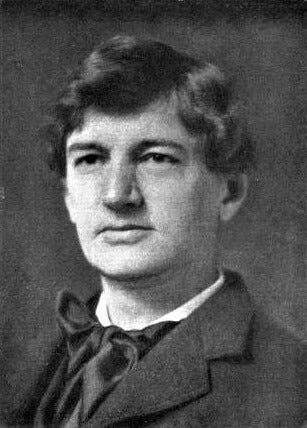
His poetry is pretty wide-ranging, but I think you will immediately sense the appeal of “The Joys of the Road.” I think of the wonderful travelogue by that inveterate walker, Hillaire Belloc, The Road to Rome. But Carman isn’t interested, as Belloc was, in the peoples he encountered on his way by foot from the English Channel to the Eternal City. Carman wants to capture instead the footloose freedom of it, accompanied by a good pal who is the best traveling companion you can ask for, somebody who takes the good things with a willing heart, and the trouble of the road with a patient shrug, somebody you can talk to if you feel like it, and not talk to if you don’t. And it’s the natural world you mainly encounter, not as a tourist, but as a comfortable part of that world.
We think of our archive as a little treasure trove. Our paid subscribers have on demand access to the entire of Word & Song, many hundreds of entries. For everyone else, there’s always plenty to see here, as well. We hope that all of our readers will revisit and share our posts with others as we continue our mission of reclaiming — one thing at a time — the good, the beautiful, and the true.
Text within this block will maintain its original spacing when published
Now the joys of the road are chiefly these:
A crimson touch on the hard-wood trees;
A vagrant's morning wide and blue,
In early fall, when the wind walks, too;
A shadowy highway cool and brown,
Alluring up and enticing down
From rippled water to dappled swamp,
From purple glory to scarlet pomp ;
The outward eye, the quiet will,
And the striding heart from hill to hill ;
The tempter apple over the fence;
The cobweb bloom on the yellow quince;
The palish asters along the wood,
 — A lyric touch of the solitude;
An open hand, an easy shoe,
And a hope to make the day go through, —
Another to sleep with, and a third
To wake me up at the voice of a bird;
The resonant far-listening morn,
And the hoarse whisper of the corn ;
The crickets mourning their comrades lost,
In the night's retreat from the gathering frost;
(Or is it their slogan, plaintive and shrill,
As they beat on their corselets, valiant still ?)
A hunger fit for the kings of the sea,
And a loaf of bread for Dickon and me;
A thirst like that of the Thirsty Sword,
And a jug of cider on the board;
An idle noon, a bubbling spring,
The sea in the pine-tops murmuring;
A scrap of gossip at the ferry;
A comrade neither glum nor merry,
Asking nothing, revealing naught,
But minting his words from a fund of thought,
A keeper of silence eloquent,
Needy, yet royally well content,
Of the mettled breed, yet abhorring strife,
And full of the mellow juice of life,
A taster of wine, with an eye for a maid,
Never too bold, and never afraid,
Never heart-whole, never heart-sick,
(These are the things I worship in Dick)
No fidget and no reformer, just
A calm observer of ought and must,
A lover of books, but a reader of man,
No cynic and no charlatan,
Who never defers and never demands,
But, smiling, takes the world in his hands, —
Seeing it good as when God first saw
And gave it the weight of his will for law.
And O the joy that is never won,
But follows and follows the journeying sun,
By marsh and tide, by meadow and stream,
A will-o'-the-wind, a light-o '-dream,
Delusion afar, delight anear,
From morrow to morrow, from year to year,
A jack-o'-lantern, a fairy fire,
A dare, a bliss, and a desire !
The racy smell of the forest loam,
When the stealthy, sad-heart leaves go home;
(O leaves, O leaves, I am one with you,
Of the mould and the sun and the wind and the dew!)
The broad gold wake of the afternoon;
The silent fleck of the cold new moon;
The sound of the hollow sea's release
From stormy tumult to starry peace;
With only another league to wend;
And two brown arms at the journey's end!
These are the joys of the open road —
For him who travels without a load.
Comments
Nothing yet. Say the first thing.
Sign in to join the conversation.