
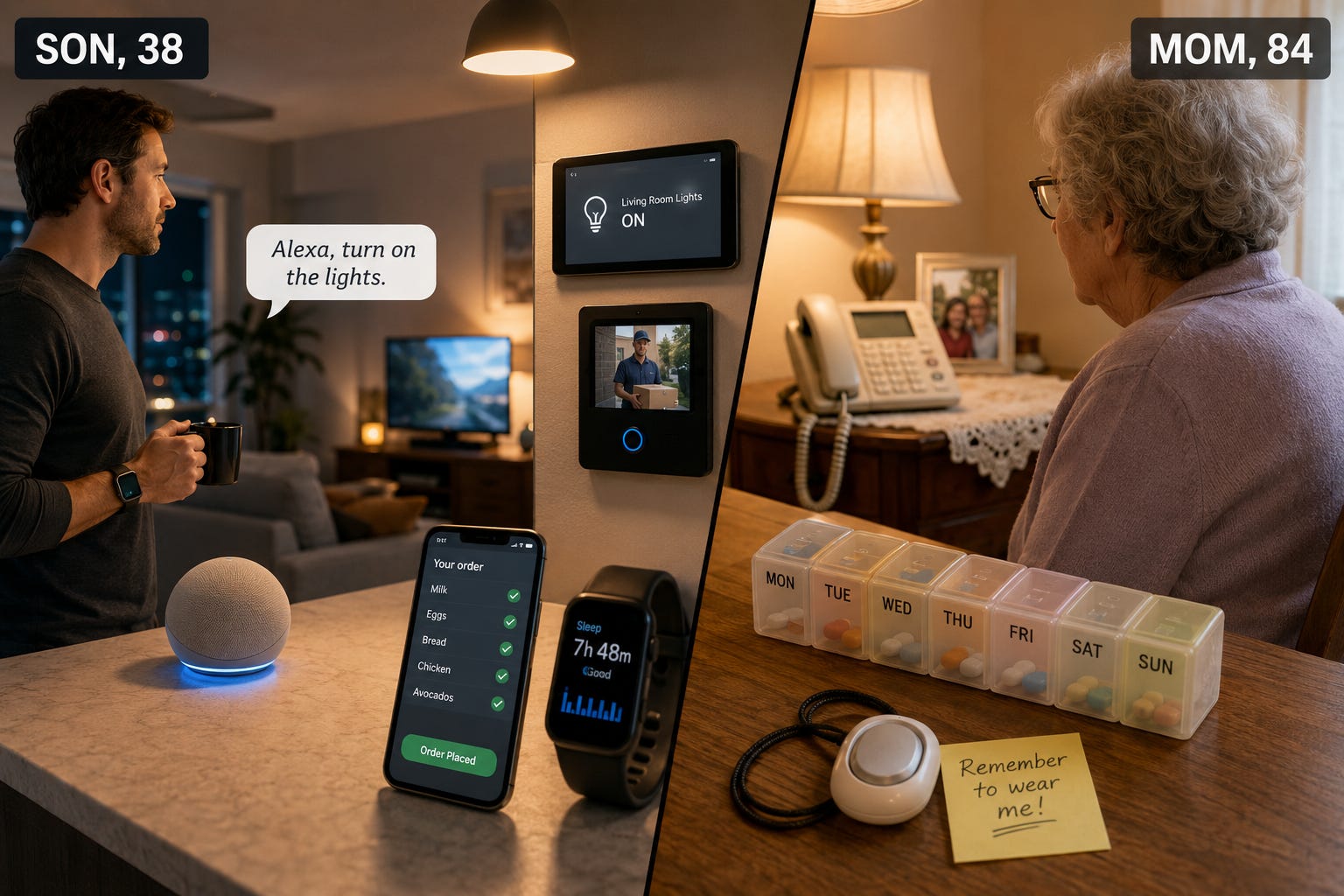
Walk into a 38-year-old’s apartment and there’s a decent chance a voice assistant turns on the lights, a doorbell camera screens visitors, a wearable tracks his sleep, and a app orders his groceries before he’s finished the thought. Walk into his 84-year-old mother’s house — the one he worries about constantly — and you’ll find a landline, a pill organizer with Monday through Sunday, and maybe a medical alert pendant she keeps forgetting to wear.
This is not a technology gap. We have the technology. Fall-detection sensors that don’t require a button push. Stove sensors that shut off automatically. Medication dispensers that text a family group chat when a dose is missed, not just when it’s taken. Voice interfaces simple enough that “remind me” actually works instead of requiring six menus. None of this is experimental. Most of it has existed in some form for close to a decade.
So why is it sitting in pilot programs and demo videos instead of actual homes?
Because we never built the distribution system. The fitness tracker on your wrist got there through Apple stores, Instagram ads, and word of mouth among people who already had disposable income and an appetite for gadgets. The smart pill dispenser that could keep your father out of the hospital has none of that. It has to be discovered by an exhausted caregiver, researched at midnight, purchased without a salesperson explaining it, and then installed and configured by someone who is already stretched too thin to learn a new piece of software. There is no Best Buy aisle for “things that keep Mom safe.” There’s a fragmented catalog of small companies, most of which will not exist in five years, selling to a population that has the least bandwidth of any demographic to evaluate new tech.
That’s the real story here, and it’s an uncomfortable one for an industry that loves to talk about innovation: the bottleneck isn’t engineering. It’s that the entire consumer tech economy is optimized to sell to people who are young, healthy, and have time to shop around — and elder care technology has been left to limp along on leftover attention and underfunded niche startups.
There’s a second, quieter reason, and it’s less about capitalism and more about us. A lot of families don’t install this stuff because doing so feels like an admission. A fall sensor in the bathroom means you’re acknowledging your mother might fall. A camera by the front door means you’re acknowledging she might wander, or that strangers might take advantage of her. We talk ourselves out of the tools that would actually help because installing them confronts us with the thing we’re trying not to think about. So instead we wait for the crisis, and the crisis is what sends people to assisted living intake forms instead of a $90 sensor that could have caught the problem three years earlier.
Here’s where I’ll be blunt: assisted living facilities are, in part, a multibillion-dollar industry built on a technology adoption failure. If even a fraction of the capability sitting in current smart-home tech were deployed in the homes of aging Americans — paired with a caregiver who saw monitoring data instead of a caregiver who showed up twice a week hoping nothing happened in between — a meaningful chunk of “she can’t be alone anymore” decisions would simply not need to be made when they currently are. Not never. But later. On better terms. With more dignity.
This is also where the caregiver role has to evolve, because none of this technology installs itself or interprets itself. The adult child who used to drive over every Sunday to “check in” now has a more useful job: configuring the system, reviewing the data, deciding what’s actually concerning versus what’s noise, and building the human network — a neighbor, a NORC coordinator, a part-time aide — that responds when the technology flags something. That’s a fundamentally different skill set than “showing up,” and it’s one almost nobody trained us for.
The tools to age in place safely already exist. What’s missing is the will to treat elder care technology like a real market instead of an afterthought, and the willingness, as caregivers, to look directly at what these tools mean instead of looking away.
No posts
Comments
Nothing yet. Say the first thing.
Sign in to join the conversation.