
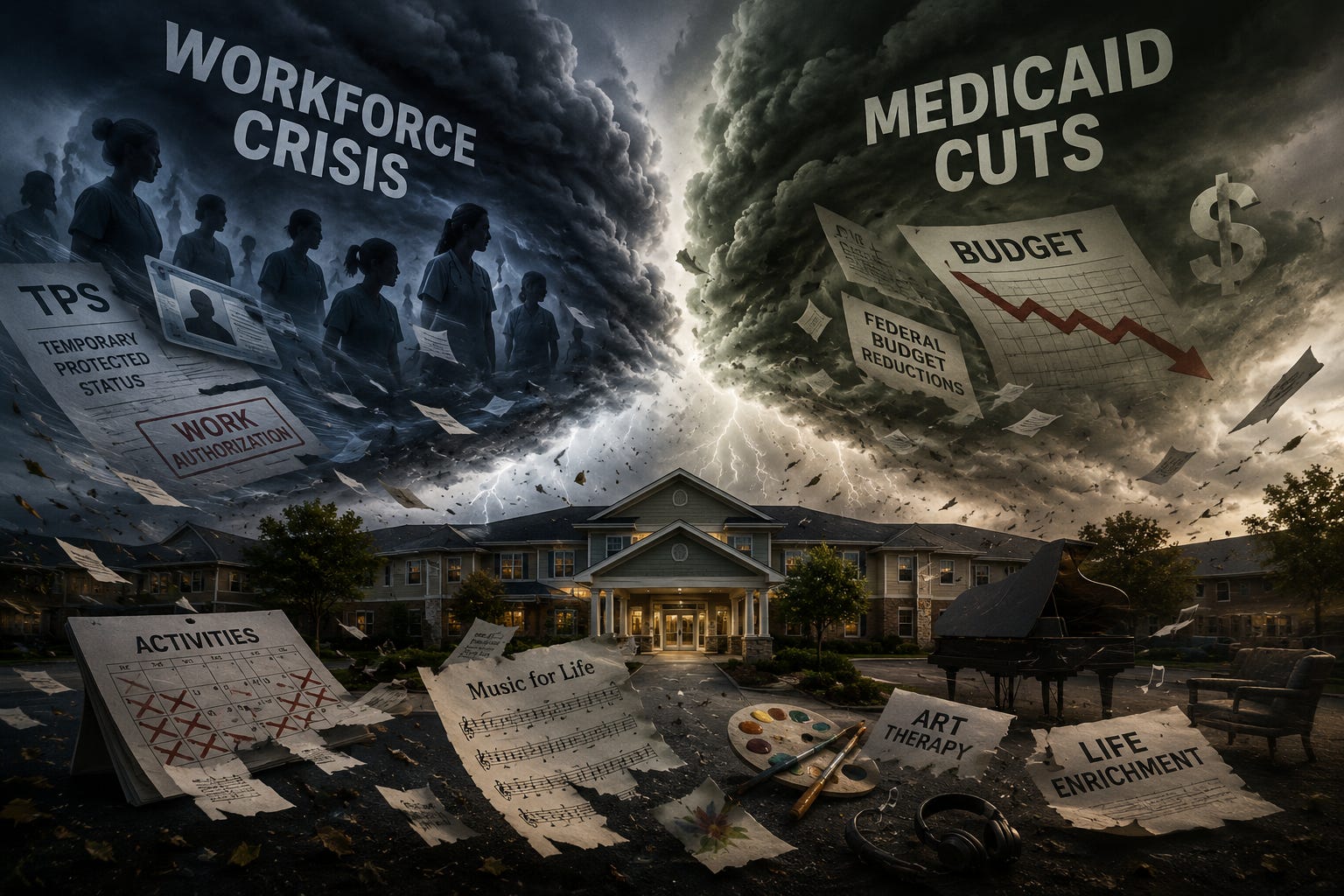
Let’s stop pretending this is a slow-moving storm.
It already made landfall.
On June 25, 2026, the Supreme Court ruled 6-3 that the Trump administration can move forward with stripping Temporary Protected Status from roughly 350,000 Haitians and 6,000 Syrians — and the reasoning the majority used, that courts have no authority to second-guess how these terminations happen, doesn’t just apply to Haiti and Syria. It potentially exposes TPS holders from seventeen countries, more than a million people, to the same fate. The court didn’t say Haiti is safe. It said the question is none of the judiciary’s business.
Sit with that for a second, then think about your staffing roster.
The Workforce Shock Nobody’s Budgeting For
Home care and long-term care in this country run on an immigrant workforce, and TPS holders — Haitians especially — are a disproportionate share of the direct care labor pool in markets like South Florida, New York, Massachusetts, and Ohio. These are home health aides, CNAs, and dietary and housekeeping staff who show up on the overnight shift nobody else wants. Pull a meaningful percentage of them off the floor through deportation, detention, or simple loss of work authorization, and you don’t get a staffing shortage.
You get a staffing collapse layered on top of a staffing crisis that was already chronic before this ruling.
(Read this WAPO article for perspective.)
And the irony cuts deeper than immigration status alone. A large share of your own direct care workforce — aides, CNAs, the people actually staffing the floor — don’t have employer-sponsored health coverage and rely on Medicaid themselves. As eligibility rules tighten and redetermination cycles get more aggressive, those same employees will be churning on and off coverage, dealing with their own health crises untreated or unstable. That’s not a side issue. That’s your staffing pipeline taking a second hit from the same policy, this time from the inside.
The Medicaid Cliff You’ve Already Forgotten
And it doesn’t stop there. November is circling back around, and most operators have let themselves forget it’s coming: the Medicaid cuts baked into this year’s federal budget law start landing. This isn’t only about reimbursement rates getting trimmed at the margins. It’s about eligibility itself narrowing — work requirements, redetermination cycles, and tightened rules that will push people off the rolls who have relied on Medicaid to fund home and community-based services or to cover the custodial cost of long-term care. Fewer eligible residents means fewer billable days. Fewer billable days means tighter margins. Tighter margins means staffing ratios get “right-sized,” which is corporate language for cut.
What Gets Cut First
So here’s the equation nobody wants to write on the whiteboard: a workforce shock on one side, a revenue and eligibility shock on the other, hitting the industry in the same twelve-month window. You don’t need an MBA to know what gets cut first when an operator is staring down both. It’s not the call light response time, because that’s a survey deficiency waiting to happen. It’s not medication administration, because that’s a lawsuit waiting to happen. What gets cut is the stuff that was always coded internally as “nice to have” — the music programs, the art therapy, the life enrichment positions, the engagement coordinators whose entire job is making sure residents have a reason to get out of bed that isn’t a med pass.
That is the actual tragedy buried inside this policy collision.
Quality of life programming is the first thing on the chopping block precisely because it’s the thing that doesn’t show up on a regulatory survey but shows up everywhere else — in fall rates, in antipsychotic use, in depression scores, in how fast a resident with dementia declines once nobody is reaching them anymore.
The research on music and memory isn’t speculative at this point. Personalized music has been shown again and again to cut agitation, reduce reliance on chemical restraints, and pull people with advanced dementia back into something resembling presence, even briefly. Cutting that program to save a part-time salary is the single worst trade an operator can make, and it’s exactly the trade hundreds of communities are about to be pressured into making.
What You Can Actually Control
Here’s the harder truth: you cannot lobby your way out of a Supreme Court ruling, and you cannot out-advocate a federal budget reconciliation bill that already passed. Those fights are over, or close enough to over that planning around a reversal is wishful thinking, not strategy. What you can control is how efficiently and how cheaply you deliver the quality of life programming that’s about to get targeted for the cut list.
This is exactly the moment operators need to stop treating engagement programming as a luxury staffed position and start treating it as infrastructure — something that runs reliably without depending on one full-time activities director who might not survive the next round of “right-sizing.” If music-based engagement is the highest-leverage, lowest-cost intervention you have for combating isolation, agitation, and decline, the conversation can’t be “do we keep the program.” It has to be “how do we make the program survive a workforce and budget shock that’s already arrived.”
Infrastructure, Not a Luxury Line Item
That’s the conversation worth having now, before the next staffing meeting turns into a list of programs on the cutting board.
Sage Stream (https://sagestream.live) is built for exactly this moment: personalized LIVE, IN THE MOMENT, INTERACTIVE music streaming designed specifically for older adults and people living with dementia. Access to music in all genres with 120 high-caliber artists from the U.S. and U.K.
It’s the difference between a quality-of-life program that depends on headcount you may not have in six months, and one that runs on infrastructure you already control. And critically, it’s priced for the reality operators are actually facing — built to be affordable at the community level even as margins compress, not a premium add-on that gets justified away in the same budget meeting where everything else is getting cut. Live, on the floor entertainers, are expensive and their costs are rising too - think gas to get to a gig - so their rates will rise accrodingly.
Operators who wait until the Medicaid cuts hit in November to think about this will be making the decision under duress, scrambling to defend a program with a price tag that no longer fits the budget. Operators who move now get to make the call on their own terms, lock in something affordable while they still have room to plan, and protect the one part of resident care that’s hardest to rebuild once it’s gone.
The policy fights are largely decided. What residents experience next is still up to you.
Comments
Nothing yet. Say the first thing.
Sign in to join the conversation.