
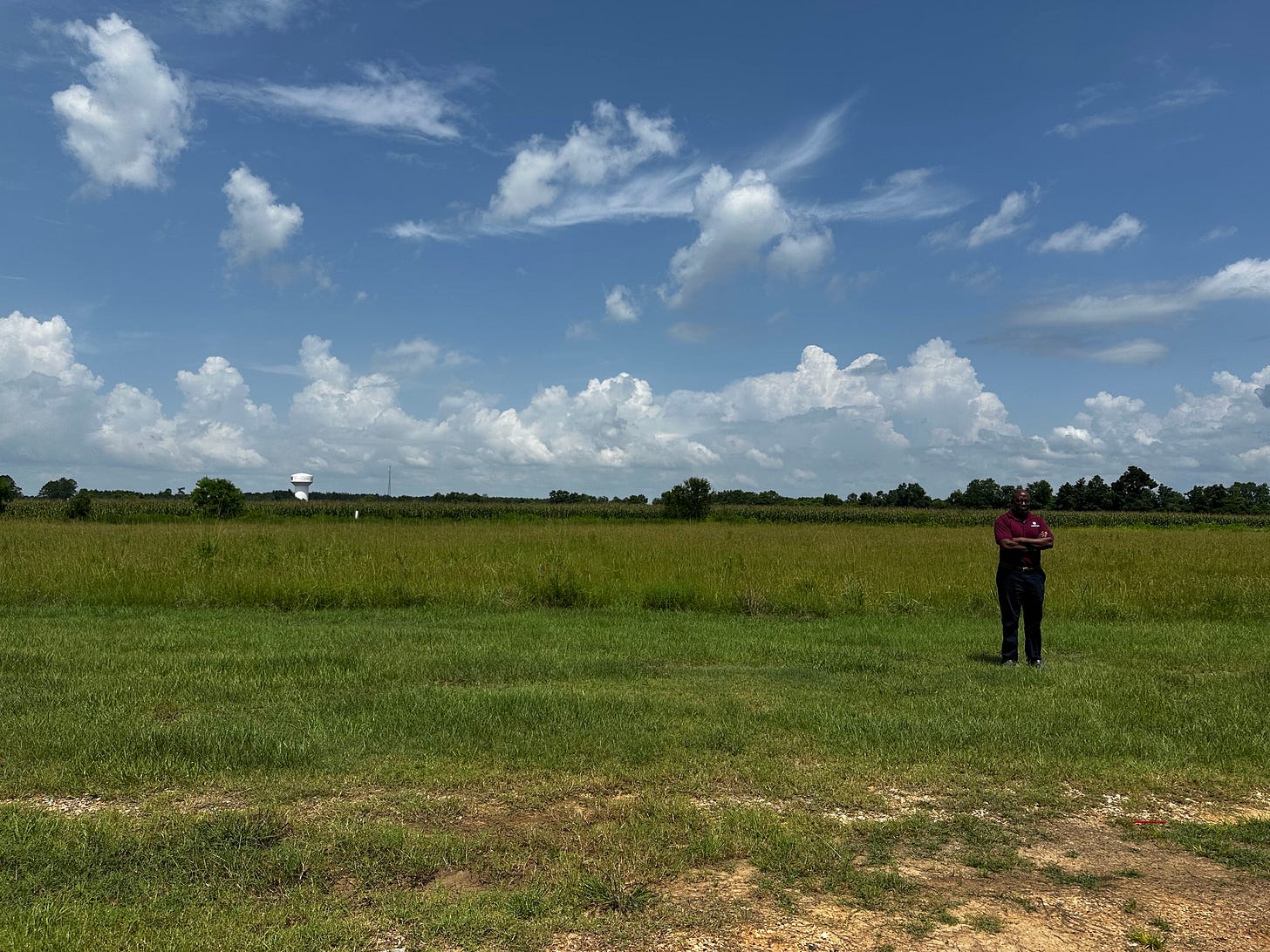
I am wrote this from Atmore, AL, a small city of about eight thousand people in Escambia County, just north of the Florida state line. It is July, which in southwestern Alabama means the air is thick enough with humidity to swim in it. I was there for the Bradley-Sampey family reunion, a three-day gathering running July 17-19, 2026. There are people here I have not seen in years and a few I am meeting for the first time. We were eating, telling stories, comparing notes on who married whom and who moved where. It is the kind of event every large black family in the South knows well. Great food and a lot of laughter.
We are also just a few miles from the Bradley slave plantation where my family was once enslaved.
I have known this in a general sense for most of my life. But my father is the one who was tasked to put the full picture together at the reunion. He told the story, copied the documents, preserved the handwritten genealogical charts and the photographs and a even framed newspaper article about a school called Bethlehem Industrial Academy.
In 1904, a private Black church school was established in Monroe County, Alabama, under the name Bethlehem Industrial Academy. The founding of B.I.A. was one of the most important events in the history of the Black community in Monroe County, and the Bradley family’s connection to this institution is one of the most significant threads in the family’s history. To understand B.I.A.’s significance, one must understand the state of education for African Americans in Alabama at the turn of the twentieth century.
All of this history was eventually summarized into a family history spanning seven generations, reaching back to the 1830s. It names names. And it forced me to reckon with something I’ve had to think hard about: the specific mechanism by which the name Bradley entered my family.
This is a common, standard story for African Americans. The earliest known patriarch of the Bradley line was a man named Simon, originally enslaved by the Gully family here in Monroe and Escambia Counties. He bore their surname because that is how the system worked. You were called what your owner was called. At some point the Gullys sold Simon to the Bradley plantation. When he arrived, he was given the Bradley name, the same way he might have been given a new set of work clothes or assigned to a different field. The name was not chosen. It was transferred, along with the body it was attached to.
Because of the America’s slave system, my last name could have just as easily been Gully.
Standing a few miles from where that transaction took place puts a different weight on it. The land is right there. The soil Simon worked is the same soil I can in the area. Monroe County, AL was cotton country, opened to white settlement after the Creek War of 1813 to 1814. Escambia County was timber country (my grandfather worked in a lumber mill). Settlers arrived from Virginia, the Carolinas, and Georgia, many bringing enslaved people or buying them through the domestic slave trade. By the 1840s the county’s economy rested on enslaved labor. The 1860 census listed enslaved persons by age, sex, and color under their enslavers’ names. Not by their own. They were inventoried alongside livestock. My family was in that inventory. And the Gullys, when they were finished with Simon or when they needed the money, sold him to another family and his name changed accordingly.
That is how the name on my birth certificate, on my degrees, on every book I have published, came into existence. Through a slave sale.
I have been thinking about this while watching my relatives fill their plates and argue about who was the best at playing Spades. There is a version of this story that is easier to tell, the version where the name is chosen after emancipation, where the formerly enslaved patriarch selects a new identity as an act of self-determination. That is not what happened. The name was imposed by the family that purchased Simon. It was a property tag. And yet it is the name under which more than a hundred people are gathered this weekend, a few miles from where the tag was first applied.
I am not sure what to call that. It is not reclamation, because nobody sat down and decided to take the name back. It is not defiance, because the name was never rejected and then re-adopted. It is something more like habitation. The family moved into the name the way you move into a house that was never built for you. You do not tear it down. You fill it with your own things until it belongs to you.
After emancipation, Simon married a woman named Mary. Together they had twelve children here in Escambia County, in conditions that resist exaggeration: poverty, no medical care, staggering infant mortality, constant racial violence. All twelve survived long enough to be recorded by name in the family’s genealogical charts. On the Sampey side, a woman named Lacynthia, enslaved by the Watson family, became Lacynthia Sampey. She and another ancestor named Juliet Sampey raised eight children through the post-Reconstruction collapse, when poll taxes, literacy tests, and Jim Crow stripped Black Southerners of every gain they had secured. The two families fused when three Bradley brothers married three Sampey sisters, producing double cousins connected on both sides. The people at this reunion carry dozens of surnames now: Donald, Kidd, Lee, Martin, Currie, Hosey, Brown, Wilson, Kennedy, and more.
What interests me about all of this, standing here in July heat with people who share a name that originated in a slave sale, is not the triumphant arc. You can narrate any black family’s Southern history as an overcoming story, and it will be true as far as it goes, but it does not go far enough. It smooths the edges. The harder thing is to sit with the fact that the Gullys sold Simon because he was property, and the Bradleys bought him and branded him with their name, and neither family considered him a person, and the name stuck anyway. It stuck not because anyone reclaimed it but because people lived under it long enough to make it theirs. Simon Bradley was not considered fully human and made in the image and likeness of God.
But here is what the Gullys and the Bradleys did not get to decide. They did not get to decide what happened after the system collapsed. They did not get to decide that Simon and Mary would raise twelve children, or that those children would marry into the Sampey family, or that the combined clan would grow across seven generations into the crowd of people laughing and taking photographs in Atmore this weekend. The name was imposed. What the family did with it was not.
What’s even more remarkable is that they emerged from slavery and then stepped right into Jim Crow Alabama. Or, as some would say, “Sweet Home Alabama.”
It was late afternoon on Saturday. The heat broken by a rain storm. At meals, children are running between the tables. We are a few miles from where Simon was sold from one plantation to another and given a new name like branded cattle. A hundred and sixty years later, his descendants are still carrying it, not because they chose it, but because they filled it with so much life and hope that it became, irreversibly, theirs. This is what resilience looks like, folks!
“Why do black people talk about race so much?”, many people ask. Well, this is why. Every time I see my name, I’m reminded of a slave plantation. Imagine having the privilege of never having to think about that!
Oh yeah, I forgot to mention this. Several years ago, some members of my family bought the land where the plantation sat. Only in America is it possible that those who were formerly enslaved can purchase the property where their family was once enslaved.
No posts
Comments
Nothing yet. Say the first thing.
Sign in to join the conversation.