
No sooner had I posted about three successful art theft recoveries last week than another museum theft hit the wires. This time, thieves in Messina, Sicily, pulled off a heist for the ages.
The venue this time was the Regional Museum of Messina. According to early reports, the theft took place just before 10 p.m. local time. Thieves took just minutes to steal a polyptych, Polittico di San Gregorio, by Antonello da Messina, the 15th-century master known for blending Flemish and Italian art. They also smashed a case and stole Antonello’s double-sided Virgin Mary and Christ in Pietà.
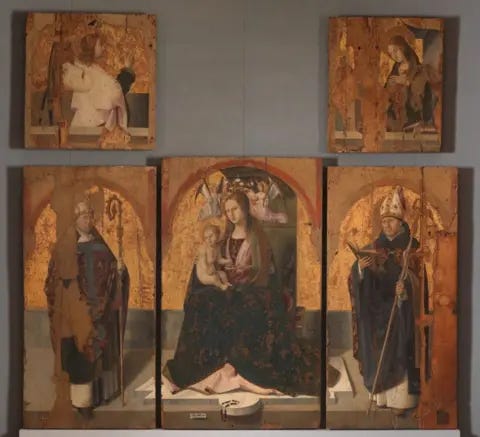
While making their getaway, the thieves left two panels from the polyptych abandoned by the museum, perhaps finding it too difficult to quickly abscond with all five panels. One cannot help but be reminded of the crown left behind by the thieves who stole the Napoleonic jewels from the Louvre last October.
I’m hesitant to rely on early reports, because in security incidents they are often wrong. But what has been reported so far—if accurate—comports with what is somewhat common in museum heists:
The theft coincided with a major local festival to commemorate the Assumption of the Virgin.
The smash and grab style heist took approximately 3 minutes.
Highly valued works that will be enormously difficult to fence were stolen. Antonello’s Ecce Homo, which was widely reported in Italy to recently have sold for $15 million, may have been the impetus that led thieves to target the museum located in his hometown and rich with his works.
It has also been reported that security staff were on-site during the heist, and that alarms were working when it took place. However, it wasn’t until passersby saw thieves fleeing with works that authorities were alerted to the crime.
If this is true, that’s troubling. With security staff on-site and ostensibly operating alarms and cameras, it’s hard to imagine how no one was wise to what was happening. However, it’s important to reserve judgment until we know all of the facts.
So far, the theft has already delivered on the tropes. One report says that the quickness of the heist points to a carefully planned theft. All major thefts are planned to some extent. But the brevity is indicative of a theft of this sort, where thieves use a raid (as opposed to, say, a stay-behind or a ruse) to get the goods. And many have been reporting that the theft raises new questions about museum security. But does it? These are age-old questions, like “Is it possible to completely secure valuable items that are meant to be accessible to the public?” and “How much money can be allocated to security in an institution that is not cash-rich?”
This will be an investigation to watch closely, and it will be interesting to one day learn how the Carabinieri ultimately caught the thieves—and I believe that they will.
Comments
Nothing yet. Say the first thing.
Sign in to join the conversation.