
I’ve known Russ Webster for more than 20 years. His career has been nothing short of extraordinary. His last assignment was in the Senior Executive Service as FEMA’s Regional Administrator for Region I, which covers six New England states and its population of 15 million people including ten Tribal Nations. During the COVID-19 pandemic, he led Region I’s efforts in response, recovery, and long-term health and economic resilience planning and operations.
In a previous FEMA assignment, Webster was New England’s first Federal Preparedness Coordinator and FEMA Region I’s initial Incident Commander for the 2013 Boston Marathon Bombing.
Prior to FEMA, Captain Webster served in the Transportation Safety Administration (TSA) as Deputy Federal Security Director for all airports and transportation venues in Massachusetts. He co-developed two TSA initiatives that eventually evolved into national programs: Screening of Passengers by Observation Technique behavioral detection, and the use of TSA screeners at other transportation venues sites, such as rail stations.
Before TSA, Captain Webster served for twenty-six years in the Coast Guard. As Commander at Group Woods Hole, then one of the largest search and rescue groups, Captain Webster was Incident Commander for both the 1999 JFK, Jr., and Egypt Air 990 air crashes. In his final mission assignment, Captain Webster served as Chief of Operations (District 1) in the Northeast between Canada and New Jersey. During 9/11, Captain Webster supported all operations in response to the terrorist attack.
(Most importantly, he’s also a Yankee fan.)
1. What led you to a career in the Coast Guard?
My mom and dad were from the Greatest Generation, and both were public
servants. Dad was in the Army Air Corps during WWII and my mother worked
for the city of New London, Connecticut, for more than 50 years. They taught me
the value of hard work and commitment to service. I grew up fishing along the
Thames River, watching the sleek Coast Guard utility boats on their way out to
assist mariners in distress, and I always thought, ‘I’d like to do that!’ And so I
went to the nearby Coast Guard Academy and served 30 years and loved it. I
learned a foreign language, visited multiple countries, and earned two master’s
degrees and made many great friends.
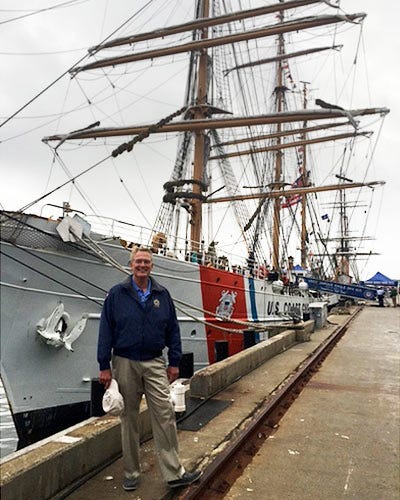
2. What was your favorite part about the work?
The people. Sharing the nobility of the lifesaver, law enforcement and
environmental missions and traveling extensively and making a difference with
people who genuinely were motivated and enjoyed what they were doing. As a
service smaller than the NY City police department, the Coast Guard had been
vested with law enforcement authorities since the time of Alexander Hamilton.
Every petty officer and officer, no matter how junior, has law enforcement
(Customs) authorities. This has come in handy in many situations, especially
when working with other federal agencies that needed to deputize some of our
people for urgent requirements. I’ve also enjoyed studying our history,
understanding we’re technically the oldest continuing federal seagoing service
(older than the Navy), and have fought in every conflict since the French and
Indian War. I love contextualizing today’s challenges for future leaders,
understanding that historic leaders and service lessons can facilitate better critical
thinking and provide hero modeling possibilities.
3. From a security point of view, what is the chief challenge of the USCG?
Probably the extremely rapid shift in priorities this Administration has brought to
the table, necessitating renewed emphasis and resourcing in the alien migration
interdiction operations, drug enforcement, and operations in the Arctic and around
the globe. Fortunately, the Administration and Congress have also funded
significant infrastructure items for the long term. I’ve studied and seen two other
times; WWII and after 9/11 where these drastic priority shifts have occurred.
There’s always a lag in resource and recruitment that puts added strain and risk on
the organization. That’s leadership’s challenge.
4. What did you miss about it most when you retired?
It’s the people. There’s nothing like sharing and believing in what you’re doing,
together.
5. You’ve had a lot of high-level roles in the USCG, TSA, and FEMA. What would you say was the single biggest challenge you faced in your career?
Easy! My time as the FEMA Region 1 Administrator during the COVID 19
Pandemic challenged every leadership experience and capability I had developed
to this point in my careers. COVID 19 was not only unique in its scope, but also
the intimacy of fear that every person in the chain, from me to the newest public
servant on the team were experiencing. We all were challenged to perform in
what many viewed as a hostile, threatening environment while pursuing a mission
to help people before, during and after disasters. With that context to support the
16 million New Englanders, we engaged with five ACOE scientists who helped
me assess the risk to the FEMA team and the people we served in such a way that
we could more precisely define when and where people should work and how
much of and where scarce medical resources should be distributed throughout the
six New England states.
6. What was it like dealing with aviation security challenges in the early years after 9/11?
Probably one of the most unique times of my career, working for a relatively new
organization that was going from zero to 60,000 employees and without many
formal policies or doctrine. And, requiring a commitment to innovation while
preserving the safety of a major commercial backbone that the Nation needed to
rely upon. We did this by initiating more than 60 new policies, ranging the gamut
from a new strategic plan to forming bid processes, recognition and leadership
programs and creating the first behavioral detection program. It was an exciting
time, working with five different generations of employees, many who were
experiencing their first jobs and others who came out of retirement to make
contributions to aviation and America’s security. I was fortunate to have worked
with inspirational leaders like you and George Naccara.
7. When you were appointed to run FEMA in New England, what did you see as your first goal?
I had two goals. First and foremost, I recognized that the region had not been led
by a permanent administrator in several years and needed the stability of a
strategic plan that would take the organization from 2020 to 2030, or “over-the-
horizon.” Second, we needed an informal program to define how personnel could
define trust and learn to trust each other and the organization. And most
importantly, resolve conflict at the lowest level. Too often, I had seen how senior
management was stuck managing the fallout from individual employees who just
didn’t know how to say no to whatever was bothering them or articulate the
impact of other’s actions. New systems were put in place that enabled every
employee to have the tools to understand how they were empowered to stand up
for themselves in the moment and for the rest of their careers.
8. When you left FEMA, did you feel that you had enough time to make your mark with the agency?
I left every agency knowing I never had enough time. After a while, you realize
that life and working is a leadership conveyor belt where when you get off,
someone else will inevitably get on. If you’ve done your job well, you’ve
influenced some future leaders who will take the best of what you had to offer and
make a difference with their own style.
9. Where do you find your stories for your books on the history of the Coast Guard?
Some of the stories I’ve lived. Others, I’ve studied history and learned from. And
still others, I’ve been inspired by the people and heroes I’ve worked with and
known.
10. Can you share a bit about your next book project?
My wife, Theresa, and I have coauthored The Last Flight that details the five days
after JFK Jr.’s airplane crashed off Martha’s Vineyard the night of July 16, 1999.
Specifically, our new book details how local, state, and federal agencies came
together in the unified pursuit to search and then respectfully place the ashes of
JFK Jr, his wife, and her sister, over the wreck site, all within the five days after
the crash. There’s no celebrity angle, nothing gossipy about their personal lives.
Our book begins where every other book about JFK Jr. has left off. The publisher
has tentatively scheduled the book for an October 16, 2026, publication date.
No posts
Comments
Nothing yet. Say the first thing.
Sign in to join the conversation.