
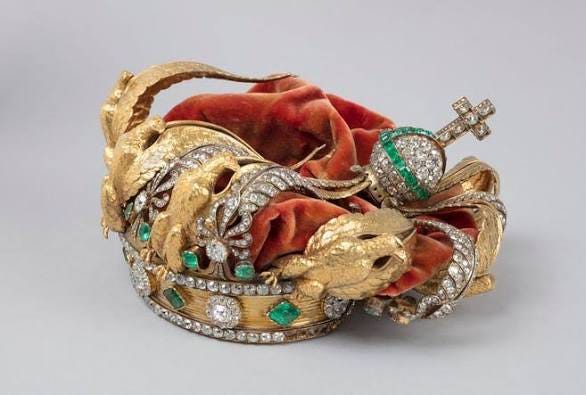
Holly Salmon is the John L. and Susan K. Gardner Director of Conservation at the Isabella Stewart Gardner Museum. She’s a very highly respected objects conservator with decades of experience working on the care and restoration of art. She oversees a team of experts who do the same: paintings, sculptures, textiles—all manner of artifacts. I asked her to address the precious crown damaged and left behind by the Louvre thieves last October (pictured below), as well as a number of other intriguing questions about her work.
1. I know that it’s hard to answer this without seeing it and evaluating it in person, but what would be the first steps an object conservator would take when presented with this now famously damaged crown from last October’s heist at the Louvre?
The first step in any conservation project is to spend a lot of time just doing close looking at the object. You need to understand what a piece is made out of, how it was made, what has happened to it over time, what are the challenges you might face in each step before even developing a project plan. This is a crucial part of conservation work that not everyone realizes. Even though the basic materials of this crown might be listed and the original maker is known, that doesn’t mean a conservator knows exactly how the jewels are mounted, what percentage of gold to other metals is used in the structure, were those eagles made from a mold or shaped by hand, etc. All of those kinds of details need to be understood before someone would develop a treatment plan and then touch a work like this.
2. Would repairing something like this object be the work of one person or a team?
I imagine only one or two people will do the actual hands-on work. However, given the high profile and important nature of this particular restoration project, I know from articles in the press that they will be utilizing a committee of experts to consult on the full process. These will include, “museum specialists, a jewelry historian, a Second Empire decorative arts curator from the Musée d’Orsay, a mineralogist from the National Museum of Natural History, and a metals conservation specialist… and representatives from five historic French jewelry houses” Source.
3. Have you worked on objects damaged to this extent in the past?
Yes and no. I have worked on objects that have been heavily damaged at some point in history and then repaired. Often, now that we have more sophisticated tools or materials, our work might entail redoing a repair- such as a porcelain ceramic broken into many pieces and repaired with now-yellowed adhesive. We would take a piece like this apart, remove the old adhesive and then put it back together using a more stable material. I do expect to participate in the restoration of the Gardner stolen works, some of which were severely damaged, once they are recovered!
4. Does the Louvre have staff on site to deal with this, or would you suspect they will have to bring in outside experts?
While I am not familiar with the Louvre’s Conservation staff, I suspect that they would be bringing in someone who is specifically experienced in jewelry restoration. This type of work is quite specialized and, given the importance of the piece, as well as the high profile nature of the theft, they will want someone who can demonstrate they have extensive experience working on similar objects. Additionally, as I mentioned previously, a large team of experts will participate in this particular project. This type of checks and balances is actually quite common in museum conservation. For even our most basic projects, the curator and supervisor will review a treatment proposal. For high profile and important works, such as with the recent treatment of Titian’s Rape of Europa at the Gardner, we will also often bring in outside experts to review and discuss a treatment plan.
5. What is the range of time repairing something like this might take?
That is really hard to say without knowing the full extent of damage and special techniques needed to repair it. A project like this might take just weeks, if someone is placing all of their attention on the work, or it could take months. I’m guessing given the large committee involvement and very high profile nature, this project could take up to a year to complete. But I’m only confident enough to wager about $10 on that - would you take that bet?
6. What is the greatest challenge in preserving objects?
I hate to say it but, people are the greatest challenge. And, not just because of a damaging theft like this or tourists who knock over something while taking a selfie in a museum or people who unintentionally sit on a collection chair in a historic house. Those are extreme cases. Our bodies and clothes also produce dust and just the light we need to see art is damaging over a long period of time. During the pandemic everyone joked that I must have loved the Museum being closed because it kept the people away and the lights out. But the whole purpose of a museum is for people to experience cultural heritage inside and it is my job to try and preserve that for as long as possible.
7. As an objects conservator but also the head of a conservation department, how active a role do you take in things like textiles and painting conservation?
I have a very basic understanding of textiles and paintings conservation through my graduate school training and exposure to projects during my career at the Gardner. As mentioned above, conservators will review treatment proposals with me and also our curator. We will also often collaborate on how to approach a project. However, we have an excellent team of conservators at the Gardner so I trust and rely on them, and their individual expertise, implicitly.
8. What would you say is the biggest advance in conservation in your career?
Imaging is an essential part of documenting an object before and after it is treated and the biggest advancements in the field have been in imaging. It’s an easy answer for me because when I started in conservation, digital imaging was only just becoming commercially available. But in all seriousness, it is extraordinary the wide variety of imaging techniques, such as multispectral imaging, reflectance transformation imaging, xray fluorescence mapping, etc that have been developed over the past 25 years. Using tools like these allows us not only to do basic documentation but also to better understand artists techniques and materials, as well as how best to approach our conservation treatments.
9. What sort of influence does George Stout have in your work, if any?
George Stout was a pioneer in the field of art conservation. His work as a conservator at the Gardner began in the 1930s, essentially founding our conservation department, and his care for our collection continued through his time as the museum’s director from 1955 to 1970. While Stout is known in many circles as one of the Monuments Men and Women, responsible for protecting art from destruction during World War II, amongst conservators he is known for his tremendous impact on our field. This includes his promotion of the scientific approach to conservation and as a champion for using the best and most innovative methods for the examination and treatment of art. He was also one of the people who founded an ethical approach to how we document our work and isolate our work from the original artists’. We are also learning that not all of his treatments were successful. He did the best he could with what was available and known at the time. I keep a photo of him above my desk as a reminder of his legacy and also as a reminder that future conservators might one day reevaluate my own work and we always need to keep that in mind when looking at past restorations.
10. How does one become an objects conservator?
The process of becoming a conservator is often compared to becoming a doctor (although less expensive and time consuming but maybe still as stressful!). Someone would need to fulfill required undergraduate coursework, as well as a certain amount of hands-on experience, in order to gain entry into one of the few masters programs in conservation. Those graduate programs usually include summer and at least one full academic year internships. After matriculation, a conservator often will have post-graduate fellowships. Fully trained conservators, like me, are always seeking continuing education opportunities through research projects, journal articles, workshops, conferences, etc. More information on how to become a conservator can be found on the American Institute for Conservation website.
No posts
Comments
Nothing yet. Say the first thing.
Sign in to join the conversation.