👄 Spellcheck the game has been revived thanks to our friends at TED. The daily spelling game has new rounds, functional text-to-speech, and human curation! You can play the daily game right here!
🦷 Sabrina made a video about toothpaste. Be sure not to rinse for 30 minutes after watching it here!
👨🎨 Taha talked about the creator economy in this episode of Creators on Creators.
💥 Joe the Editor made some noise in this video where he broke down a sound effects sequence from the toothpaste episode.
✨ Get your bonus content! Sabrina’s shared her extended interviews with all the experts from the toothpaste video. Watch them with this month’s password: TEETH.
Brushing your teeth for the full 2 minutes is important but boring. That’s why we’ve collected this playlist to make sure you can be bumpin’ while you’re brushing.
📢 Audience Participation
We are working on a video about air travel and want to hear about your experiences! If you want to help us out, fill out this quick 5 minute survey!
Joe the Editor found something very strange while hunting for toothpaste b-roll for the toothpaste video.
Also, yes, this does mean that we took so long to make a video that our video editor made a different video about something he discovered while making the original video and managed to release it basically a month earlier.
🔓 Patreon Unlocked
Sabrina, Taha, and Melissa confront their accidental 6 month hiatus and all the videos that were abandoned in the process.
If you want to support our work and get access to even more bonus content and aftershows, consider subscribing to our Patreon :)
✂️ Cut for Time by Sabrina
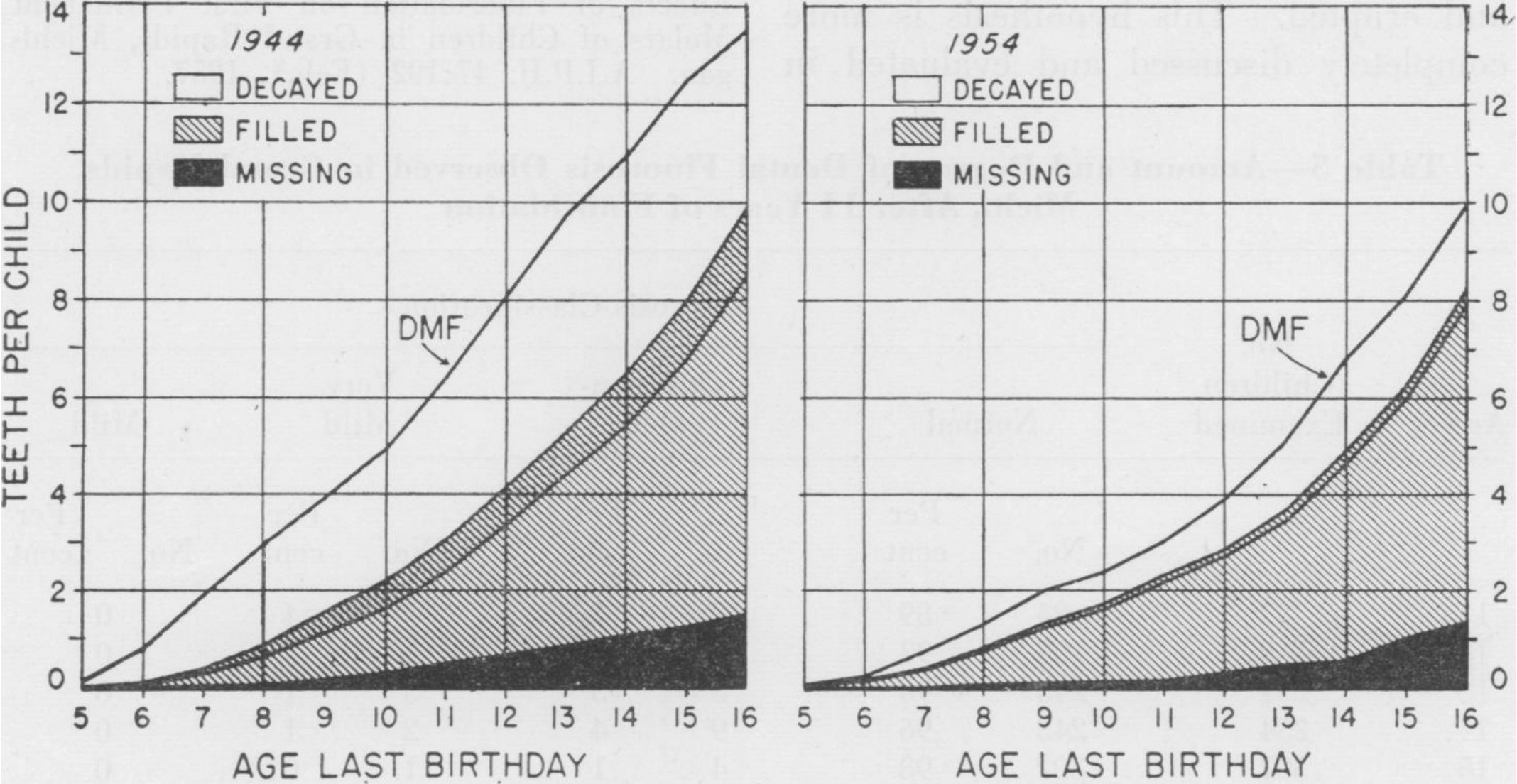
Dental Caries Prevalence in Permanent Teeth Examinations Made in 1944 and 1954 (Grand Rapids, Mich., Ages 5-16) via AMERICAN JOURNAL OF PUBLIC HEALTH (MAY 1957)
Nowadays, we associate fluoride-free toothpaste with alternative wellness; but, in the 20th century, it was mainstream because we hadn’t yet discovered fluoride’s dental benefits.
That discovery is largely credited to a young dentist named Frederick McKay, who spent decades trying to solve the mystery of the Colorado Brown Stain. This bizarre affliction left patients’ teeth covered in harmless but unsightly brown splotches.
McKay recruited the help of another dentist named Greene Black (seriously). Together, they discovered when in a tooth’s life cycle the staining occurred, and identified some unique characteristics — like a surprising resistance to decay.
Unfortunately, they still weren’t sure what CAUSED it.
Searching for answers, McKay found other towns facing similar problems. He hypothesized that the staining had to do with the water supply, and grew more confident when one town’s staining problem stopped after switching to a different water source.
McKay still wasn’t sure what in the water was responsible, but he published a paper with all he had — a paper that eventually reached the Aluminum Company of America which owned a smelter in one of the tooth stained towns.
Fearing bad press for potentially dangerous pollution, the Aluminum Company of America tested the water supply using more advanced technology. They found what McKay couldn’t — the source of both the staining and surprising decay resistance: unusually high levels of fluoride.
This discovery piqued the curiosity of Dr. H. Trendley Dean, a dentist and epidemiologist working at the National Institute of Health. He wanted to know if fluoride would still prevent tooth decay if provided at safe levels. He found his answer with the Grand Rapids study, which tracked tooth decay in nearly 30,000 schoolchildren for over a decade. Cavity rates dropped by more than 60%.
Tooth decay is one of the most prevalent diseases humans face. It can lead to discomfort, disfigurement, and death — even in North America. Community water fluoridation continues to be a highly effective way to tackle tooth decay on a public health scale. I find it wonderfully ironic that after spending decades trying to figure out what was harming people’s teeth, it turned out to be the same thing that could save them.
To read about this story in more detail, check out this NIH article.
🔦 Creator Spotlight by Sabrina
Emily has worked with some of the biggest education channels on YouTube (and also us). Now, she’s making her own videos at Rabbit Hole where she shares extraordinary answers to everyday questions. Do yourself a favour and subscribe!
Thank you for subscribing and following our chaotic little journey - see ya next month!

Comments
Nothing yet. Say the first thing.
Sign in to join the conversation.